ONE DAY IN HIROSHIMA: THE 5 BEST THINGS TO DO FOR FIRST-TIME VISITORS

Hiroshima is the capital of the Hiroshima Prefecture in Western Japan. The city was founded as a castle town in 1589. After the Meiji restoration in 1868, Hiroshima’s population grew quickly, so it became an important urban centre and industrial hub.

Soon after, Hiroshima was turned into a major military centre. In fact, it played an important role during the First Sino-Japanese War, the Russo-Japanese War, and the two World Wars.

On August 6, 1945, the United States Army Air Forces dropped “Little Boy”, an atomic bomb, on Hiroshima. The explosion left the city in ruins and tens of thousands of people were killed in seconds. By the end of the year, around 140,000 people had died as a result of the attack.

After World War II, a big effort was put in to rebuild Hiroshima. Important monuments of the city, like Hiroshima Castle, were reconstructed and Hiroshima Peace Memorial Park was established to honour the victims of this catastrophic incident.

After learning about Hiroshima’s history, I knew that I had to spend One Day in Hiroshima during my Japan trip in May 2025. I’ll also tell you about stunning Miyajima Island and a local food specialty you should try on your first-time trip to Hiroshima. So stay tuned 😉

Disclosure: I only recommend products that I’ve used in the past, and all opinions expressed in this post are my own. This post contains affiliate links. If you use one of the links throughout the page to buy something, I may earn a small commission at no extra cost to you. Thank you!

Hiroshima Peace Memorial Park

Address: Nakajimacho, Naka Ward, Hiroshima, 730-0811, Japan

Hiroshima Peace Memorial Park is the city’s most prominent location. Before the nuclear bomb was dropped on August 6, 1945, this area was the political and commercial centre of Hiroshima. That’s why it was chosen as the target.

Hiroshima Peace Memorial Park was completed in 1954 to show respect to the victims of the atomic bomb attack and its aftermath. Besides, it’s a symbol for hope and it reminds humans to not take peace for granted. The park area covers 120,000 square meters.

Below are the most visited monuments inside Hiroshima Peace Memorial Park.

The Cenotaph for the Atomic Bomb Victims & Peace Flame

The Cenotaph is an arched tomb that was built to honour the victims who died from the bomb explosion and were exposed to the radiation. There’s a stone chest underneath the cenotaph with the name register of more than 220,000 victims.

The arched tomb is also supposed to be a shelter for the souls of the victims.

Every year on August 6, the Peace Memorial Ceremony is held. There’s an one-minute silence at 8:15 a.m. (the time the bomb hit the city) to mourn the victims. People also make speeches, pray for peace, and leave wreaths in front of the Cenotaph.
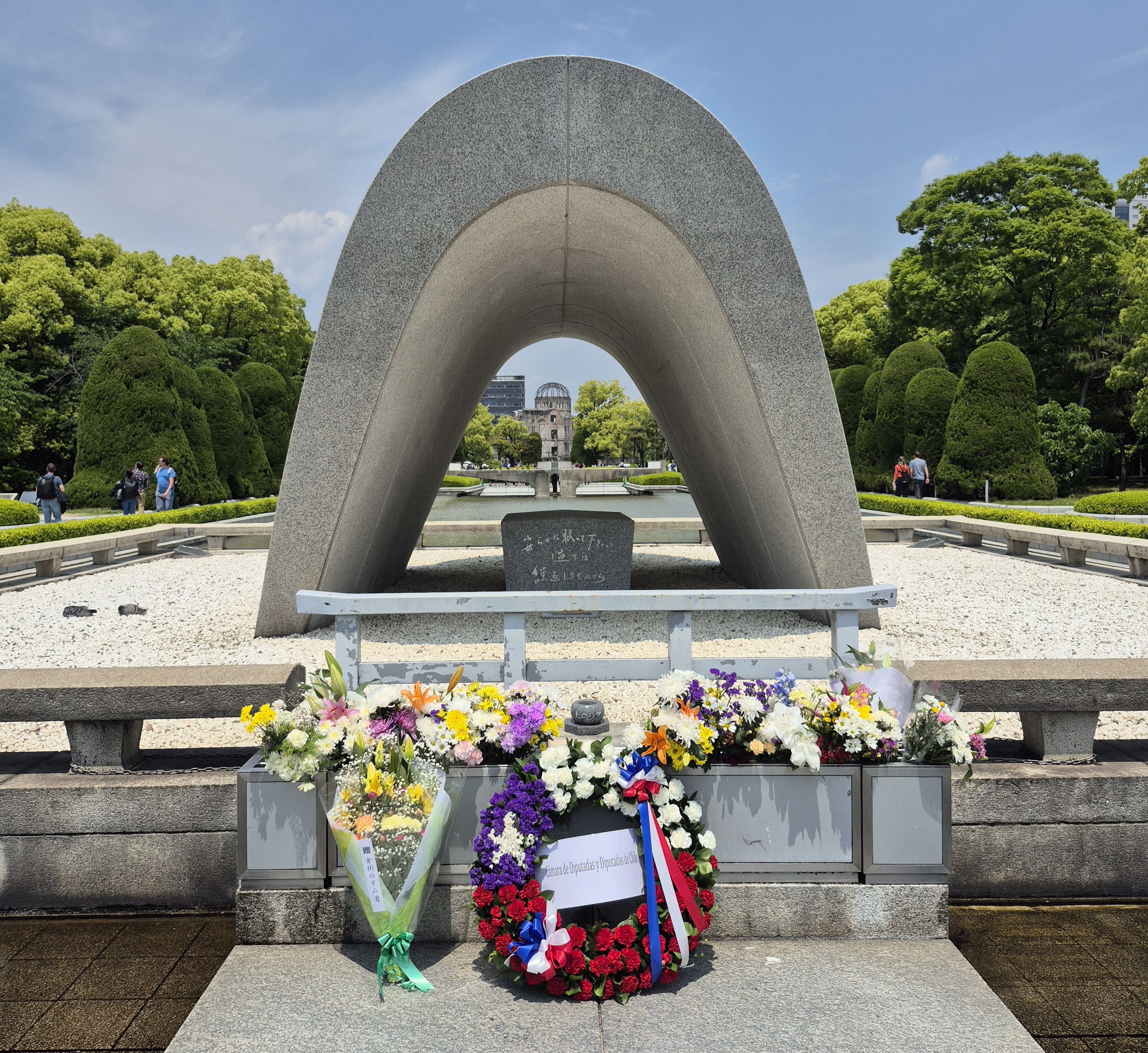
If you look through the Cenotaph, you’ll see the Peace Flame, which was first lit in 1964 and has burnt ever since. The flame is going to keep burning until all nuclear bombs in the world are destroyed and there’s no more threat from atomic weapons.

Children’s Peace Memorial

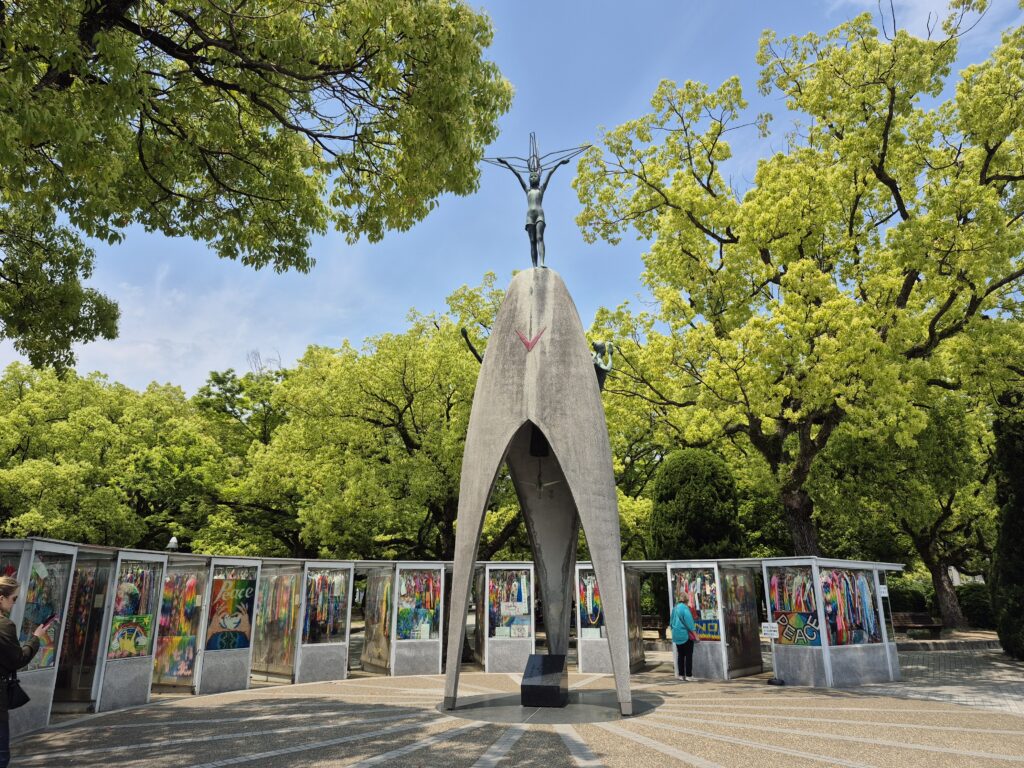
The Children’s Peace Memorial is a monument statue to remember thousands of children who died from the nuclear bombing and its aftermath.

At the top is the statue of a girl with outstretched arms and a folded paper crane above her. It’s based on the true story of Sadako Sasaki, who died from leukemia caused by the radiation in 1955. In Japanese culture, the crane is a symbol for a long life.

Sadako folded more than 1,000 paper cranes before her passing. Until the present day, children from around the world fold paper cranes and send them to Hiroshima to be put next to the memorial. As a result, there’s a huge collection of paper cranes behind glass by the Children’s Peace Memorial.
The Atomic Bomb Dome (Hiroshima Peace Memorial)

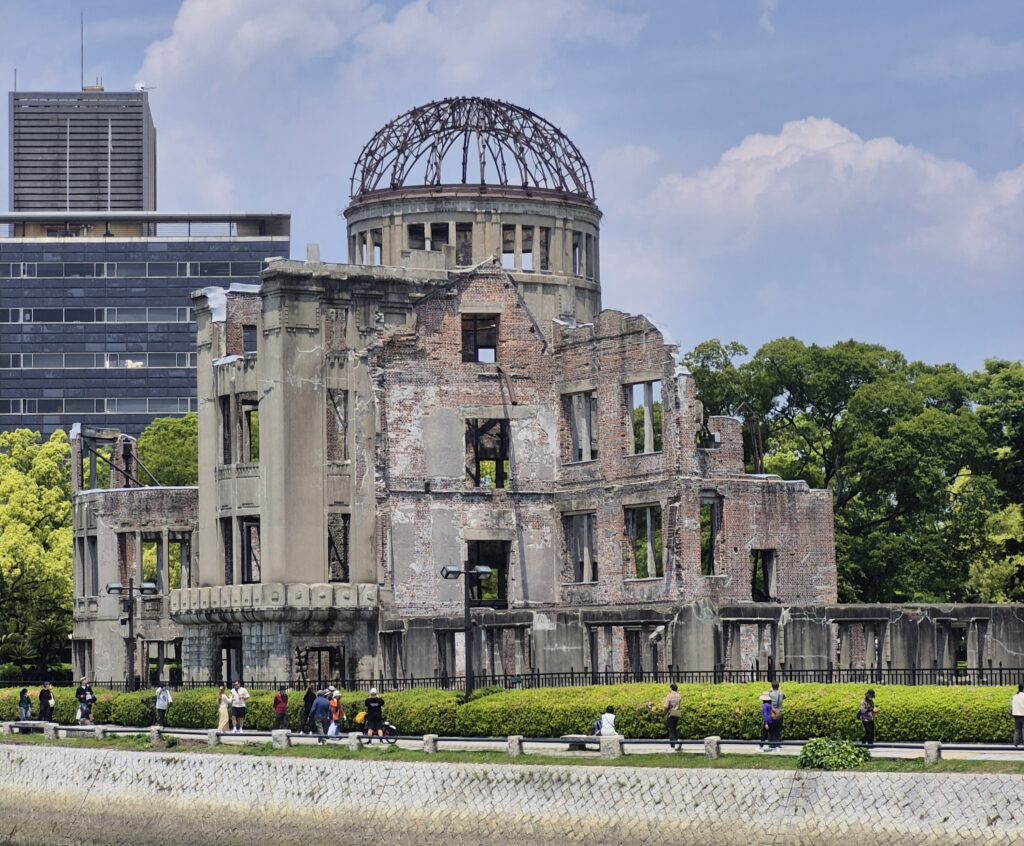
The Atomic Bomb Dome is one of the few buildings that weren’t completely destroyed by the nuclear bomb. Sadly, everyone inside was killed and it burnt down from the ceiling to the bottom immediately after the blast. But the domed steel frame survived and still stands until the present day.

The original building was completed in 1915 as the Prefectural Industrial Promotion Hall of Hiroshima. The Atomic Bomb Dome became a UNESCO World Heritage Site in 1996. Today it is a symbol for the importance of abolition of nuclear weapons and lasting world peace.
Hiroshima Peace Memorial Museum

Address: 1-2 Nakajimacho, Naka Ward, Hiroshima, 730-0811, Japan

Only a few steps further, there’s Hiroshima Peace Memorial Museum, another must-do on a trip to Hiroshima. While it talks about the history of Hiroshima before and after the nuclear bombing, its main focus is on the day when things changed forever: August 6, 1945.

The exhibit shows the devastation and suffering of the people during and after the explosion, which made me feel sad and upset at the same time. For example, visitors can look at belongings of victims, watch personal story videos of survivors, and learn how they dealt with this tragic event’s aftermath.
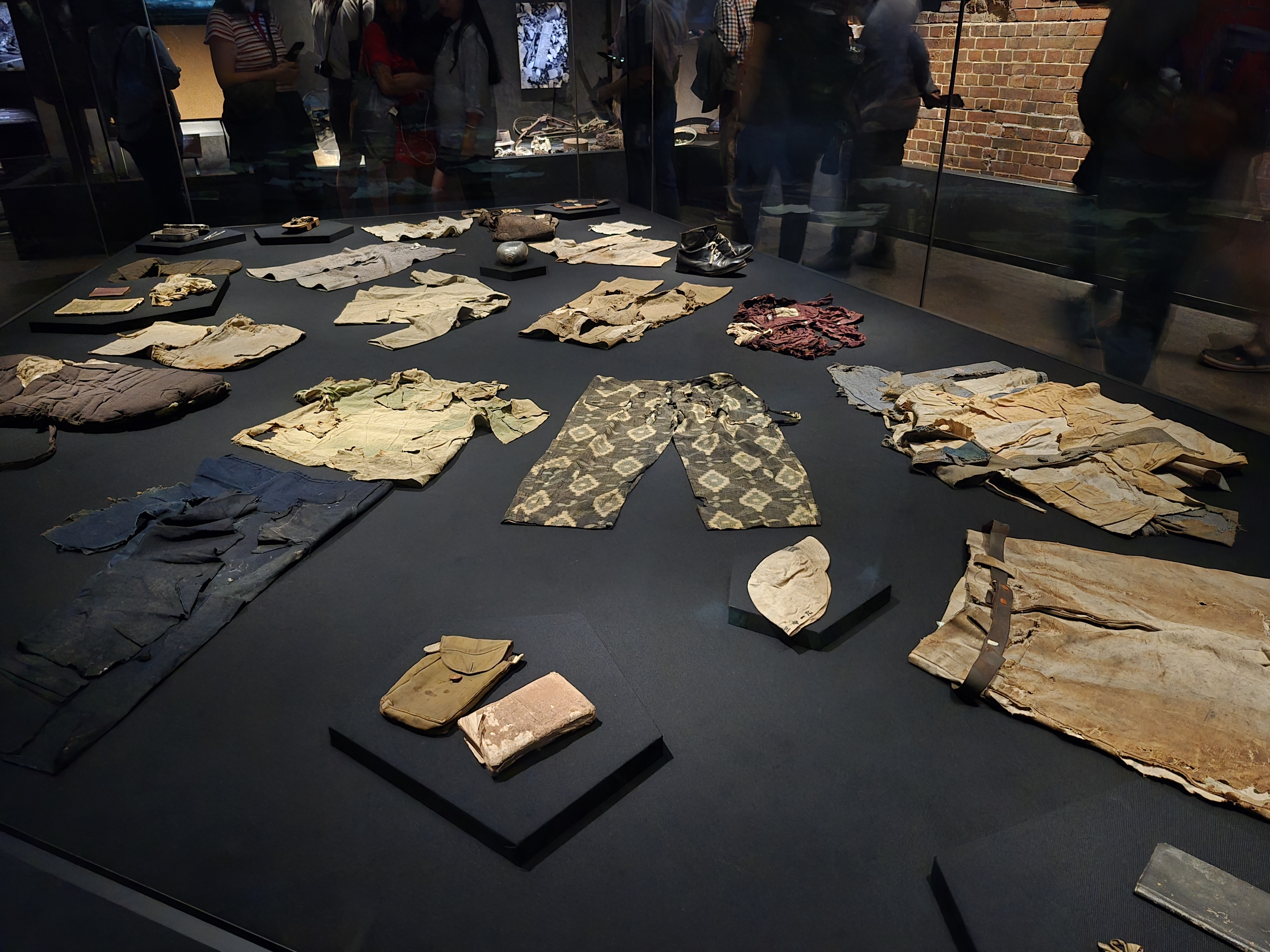
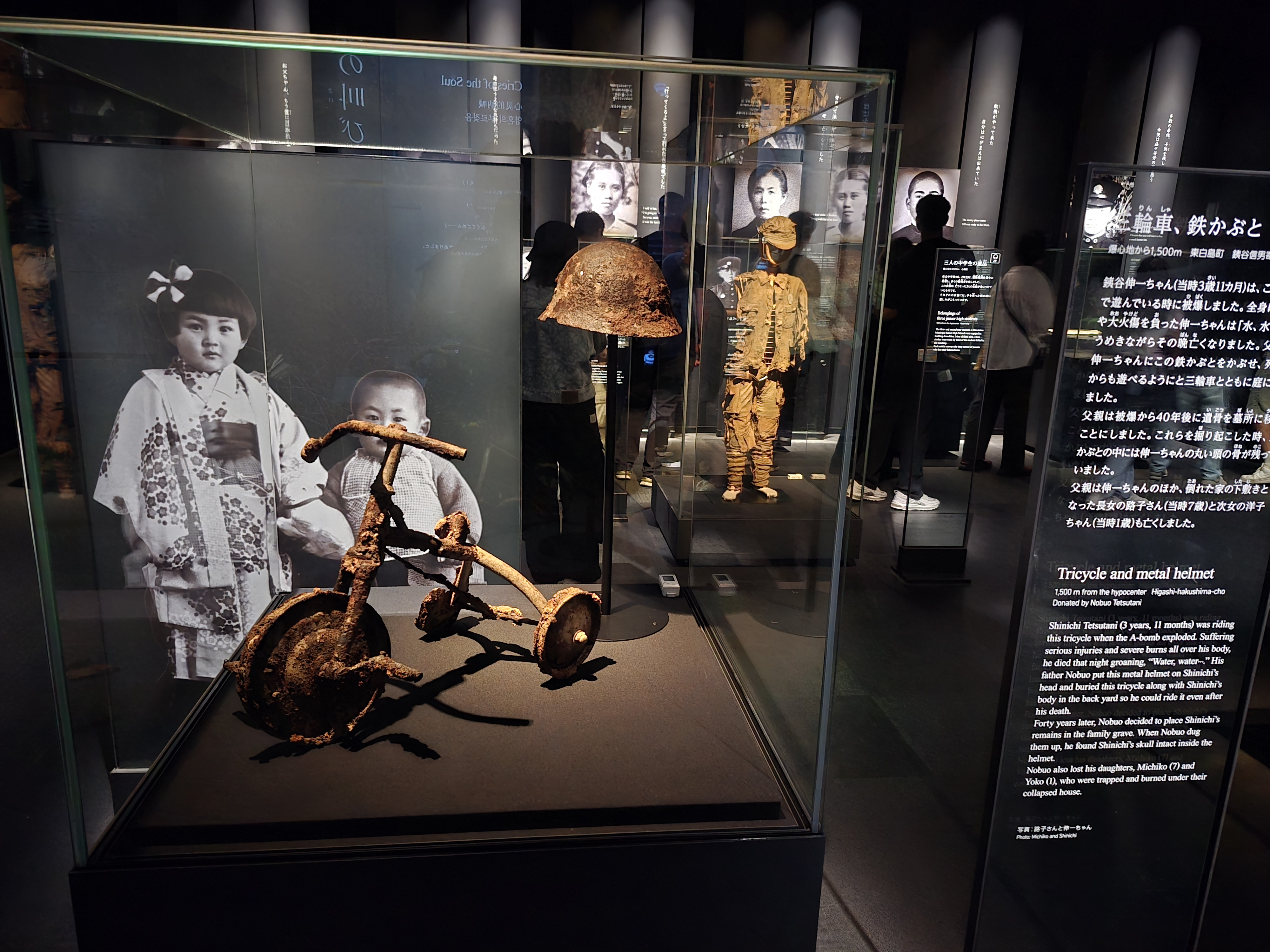
Seeing pictures of survivors and their scarred and/or partially burnt bodies was very upsetting as well. Lastly, looking at photos of Hiroshima before and after the attack was heartbreaking, especially since most of the city was destroyed within seconds.

But I was amazed that Hiroshima had risen like a phoenix from the ashes after this tragic incident. Visiting Hiroshima Peace Memorial Museum is a great reminder how devastating atomic weapons are and that we should never take peace for granted.
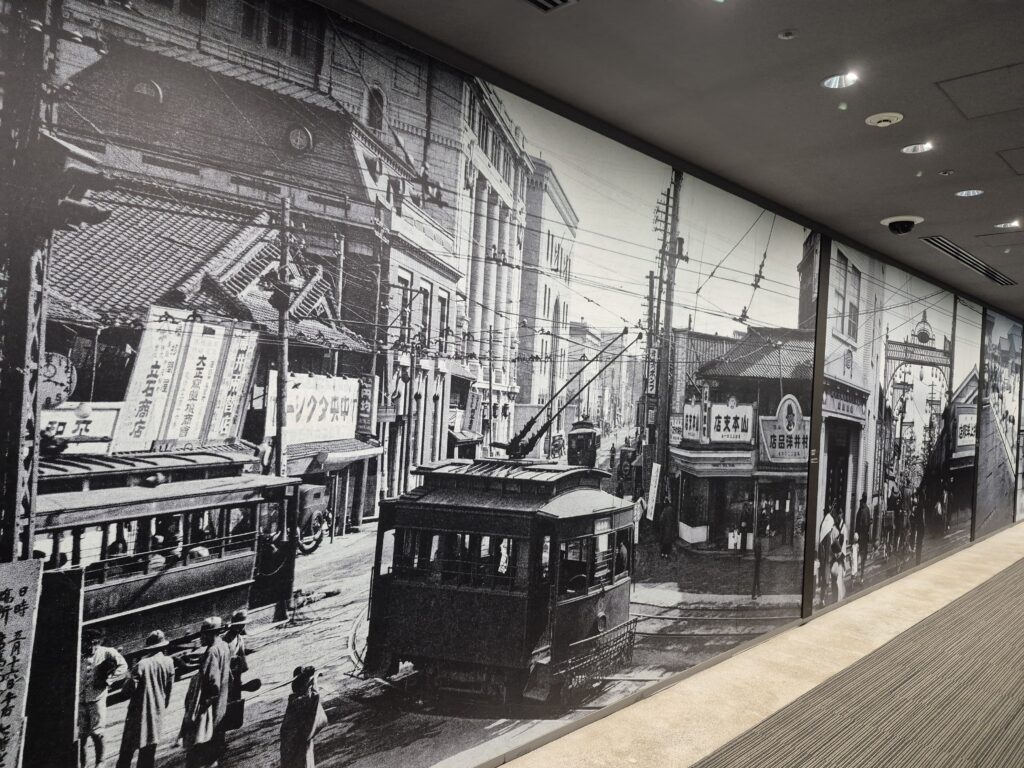
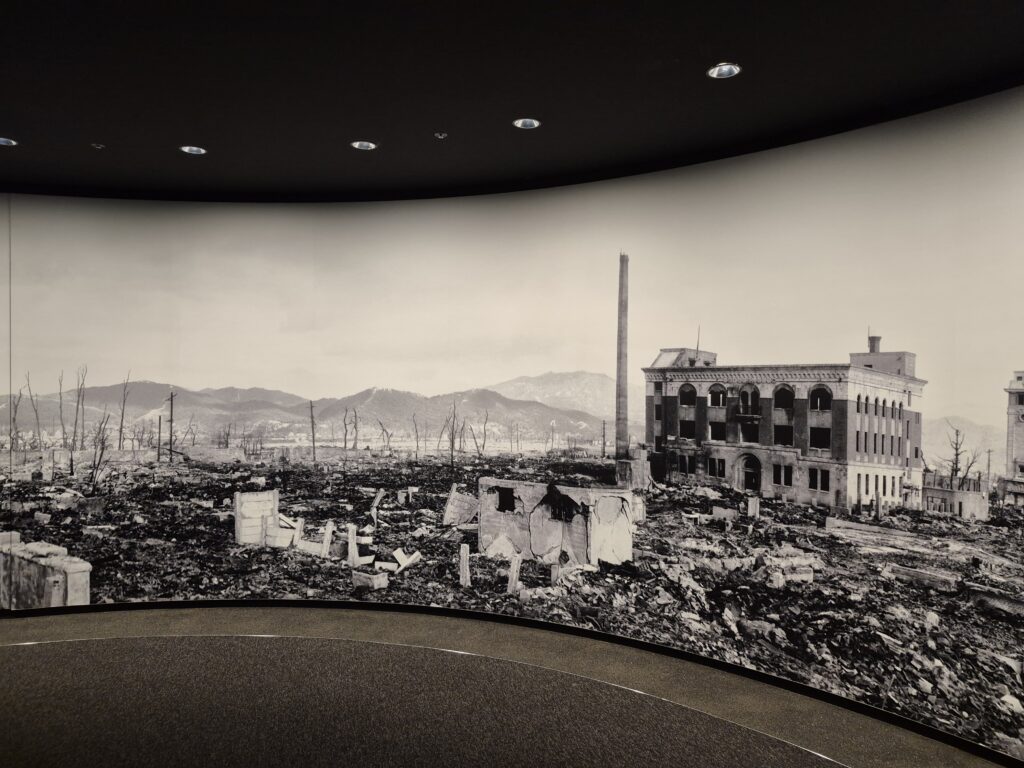
Hiroshima before and after the nuclear bomb attack.

Hiroshima Peace Memorial Museum is open seven days a week (except December 30 and 31 and three consecutive days in mid-February). Admission is 200 ¥ and I wouldn’t recommend visiting this museum with smaller children because of its severity.

Visit Miyajima

Address: Miyajimacho, Hatsukaichi, Hiroshima 739-0588, Japan

Hiroshima not just offers fascinating history, but also areas of outstanding natural beauty. One example is Miyajima, an island less than an hour outside of Hiroshima (via train and ferry or direct boat). Miyajima is a great spot to spend at least a half day during your visit to Hiroshima.

While Itsukushima is the formal name of the island, it is more popularly known as Miyajima. This translates to “shrine island” in Japanese.

Here are a few attractions on Miyajima you shouldn’t miss:

Red Torii Gate & Itsukushima Shrine

Address: 1-1 Miyajimacho, Hatsukaichi, Hiroshima 739-0588, Japan

Miyajima is most famous for its red torii gate which stands in the Seto Inland Sea. During high tide, it looks like the gate is floating in the water! This view of the torii in the water is one of the Three Best Views in Japan. During low tide, you can walk right up to the gate, which is pretty cool as well!

Behind the torii gate is stunning Itsukushima Shrine. This Shinto shrine dates back to the 12th century and it also looks like the complex is floating above the water during high tide!
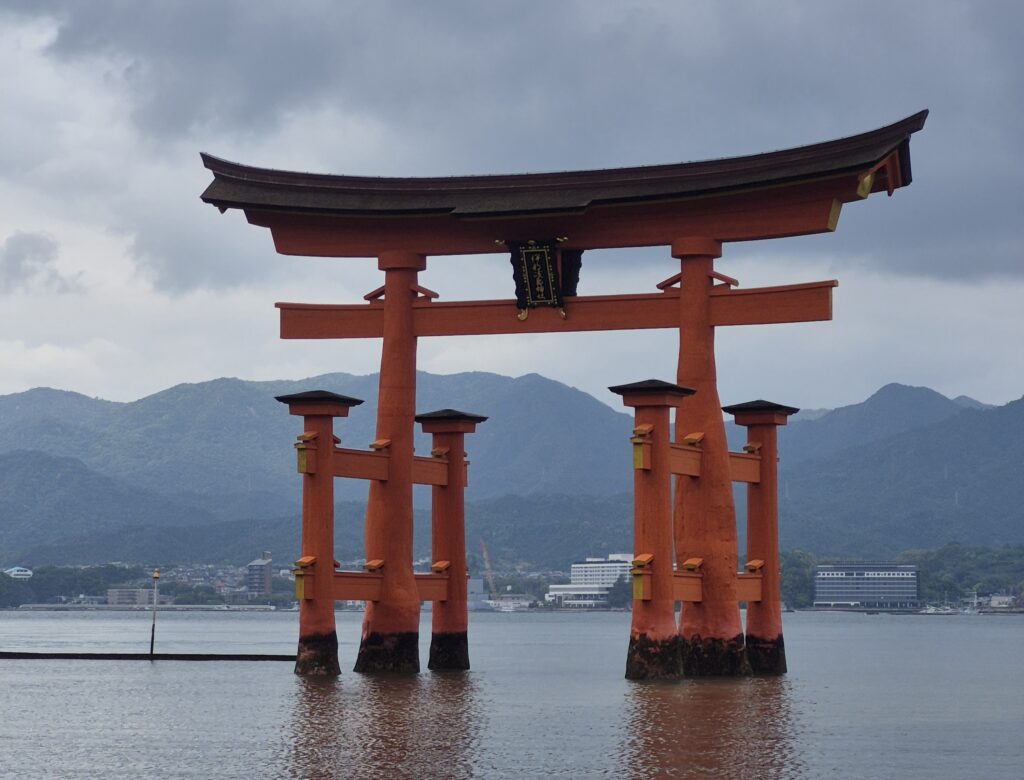
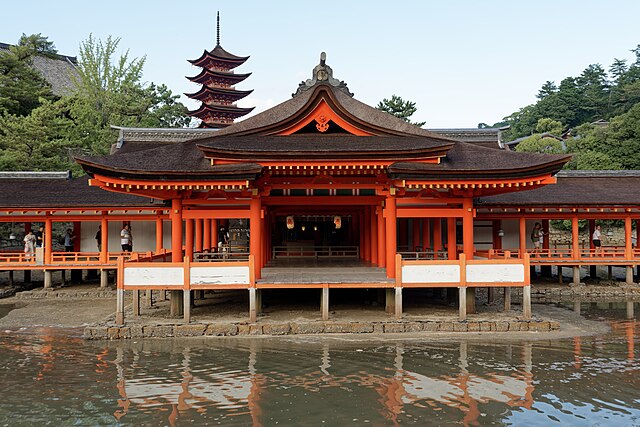
The red torii and Itsukushima Shrine. The right photo is credit of Jakub Halun on Wikimedia Commons.

Itsukushima Shrine has several buildings, like a prayer hall, treasure hall, main hall, and Noh Theater stage. They are linked by boardwalks and supported by pillars above the sea.

The red torii and Itsukushima Shrine are illuminated every night until 11 pm, which is a special sight if you decide to spend the night on Miyajima! Itsukushima Shrine is open daily and admission is 300 ¥ (500 ¥ for combined entry with the treasure hall).

Go Up to Mount Misen

If you’re a nature lover, going up to Mount Misen is an awesome idea! At 500 meters (1,640 ft), it’s the highest peak on the island of Miyajima. At the summit, you can enjoy a great view of the Seto Inland Sea and Hiroshima City on clear days.

Visitors can take a ropeway from Momijidani Station (10 minutes from Itsukushima Shrine), which takes about 20 minutes. Once you get to the upper station at Shishi-iwa Observatory, it takes about 30 minutes to walk up to the summit. The trail is rather steep, so be sure to wear sturdy shoes.

The cost for the ropeway is 1,100 ¥ (one-way) or 2,000 ¥ (roundtrip) and it runs from 9 am to 4 pm daily.
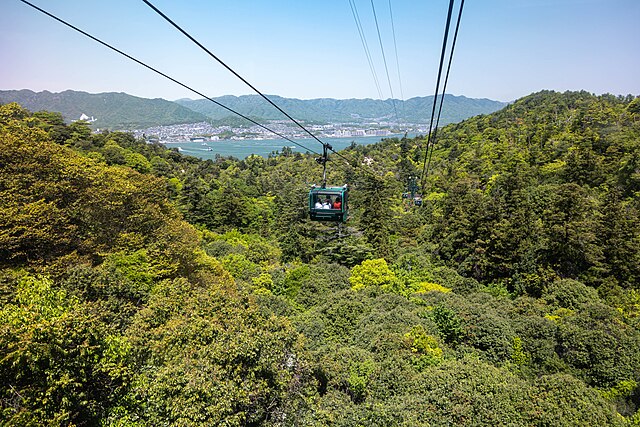
The Miyajima ropeway. Photo credit: Naokijp on Wikimedia Commons.

Or you can walk up one of the three hiking trails leading to Mount Misen: Momijidani Course, Daisho-in Course, or Omoto Course. The Daisho-in Course has the prettiest views and is the least steepest, while the Momijidani Course is the shortest, but also the steepest trail. It takes 1.5 to 2 hours to get to the top.

It is said that Kobo Daishi, the founder of the Shingon sect, first practiced Buddhism at Mount Misen. He’s one of the holiest figures in Japanese Buddhism. There are several buildings that belong to Daisho-in Temple at the base of the mountain.

Two examples are Misen Hondo (Misen Main Hall) and the Reikado (Hall of the Spiritual Flame). Apparently, Kobo Daishi lit the flame at Reikado when he first practiced Buddhism and it has burnt ever since. It was also used to lit the Peace Flame at Hiroshima Peace Memorial Park.
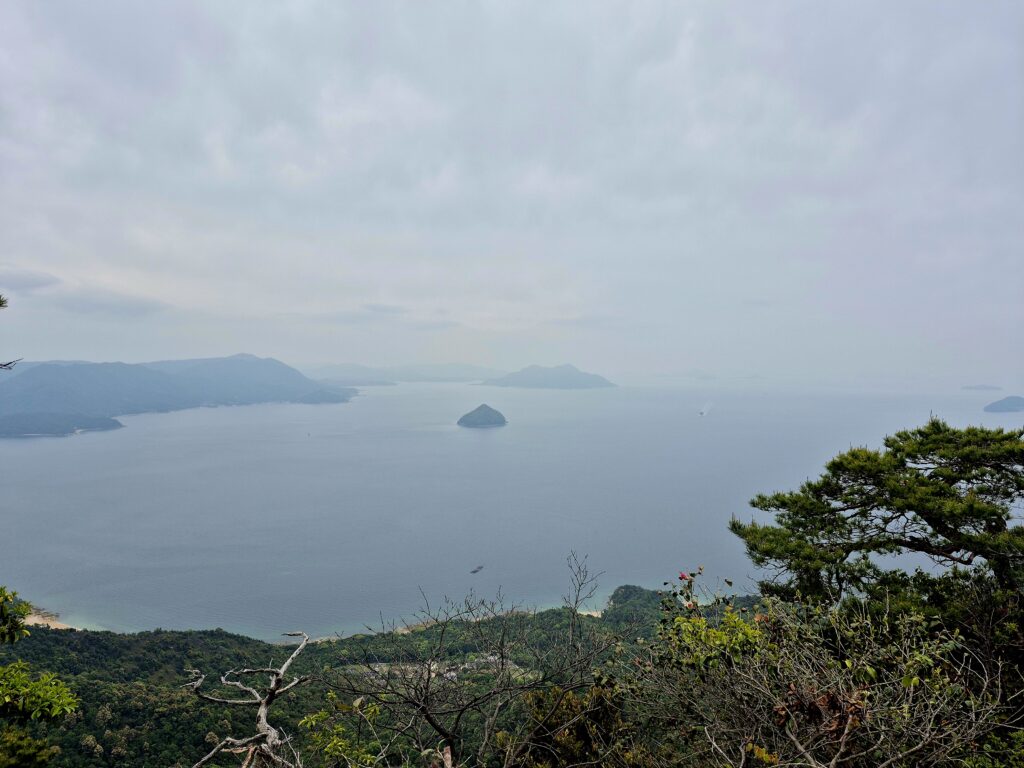
View from Mount Misen on a rather cloudy day.

Watch out for Wild Deer

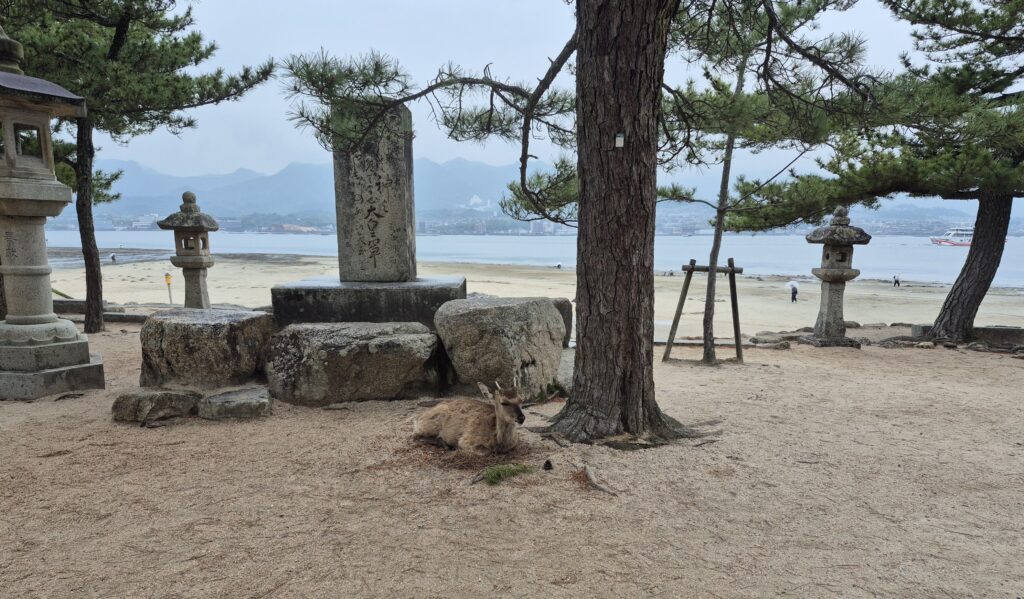
Finally, Miyajima is a great place to see local wildlife. About 500 wild deer live on Miyajima and often like to hang out near the touristy sights and along the walking paths. They are quite used to people, but they shouldn’t be petted and it’s forbidden to feed them.
Try Okonomiyaki (aka Hiroshima’s Soul Food)

Looking to try Hiroshima’s specialty food? Then go for Okonomiyaki! Hiroshima-style Okonomiyaki is a savory pancake that consists of a thin layer of batter with tons of cabbage on top of yakisoba noodles.

Popular toppings are oysters, squid, pork belly, or cheese. In the end, the chef puts bonito flakes, green laver, and Okonomiyaki sauce on top of the Okonomiyaki. The customer usually gets a small plate and spatula to cut the Okonomiyaki into small pieces.

I tried this iconic Japanese dish at Okonomiyaki Yakeppachi, a local Okonomiyaki restaurant near my hostel.

As soon as I entered the restaurant, I was warmly welcomed by the staff. Besides, while Okonomiyaki is usually not vegetarian, the chef was more than happy to prepare a yummy veggie one right in front of my eyes!
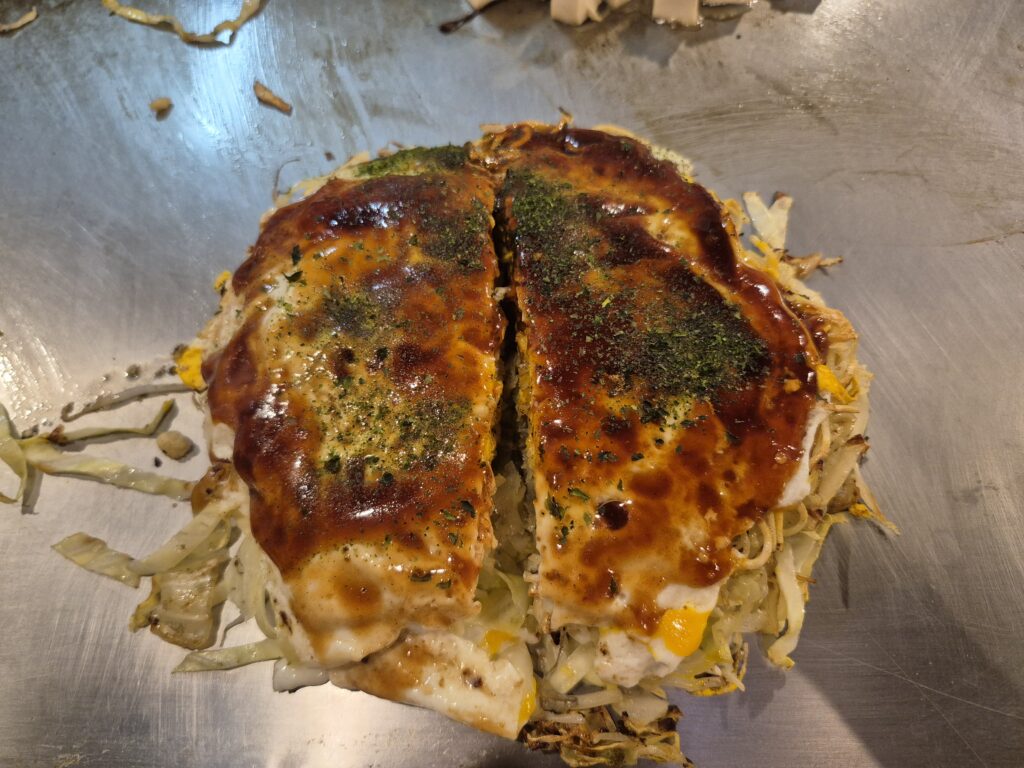
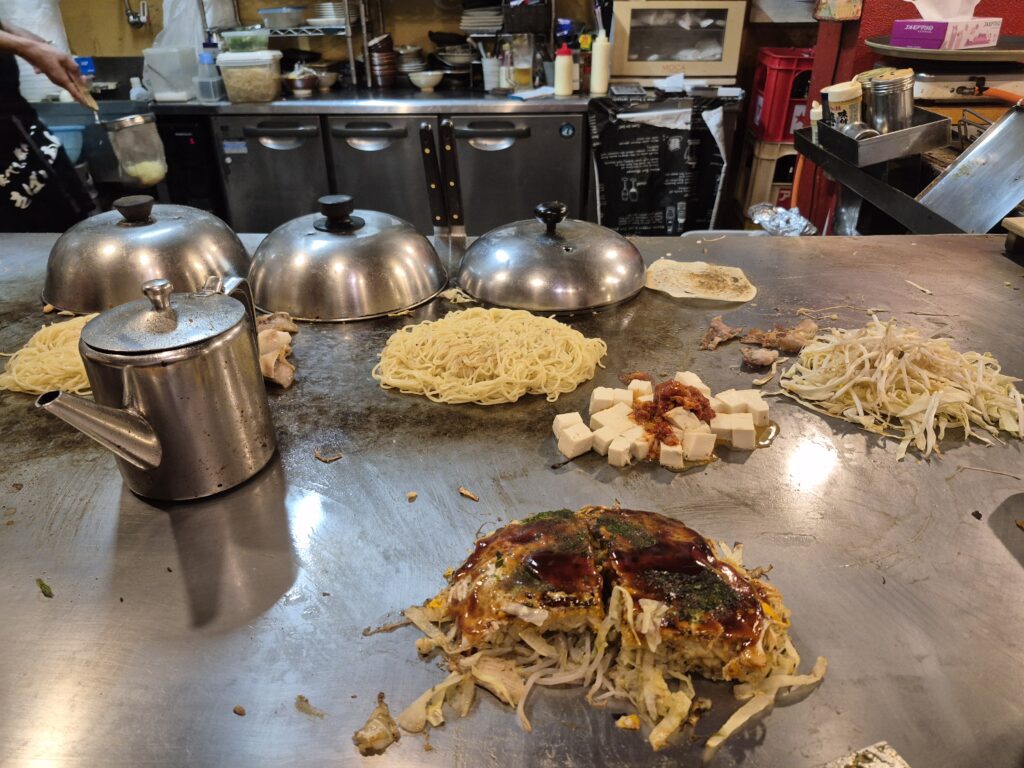
My veggie Okonomiyaki and the chef already cooking more Okonomiyaki. Itadakimasu!

The cozy vibe added to a great experience as well. Only a small number of customers could fit in the restaurant, which made me feel like a part of a group. It was awesome to chat with fellow travelers and local Japanese people who sat near me!

Visit Hiroshima Castle

Address: 21-1 Motomachi, Naka Ward, Hiroshima, 730-0011, Japan

Visiting Hiroshima Castle is a great way to finish One Day in Hiroshima. Also known as the Carp Castle, it was built in the 1590’s by the powerful feudal lord Mori Terumoto. Since Hiroshima was built as a castle town, Hiroshima Castle was the physical and economical heart of the city.

Sadly, Hiroshima Castle was ruined by the atomic bombing in 1945. But a replica of the main keep was completed in 1958 and today, it’s a museum about Hiroshima and the castle’s history before the attack. The main keep has five floors and its grounds are surrounded by moat.
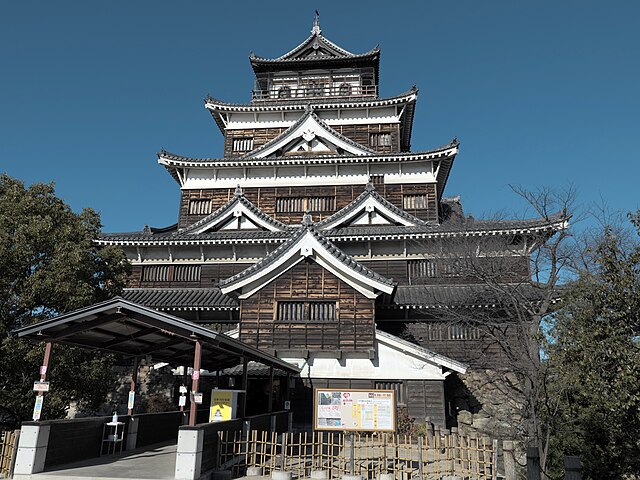
The main keep of Hiroshima Castle. Photo credit: Hyppolyte de Saint-Rambert on Wikimedia Commons.

More buildings were reconstructed after the main keep replica. Today visitors can look at a shrine, some ruins and a few reconstructed dwellings of the Ninomaru (second circle of defense) inside the castle complex. Finally, visitors can enjoy a beautiful view of the city from the top of the main keep.

It’s possible to go inside the main keep and Ninomaru all year (except December 29-31 and December 29-January 2). Admission to the main keep is 370 ¥ and Ninomaru and the rest of the castle grounds are free to visit.

Where to Stay in Hiroshima

If you’d like to take your time, I recommend spending the night in Hiroshima.

I stayed at Roku Hostel (6-18 Hakushimakukencho, Naka Ward, Hiroshima, 730-0003, Japan), which is very close to public transit, restaurants, and Hiroshima’s tourist attractions.

Roku Hostel was one of my favourite accommodations in Japan. The female dorm room was spacious and the bed was super comfy, with privacy curtains all around it. Besides, I loved chatting with Mako, the owner, and other travelers in the bar area. They even had a Nintendo 64 with Mario Kart! 😀

Mako also made me a yummy vegetarian breakfast (at a small cost) and the hostel gave out family vibes ever since I entered through the door!

How to Get to and around Hiroshima with Public transit

Many people visit Hiroshima every year, so it’s easy to reach via the famous Shinkansen from Tokyo, Kyoto, Osaka, or Fukuoka (on Kyushu island).

There are express trains going from/to Hiroshima as well. Many JR train lines are covered by the Japan Rail Pass or regional JR Rail Passes. The ferry from/to Miyajima is also included in these train passes.

Some people take (overnight) highway buses from Tokyo to Hiroshima via Willer Express, which is cheaper than the train if you don’t have a pass. Others fly from Tokyo Haneda or Tokyo Narita Airport to Hiroshima Airport.

Hiroshima has Japan’s biggest tram network. There are eight tram lines linking Hiroshima Station with most tourist attractions, like the Miyajima Ferry and Hiroshima Peace Memorial Park. I recommend buying an IC Card (like Suica or Pasmo) to pay for local transit, as JR Passes are not included in this.

Lastly, there are Hiroshima Sightseeing Loop Buses taking visitors to Hiroshima’s most popular tourist attractions. Tickets are also covered by the Japan Rail Pass and regional Japan Rail passes.

The Best Time to Visit Hiroshima

Hiroshima is known for its temperate climate, so you can visit the city anytime of the year.

The best time to visit Hiroshima is the spring (March to May) and fall (September to November). The weather is often sunny and warm, but not hot or humid. Cherry blossom season usually goes from late March to mid-April, so be sure to expect crowds then.

Golden Week (the first week of May) can be busy, too. The beautiful fall foliage in October/November is a reason why many people visit Hiroshima in the fall.

Like many other parts of Japan, summer season (June-August) is usually very hot and humid, and it’s rainy season in June/July as well. There are less crowds though.

Winters are rather cool, but not super cold, and if it snows, it usually doesn’t stick to the ground. This is the quietest time of the year in Hiroshima and many businesses are closed from December 29 to January 3.

Wrap Up: One Day in Hiroshima

Spending One Day in Hiroshima is the perfect way to get a first impression of the city. Whether you’re into history, nature, or good food, Hiroshima won’t disappoint you.

Visiting Hiroshima Peace Memorial Park and Museum was very moving and an important reminder that this terrible event should never be forgotten. Besides, I loved spending time in nature and watching out for deer on Miyajima.

Finally, I can’t wait to eat more Okonomiyaki when I’m back in Japan someday! 😛
Traveling around Japan for a while? Then check out these posts:
Is Nikko, Japan Worth Visiting?

What is Kanazawa, Japan Famous for?

HOW TO SPEND 36 HOURS IN ROTORUA WITHOUT A CAR

Rotorua is a city in the Bay of Plenty region on New Zealand’s North Island. It’s nestled along the southern shore of Lake Rotorua, the second largest lake on the North Island. Maori people first settled in this region in the 14th century and the first Europeans arrived in the early 19th century. 

Soon after, Rotorua was turned into a spa town thanks to its unique geothermal activity. Rotorua has been a tourist hot spot since the 1800’s. There’s a “rotten eggs” (hydrogen sulfide) smell lingering all over Rotorua, that’s why its nickname is the Sulphur City.

After hearing about Rotorua’s breathtaking attractions (e.g. geothermal mud pools and hot springs, fascinating Maori culture, stunning forest areas, and great shopping), stopping here on my New Zealand trip in May 2025 was a must!

While many tourists rent a car to get around New Zealand, spending 36 Hours in Rotorua Without a Car is totally possible.

Disclosure: I only recommend products that I’ve used in the past, and all opinions expressed in this post are my own. This post contains affiliate links. If you use one of the links throughout the page to buy something, I may earn a small commission at no extra cost to you. Thank you!

The Best Things to See and Do in Rotorua

Visit Whakarewarewa Forest

Address: 1 Long Mile Road/Titokorangi Drive, Whakarewarewa, Rotorua 3074, New Zealand

Many outdoor fans flock to New Zealand every year – and for good reason, as lots of its flora and fauna can only be found here! In Rotorua, one of the best examples for natural assets is Whakarewarewa Forest (aka The Redwoods, as the locals call it).

With more than 160 km (100 miles) of trails, this 5,600 hectare forest is a paradise for hikers, mountain bikers, horse riders, runners, and walkers of all ages and fitness levels. Walking trails range from 2 km to 11.5 km (1.2 to 7.1 miles) and some paths are stroller and wheelchair accessible in dry conditions.

Whakarewarewa Forest’s major attraction are the towering Californian Coastal Redwoods, which are more than 120 years old and up to 75 meters (246 ft) high!

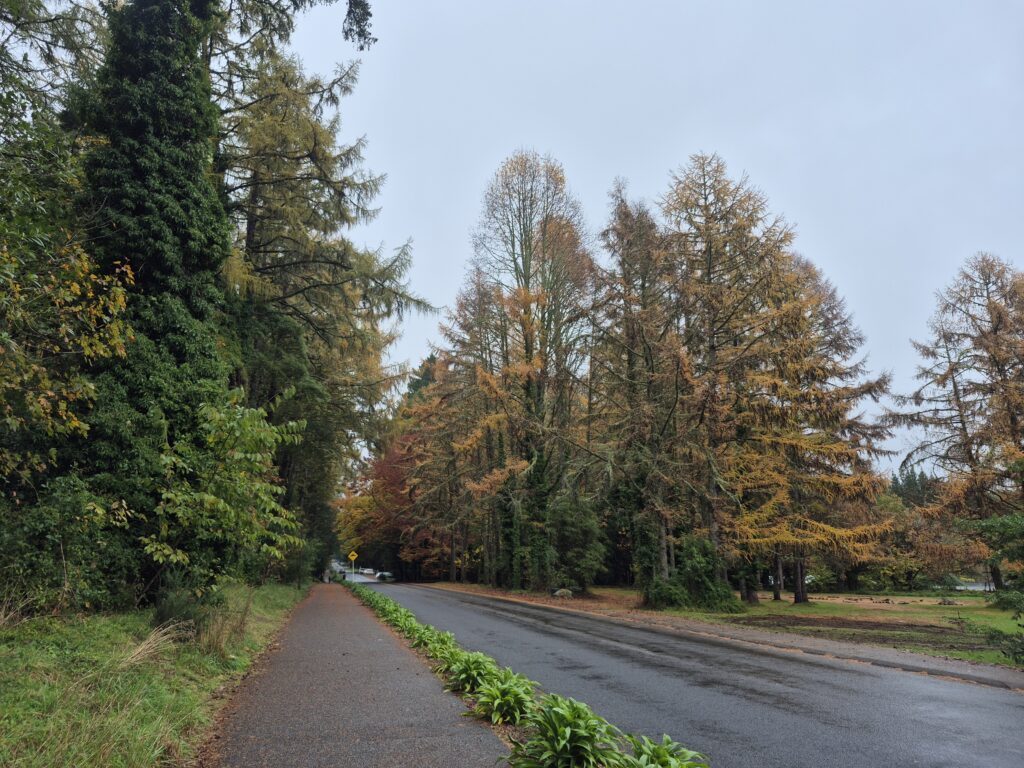
Other exotic and native plants growing here are Ferns, Radiata, Douglas Fir, Eucalyptus, and Larch trees. It’s completely free to walk or bike on these stunning trails. It was a bit drizzly during my visit, which created a rather mystic vibe, kind of similar to forests I’d visited in Japan!

Walking on Mokopuna Trail at Whakarewarewa Forest was so peaceful! 😀

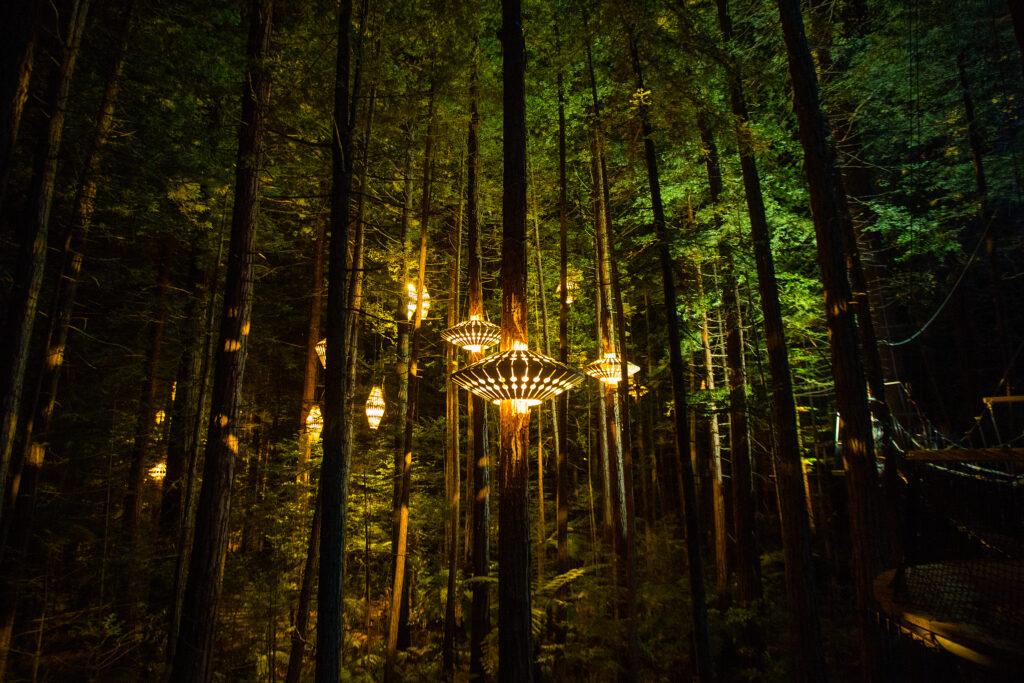
If you feel adventurous, consider adding the Redwoods Treewalk to your experience. This treetop path is 20 meters (65 ft) above ground and consists of 28 suspension bridges that are built around the Redwood trees. This way, you’ll see how tall these trees really are!

It usually takes 30 to 40 minutes to complete the Redwoods Treewalk. You can choose between the Daytime (NZ$ 42 pp) or Nightlights Treewalk (NZ$ 52 pp). Since this activity is very popular, it’s best to reserve online before your visit.

Redwoods Treewalk during the day and night. Photo credit for both: Redwoods Treewalk/Tourism NZ Visual Library.

For the ultimate thrill, look at Redwoods Altitude, a 2.5-hour guided experience up in the trees. It includes 25 jungle bridges, three flying foxes (ziplines), and two spirals, all at 25 meters/82 feet above the ground! It starts at NZ$ 125 per person.

It’s around 35 minutes from Rotorua’s city centre to Whakarewarewa Forest without a car (via local bus #3 and walking). If you’re driving, it only takes about 10 minutes to get here.

Explore Kuirau Park

Address: 1371 Pukuatua Street, Ranolf Street, Rotorua 3010, New Zealand

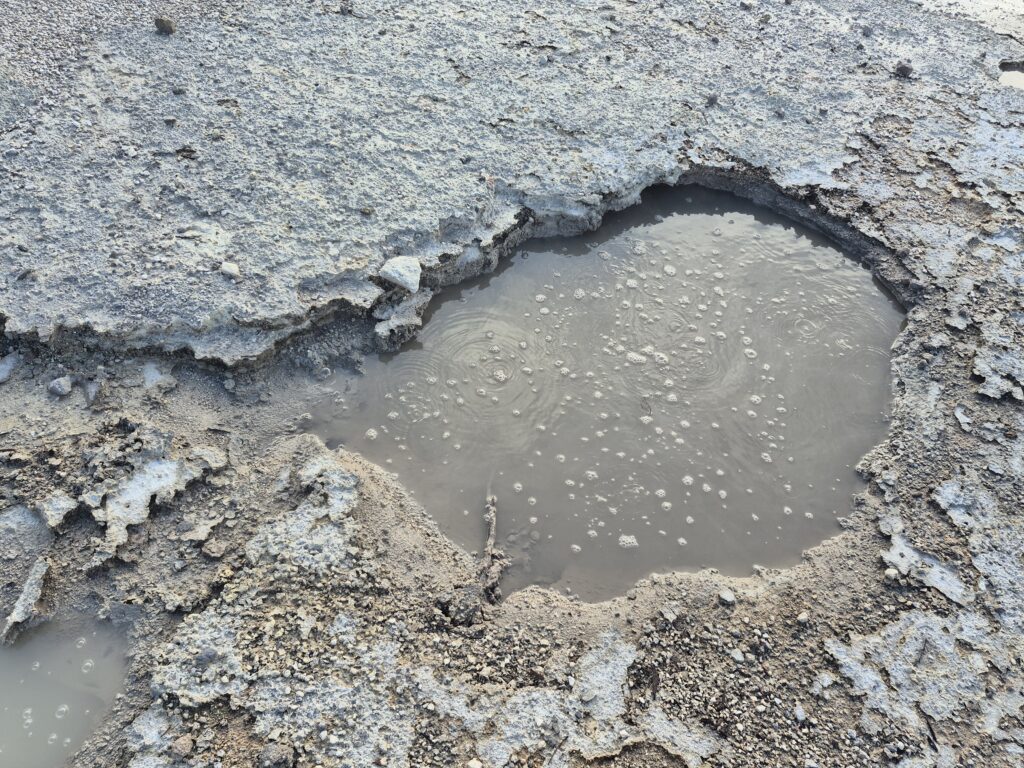
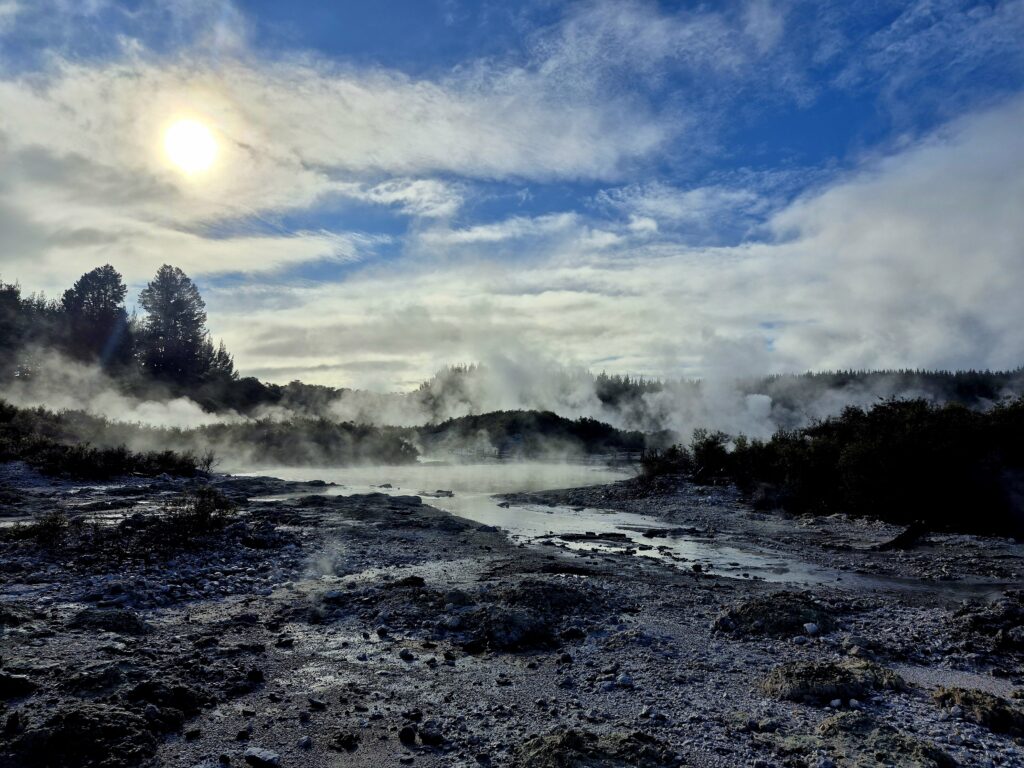
Just a short stroll from downtown Rotorua sits stunning Kuirau Park. It’s the only public park in New Zealand where you can see breathtaking geothermal activity (i.e. boiling, bubbling, and steaming in many spots) for free!

Kuirau Park has several paths that lead visitors to its crater lake, mud pools, hot springs, and a free thermal foot bath. The latter is a great way to relax for a bit while exploring Rotorua (just bring a towel)!

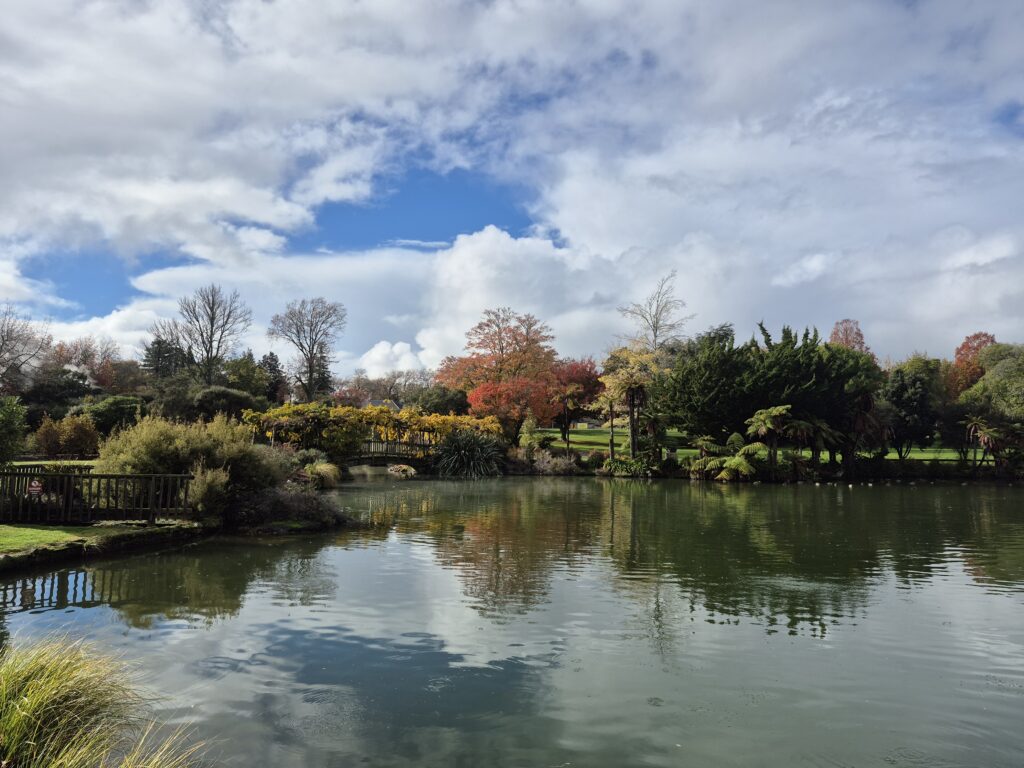
There are also flowerbeds, native plants, and lots of trees all over the park. I was lucky to visit Kuirau Park on a partial sunny day and the fall foliage was so pretty!

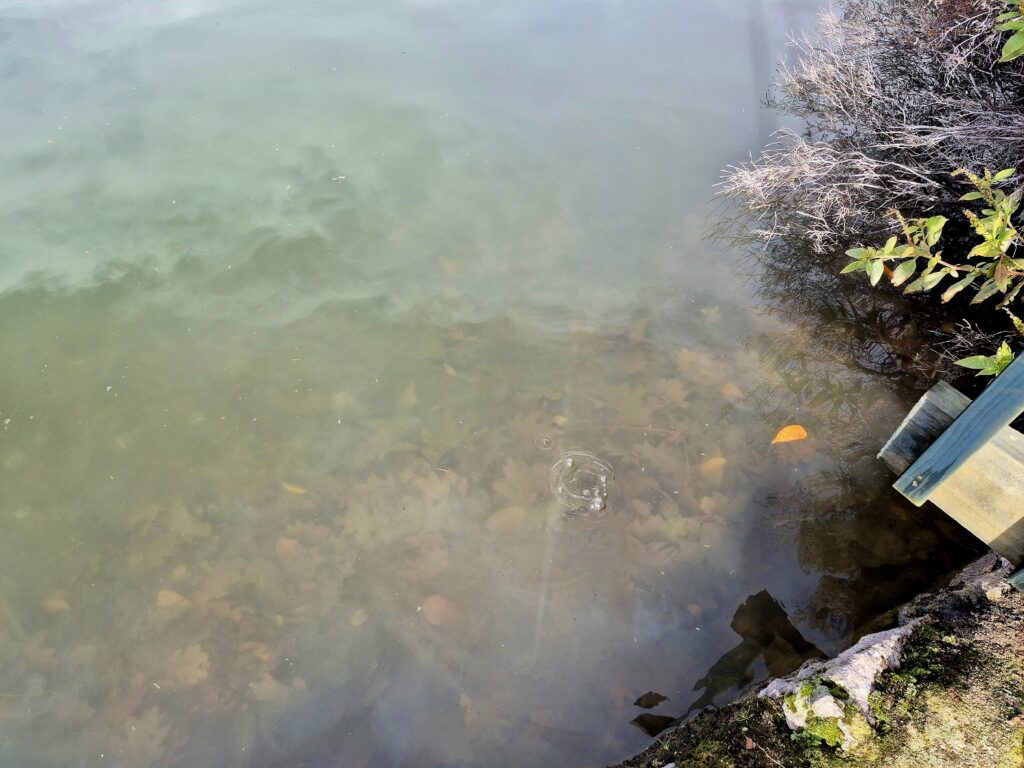
Watching tiny bubbles rising up to the mud pool surface at Kuirau Park was so much fun!

Kuirau Park is also popular with locals and visitors for having a barbeque or picnic, and there’s a playground, too.

Finally, if you’re in Rotorua on a Saturday, check out the Farmers Market at Kuirau Park for some local vendors and food trucks! It goes from 6 am to 1 pm every week.

Hell’s Gate Geothermal Reserve & Mud Spa

Address: 351 State Highway 30, Tikitere, Rotorua 3010, New Zealand

If you want to see more mud pools and geothermal activity, check out Hell’s Gate Geothermal Reserve & Mud Spa. Also known as Tikitere in the Maori language, this is the only Geothermal Reserve owned by indigenous people in the region. Besides, Hell’s Gate is New Zealand’s most active geothermal reserve.

This reserve originated about 10,000 years ago. Maori warriors started bathing in its mud pools about 800 years ago to heal wounds from their battles. Today everyone is welcome to soak in these baths, which are rich in nutrients and a great way to soothe inflammation or arthritis pain.

Tikitere first opened as a spa in 1871. Irish playwright George Bernard Shaw visited in 1934 and said “This could be the very Gates of Hell”, but he couldn’t be more wrong! Apparently, the Maori people thought this was funny, so they decided to call it Hell’s Gate in English.

Here are the experiences you can book at this unique place:

Hell’s Gate Geothermal Walk & Maori Carving session

First, I recommend checking out the Geothermal Walk, which includes many bubbling mud pools, erupting waters, an active mud volcano, land coral, a short bush walk with native plans, and Kakahi Falls, the highest hot waterfall of the Southern Hemisphere!

Geothermal steam is rising up pretty much everywhere here and visitors can book a self guided or guided tour of this unique area. Self guided tours take 1 to 1.5 hours and guided tours take 1.5 to 2 hours.

Visitors must stay on the designated walking paths at all times.

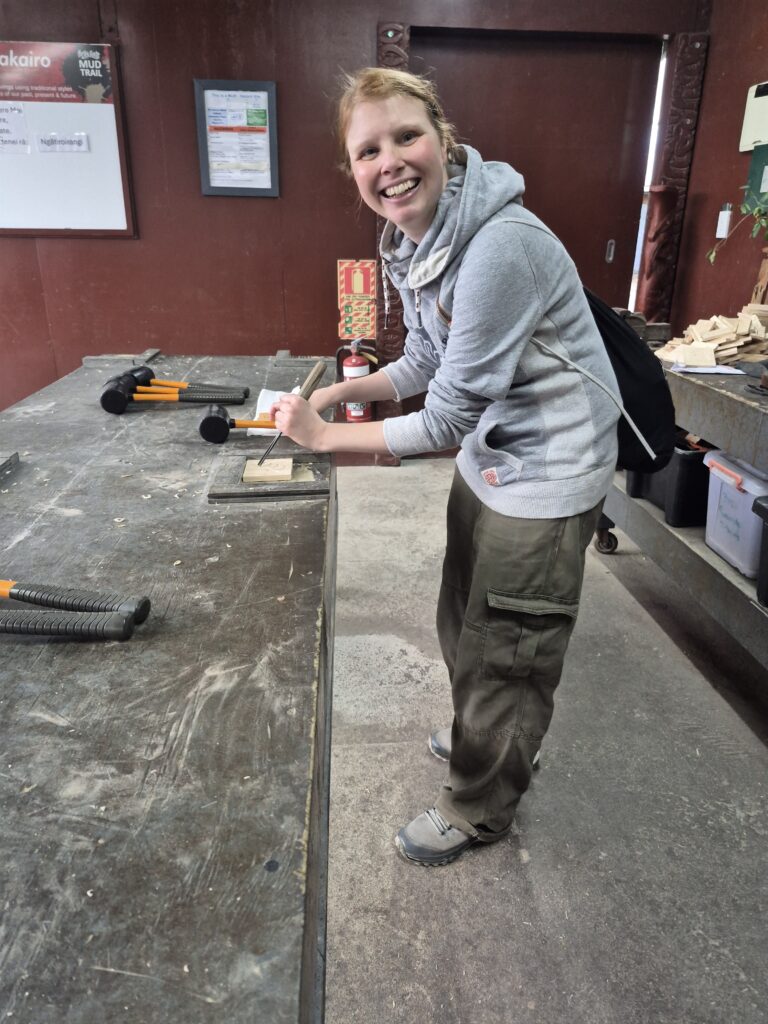
At the end of the Geothermal Walk, be sure to stop at the Carving House to try your luck at Whakairo (Maori wood carving)! There are several Maori carving patterns to choose from.

While wood carving is more difficult than it looks, it usually gets easier after practicing for a few minutes. In the end, visitors are allowed to take their carving home. What a special souvenir to bring back from New Zealand!

Hell’s Gate Mud Bath & Spa

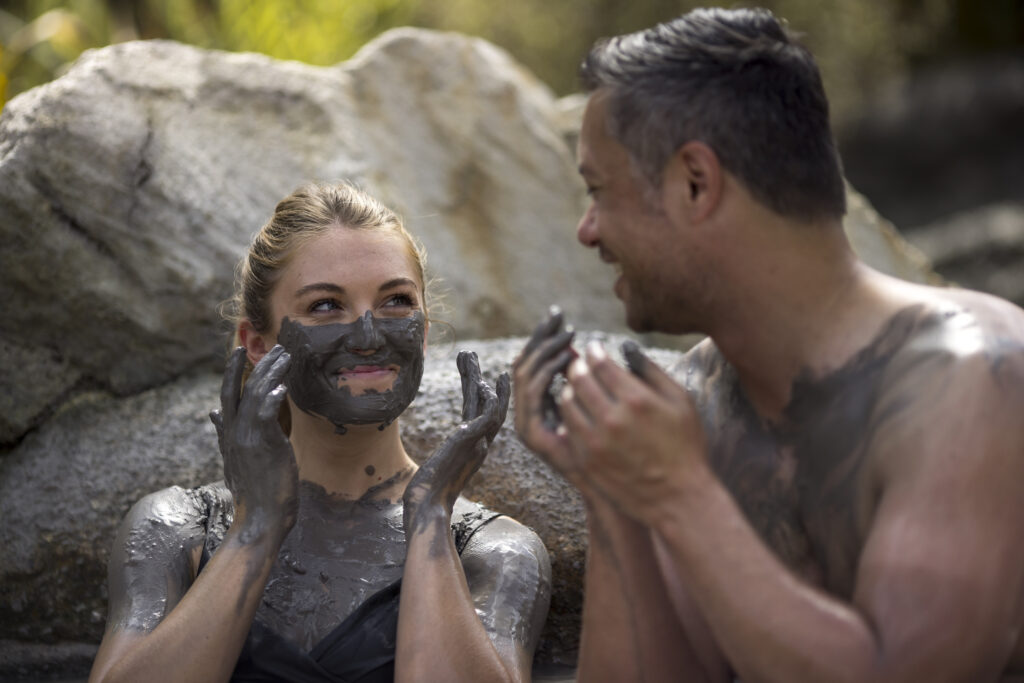
After all this excitement, your body deserves to soak in the famous geothermal mud baths! Bathing and lathering your skin with mud water is a great way to help with inflammation and arthritis pain, but also to relax and chat with other visitors. Besides, your skin will feel super soft afterwards.

Mud bathing is only possible for twenty minutes for health and safety reasons, but you’re welcome to relax at Hell’s Gate Sulphur spa pool as long as you like. Also, if you dare, try out their Cold Plunge pool!

Mud baths at Hell’s Gate. Photo credit: Miles Holden/Tourism NZ Visual Library.

Finally, visitors can book the Hell’s Gate Twilight Spa Experience. This includes mud bathing, soaking in the Sulphur spa, and Cold Plunge pool under the stars, which sounds like a cool experience as well!

Visitors can wear their own swimsuit or rent or buy one at the reception. Towels are available as well.

Hell’s Gate Geothermal Reserve & Mud Spa is about 30 minutes outside of Rotorua. While no public buses go here, visitors without a car can take their free shuttle bus from downtown and return. This service has to be booked directly (or at the Isite Tourist Info in downtown) in advance.

While the Hell’s Gate Experience (Geothermal Walk, Mud baths, Sulphur bath, and Maori carving) is a bit pricey (115 NZ$ per person), it’s really worth it! This is a unique experience that surely you will never forget!

Rotorua Lakefront Boardwalk

Address: Lakefront Drive, Ohinemutu, Rotorua 3010, New Zealand

Another fun thing to do in Rotorua is going for a stroll or bike ride on the Lakefront Boardwalk. Located inside the War Memorial Park, this is an awesome opportunity to explore the outdoors along the shores of Lake Rotorua. It’s just a short walk from the city centre.

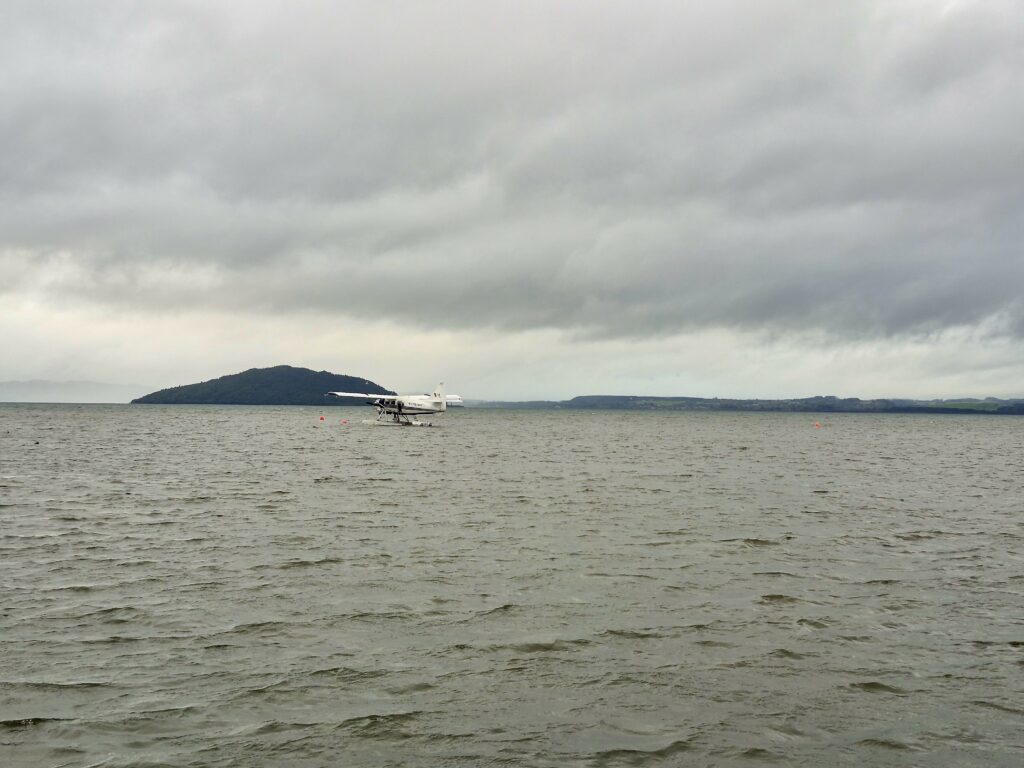
This area is a great spot to relax, admire the beautiful scenery, and watch out for local flora and fauna. There’s a playground and picnic area with barbeques, and Volcanic Air float plane tours start and land on the water as well.

By the way, the island behind the float plane above inside the lake is Mokoia Island. It is privately owned by local Maori people and is a bird sanctuary that can only be accessed by tour parties. The island is home to rare bird species, e.g. the North Island Brown Kiwi and the North Island Saddleback.

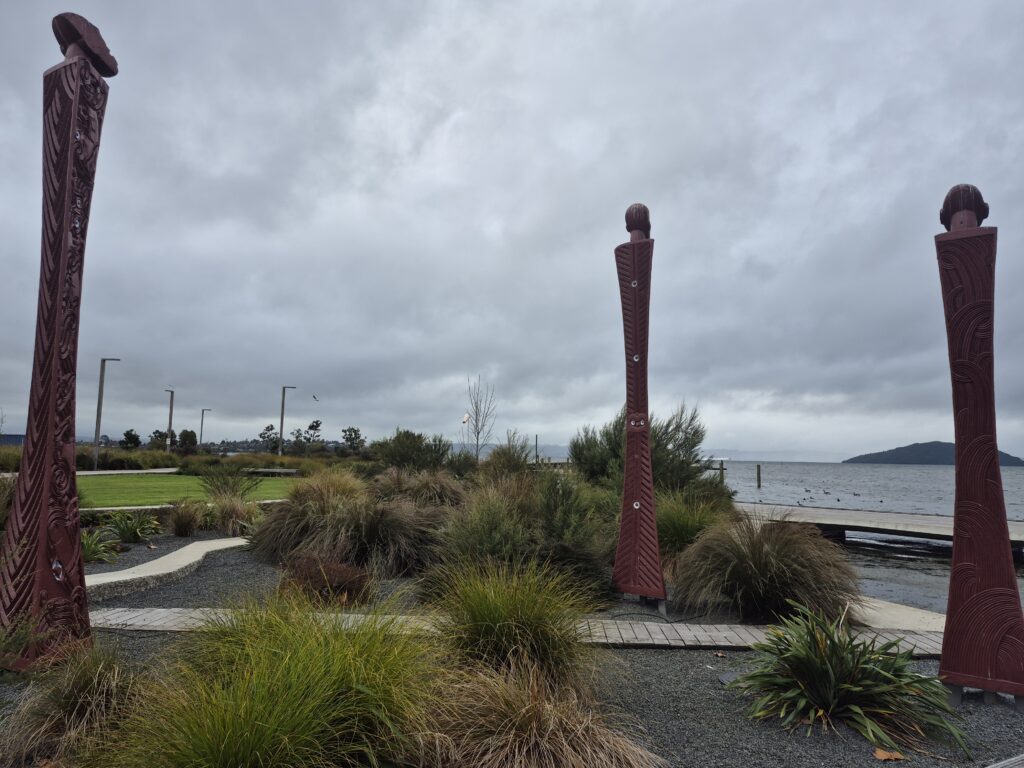
Adrenaline junkies can also book a 30-minute Katoa Jet Boat tour on Lake Rotorua, which starts and ends at Lakefront Boardwalk all year. Finally, you cannot miss the three Maori Pou Tumu (sculptures) on the boardwalk telling stories of local history.

Learn about Maori Culture & Traditions in Rotorua

Many Maori people live in the Rotorua area, so it’s the perfect place to learn about Maori culture and traditions.

Here are a few attraction ideas to find out more about Maori culture in and close to Rotorua:

Te Pa Tu

Address: 1072 State Highway 5, Tumunui 3073, New Zealand

Te Pa Tu is a recreated traditional Maori village about 20 minutes south of Rotorua. The village sits underneath an ancient 200-year-old native Tawa forest. It’s known as New Zealand’s most award-winning cultural attraction!

Te Pa Tu offers 3.5-to 4-hour evening experiences that change with each season of maramataka, the Maori lunar calendar. From May to September, visitors can join Tu Te Ihi (Winter Matariki Celebration) and Tu Te Ra (Summer Harvest Celebration) happens from October to April.

Here you can watch traditional Maori dance performances and rituals, listen to stories, witness a fire ceremony, play games, and taste Maori kai (cuisine) consisting of four courses! The Maori chefs slow-cook meat and veggies in an underground oven (the cooking method is called hangi).

Tū Te Ihi - Winter Matariki Celebration

This unique experience at Te Pa Tu starts at NZ$ 270 per person. If you don’t have a car, there’s a year round free shuttle taking guests from central Rotorua to Te Pa Tu and back.

Te Puia

Address: 20 Hemo Road, Whakarewarewa, Rotorua 3010, New Zealand

Te Puia is inside Whakarewarewa geothermal valley and is another awesome spot to learn about Maori history, culture, and traditions.

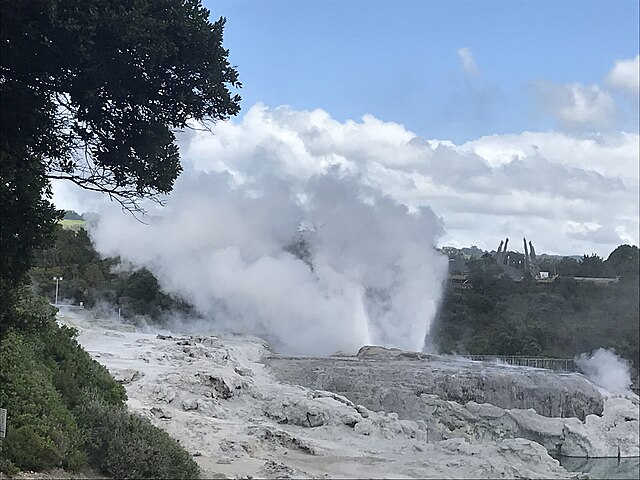
Entry is only allowed on a guided tour, which includes a 90-minute stroll through the geothermal valley, where you’ll see Pohutu Geyser (the largest active geyser in the Southern Hemisphere), the Kiwi Conservation Centre, and the New Zealand Maori Arts and Crafts Institute.

Pohutu Geysir. Photo credit: DestinationFearFan on Wikimedia Commons.

It’s also possible to add a cultural performance in their stunning carved meeting house. This add-on consists of a pohiri (traditional Maori welcome), waiata (song), moteatea (traditional chant), and haka (traditional war dance).

At night, guests can book a guided tour at Te Puia, traditional hangi buffet dinner, haka performance, and seeing Pohutu Geysir after dark! Finally, be sure to stop at the Oha Gift Store, Ahua Gallery, and Pataka Kai Restaurant & Bar.

There’s a winter deal until late September 2025, with admission starting at NZ$ 100 per person! Visitors in Rotorua without a car can take bus #11 from downtown to Te Puia (about 17 minutes). Bus service stops at 6 pm, but Uber and taxis are available to pick you up if needed.

Whakarewarewa – The Living Maori Village

Address: 17 Tryon Street, Whakarewarewa, Rotorua 3010, New Zealand

Whakarewarewa – The Living Maori Village is the legacy and home of the Tuhourangi Ngati Wahiao people, who have been telling their stories to visitors for more than 200 years. 

Here you can join Whaka Geothermal Walks with its mud pools and manuka bushlands, cultural performances (including haka), and learn about Maori history and myths. Visitors are welcome to rent E-bikes to explore the natural surroundings of Whakarewarewa as well.

Visitors without a car can hop on local bus #11 to get to Whakarewarewa village (about 19 minutes).

Check out Rotorua’s Shops & Street art in Downtown

Rotorua has a nice selection of souvenir shops in downtown. Some souvenirs are made in New Zealand, like Manuka Honey and Rotorua Thermal Mud Masks to use at home! Of course, you can also find New Zealand themed apparel, stickers, magnets, mugs, etc. here.

If you’re looking for good deals, be sure to visit some of the dollar stores or thrift stores in the city centre!

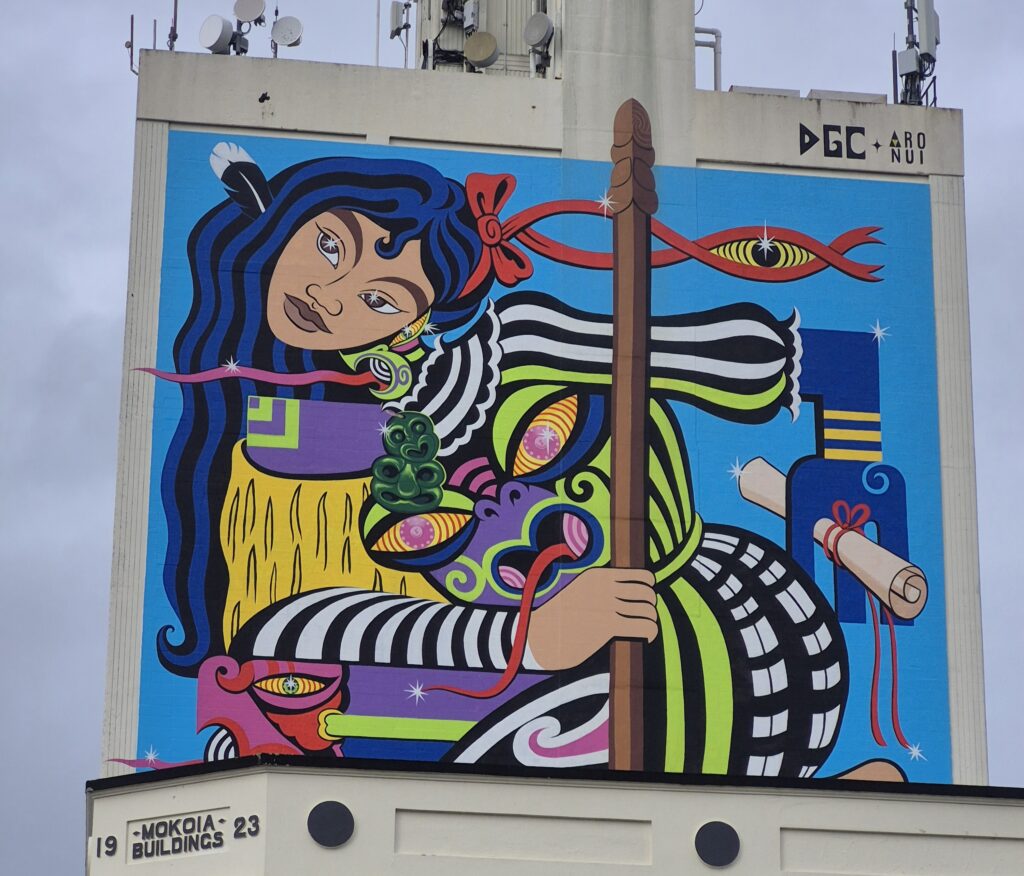
Last but not least, Rotorua’s city centre has some cool street art in random spots, if that’s your thing 😀

Where to Stay in Rotorua

As a touristy city, Rotorua has great accommodation options for every traveler’s budget.

I booked a private room at Stay Hostel Rotorua (1202a Pukuatua Street, 3010 Rotorua, New Zealand), a simple but very clean hostel in the city centre. They even upgraded me to a larger room with two bunk beds for myself, which I appreciated a lot!

Aside from that, there’s free wifi, laundry facilities, a spacious kitchen and lounge, and the staff was very friendly.

Where to Eat & Drink in Rotorua

Of course, there’s also a large variety of restaurants in Rotorua.

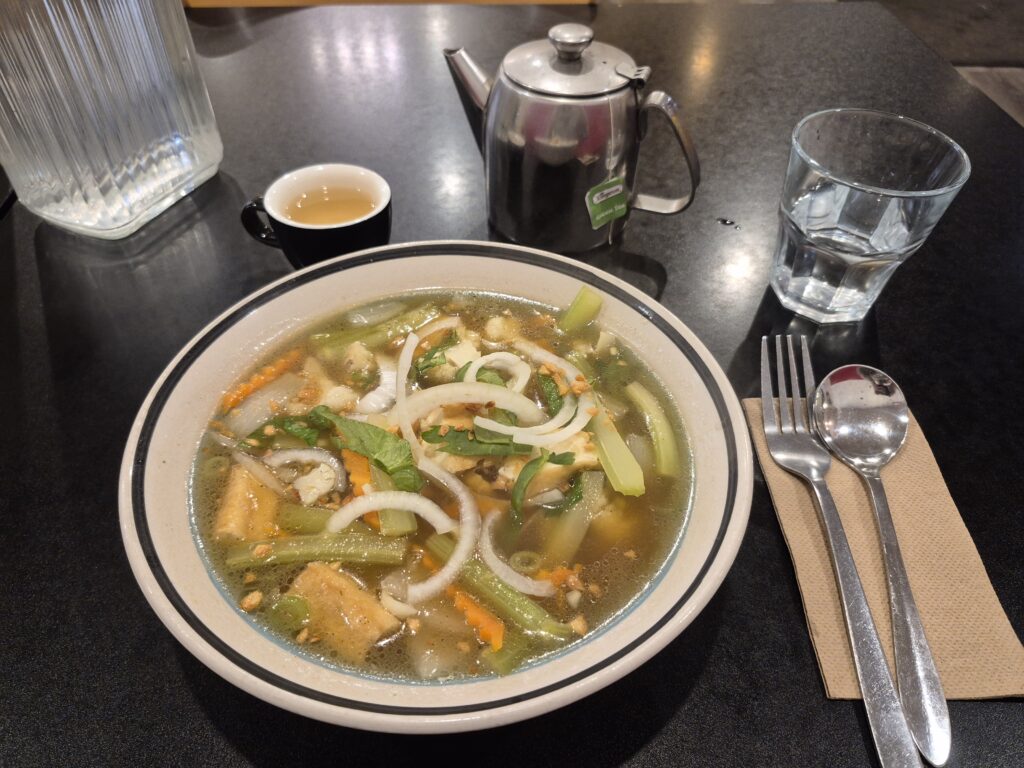
My favourite restaurant was Sweet as Rice (1205 Tutanekai Street, Rotorua 3010, New Zealand), a Vietnamese restaurant in downtown Rotorua. The inside of the restaurant was quite cozy and the staff was friendly and efficient. The price was not too bad, either.

I tried their Vegetarian Pho and after eating all the healthy veggies and broth, the cold that’d been bugging me was pretty much gone the next day!

There are also tons of grocery stores in Rotorua if you prefer to cook your own meals. Pak’nSave and Woolworths were the best ones, in my opinion.

How to Get to Rotorua with Public Transit

Getting to Rotorua without a car is pretty easy. Many people (tourists and Kiwis alike) take InterCity Bus to get around the country. This bus company goes from larger cities on the North Island (like Auckland or Wellington) to Rotorua (and vice-versa) several times a day.

The buses are clean, comfortable, (mostly) on time, and there’s free wifi on board. The ticket cost was reasonable as well.

The Best Time to Visit Rotorua

Rotorua is known for its temperate oceanic climate, which means warm summers and mild winters. It’s best to visit Rotorua in the fall (March to mid-May) or spring (September to November), as the weather is mostly pleasant, with not too many crowds.

While summer (December to February) is perfect to visit for outdoor activities, these are the busiest months for tourism and the highest accommodation prices of the year.

The winter months (late May to August) are the wettest and coldest months in Rotorua, but this is the time with the fewest crowds and lowest accommodation prices.

When I visited Rotorua in late May 2025, there was a mix of partly sunny and rainy weather conditions. Temperatures were around 15C (59F) during the day, but it got colder at night and the sun set around 5 pm. So while I loved this trip, I’ll come back to Rotorua a few months earlier next time 😉

Conclusion: 36 Hours in Rotorua Without a Car

Whether you’re traveling around New Zealand with or without a car, stopping in Rotorua is a must. Only here, you can soak in mud pools at Hell’s Gate Mud Bath & Spa. Besides, be sure to admire beautiful nature at Whakarewarewa Forest and learn about the fascinating Maori culture and traditions.

Rotorua is not super spread out, so it’s quite easy to get around via public transit (often without transfers) or walking/riding a bike. While some attractions are outside of town, like Te Pa Tu Maori Village, there are free shuttles or Uber/taxis available from/to the city centre.

Besides, Rotorua has great accommodation and restaurant (or grocery store) options for every traveler’s budget. If you’re on the lookout for souvenirs, Rotorua shouldn’t disappoint you, either. So it’s a perfect spot to spend (at least) 36 Hours on your New Zealand trip!

8 PLACES IN WASHINGTON STATE A NIRVANA FAN SHOULD VISIT ONCE IN A LIFETIME

Nirvana was a grunge band from Aberdeen, Washington, that was formed by Kurt Cobain (guitar/vocals) and Krist Novoselic (bass) in 1987.

Kurt and Krist later moved to Olympia and Seattle, where their fanbase grew much quicker. After several short-term drummers, Dave Grohl became Nirvana’s permanent drummer in 1990. Pat Smear joined them as second guitarist in 1993.

Nirvana’s grunge sound blends catchy pop melodies, heavy guitar riffs, raw punk energy, and honest lyrics and emotions. Nirvana reached their big international breakthrough in 1991, after publishing Nevermind, their second album.

Their biggest hit was Smells like Teen Spirit, which added to Nirvana being known for taking Punk to the Mainstream. They also made Seattle and the Pacific Northwest famous in the international music industry. Finally, thanks to their unique sound, Nirvana suddenly were the new voice of a generation.

Sadly, Kurt Cobain’s heroine addiction, mental health issues, and aversion with fame often overshadowed Nirvana’s career. On April 5, 1994, he committed suicide at 27 years old. Kurt’s tragic death led to Nirvana’s break up and a slow downfall of grunge music (also called “Seattle Sound”) in pop culture.

Since Kurt’s passing, thousands of Nirvana fans have flocked to Washington State to see places connected to the band. From former homes, museum exhibits, Kurt Cobain memorials, to iconic music clubs, this self-guided tour will tell you about 8 Places in Washington State a Nirvana Fan should Visit once in a Lifetime!

Disclosure: I only recommend products that I’ve used in the past, and all opinions expressed in this post are my own. This post contains affiliate links. If you use one of the links throughout the page to buy something, I may earn a small commission at no extra cost to you. Thank you!

Seattle

Check out the Nirvana Exhibit at the Museum of Pop Culture (MoPOP)

Address: 325 5th Ave N, Seattle, WA 98109, United States

If your Nirvana Pilgrimage begins in Seattle, going to the Museum of Pop Culture (formerly called Experience Music Project) is an awesome idea!

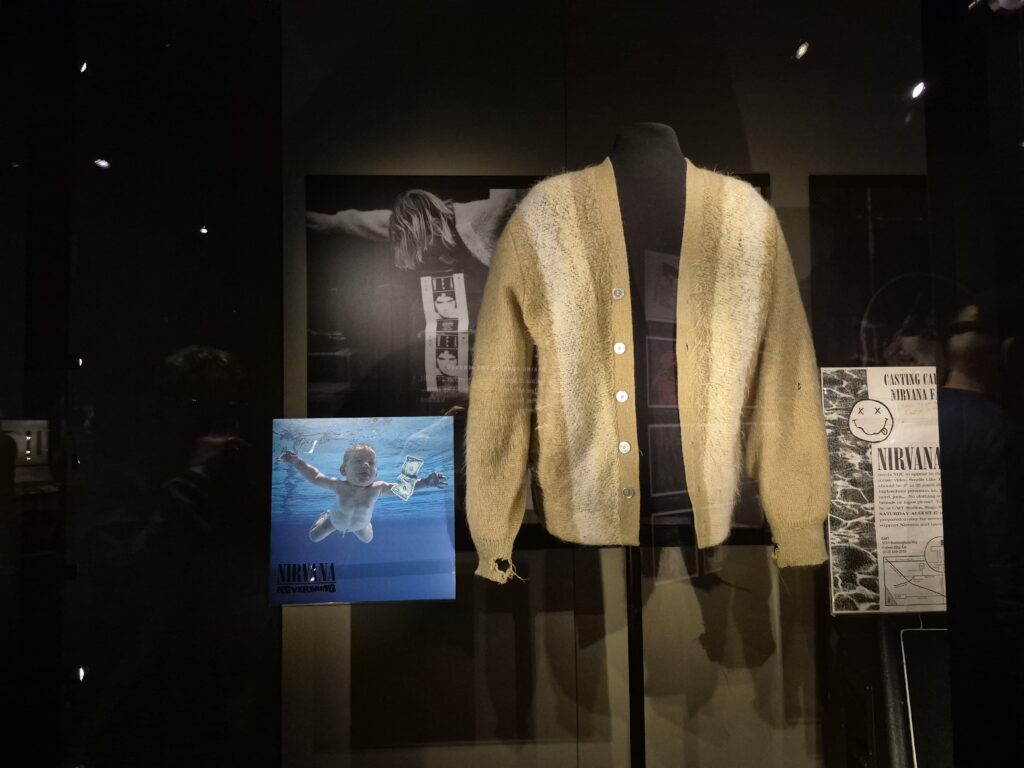
Their popular exhibit “Nirvana: Taking Punk to the Masses” starts with the band’s rather chaotic first years in Aberdeen. Then walk in the band member’s footsteps in Olympia and Seattle, soon publishing Bleach (their first album) and touring the US and UK for the first time!

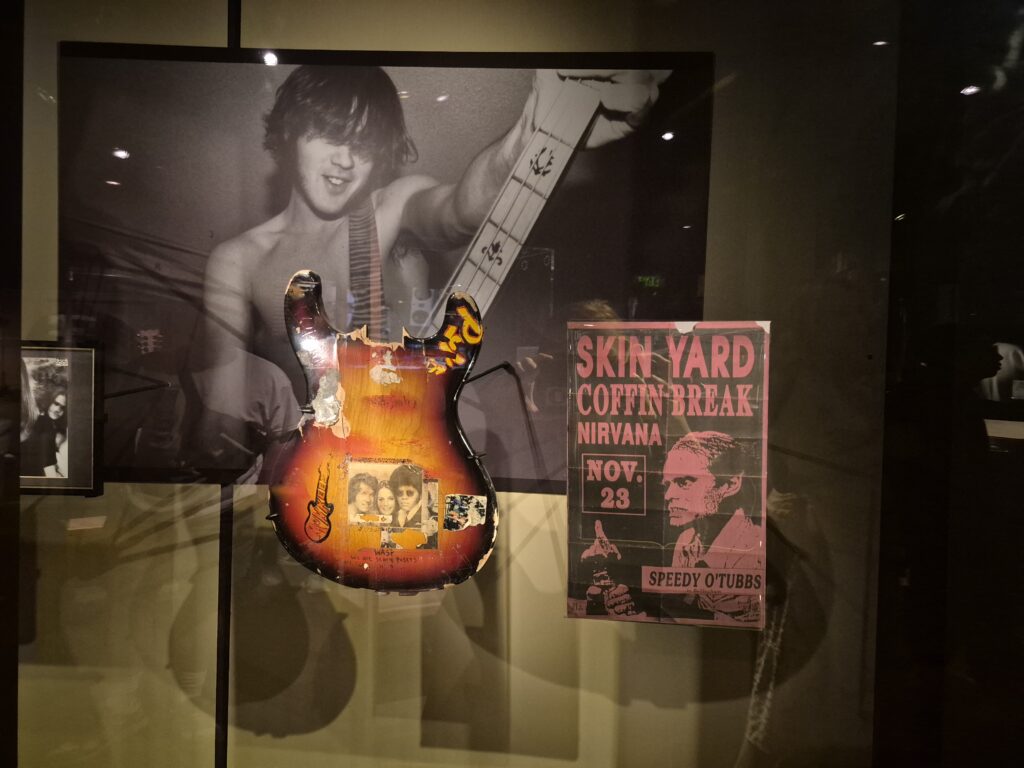
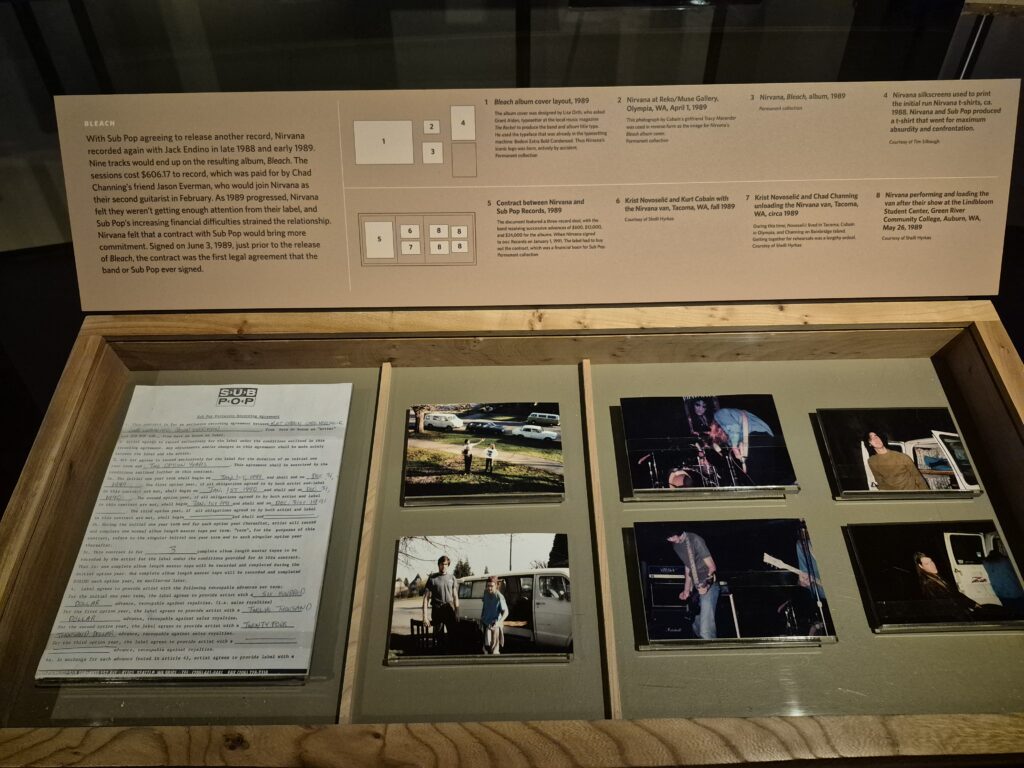
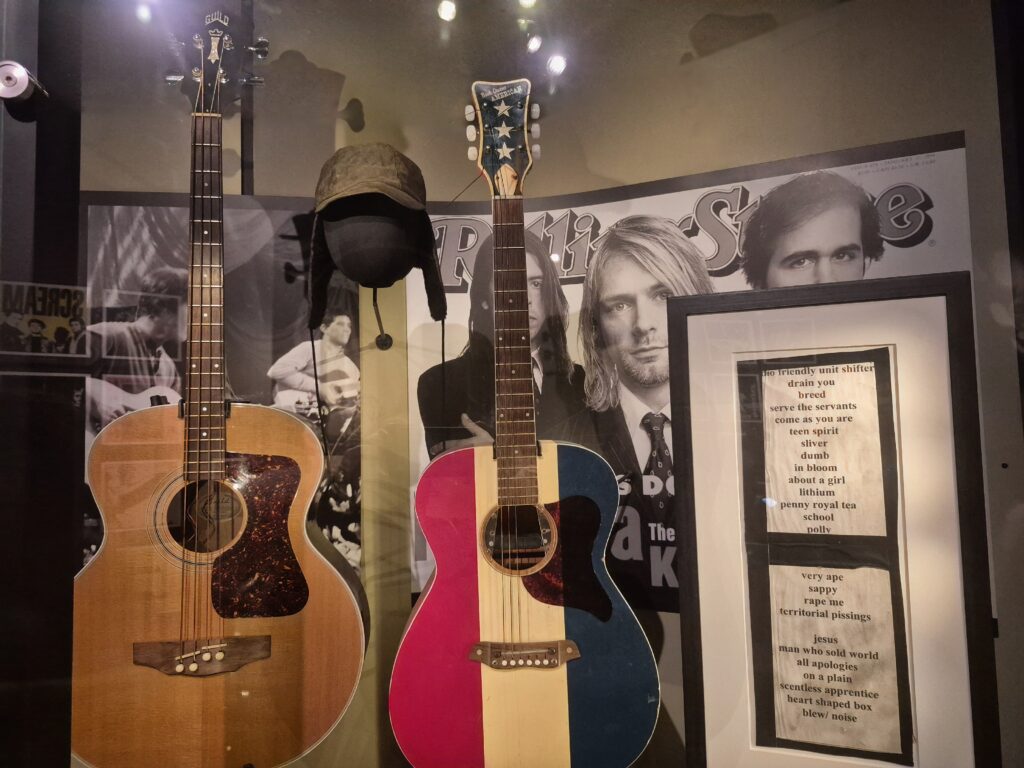
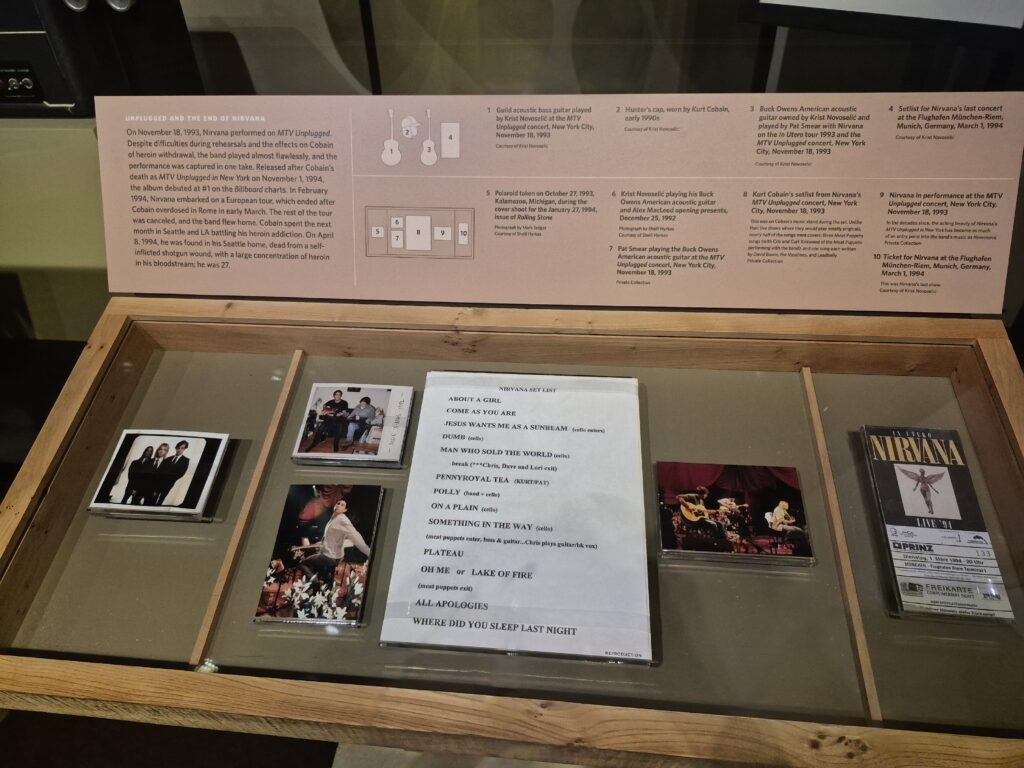
There are more than 200 rare artifacts on display. For example, look at the band member’s clothes and instruments, (often handwritten) gig flyers, casting call for the Smells like Teen Spirit music video, photos, and the record contract with Sub Pop Records!

But the exhibit also includes backstage passes, setlists, cassettes, and a concert ticket to their last show in Munich, Germany on March 1, 1994! Many of these relics were donated by the band members, their families, or close friends.

At the end of Nirvana: Taking Punk to the Masses, you’ll learn why the band’s legacy is still making a difference today. So whether you’ve just discovered Nirvana or liked them for years, this informative but also deeply moving exhibit at MoPOP will surely impress you!

Unfortunately, after 14 years, “Nirvana: Taking Punk to the Masses” is set to close on September 7, 2025. So if you’re in the area this summer, you shouldn’t miss it!

Pay Homage at Kurt Cobain Memorial Bench

Address: Viretta Park, 151 E Lk Washington Blvd, Seattle, WA 98112, United States

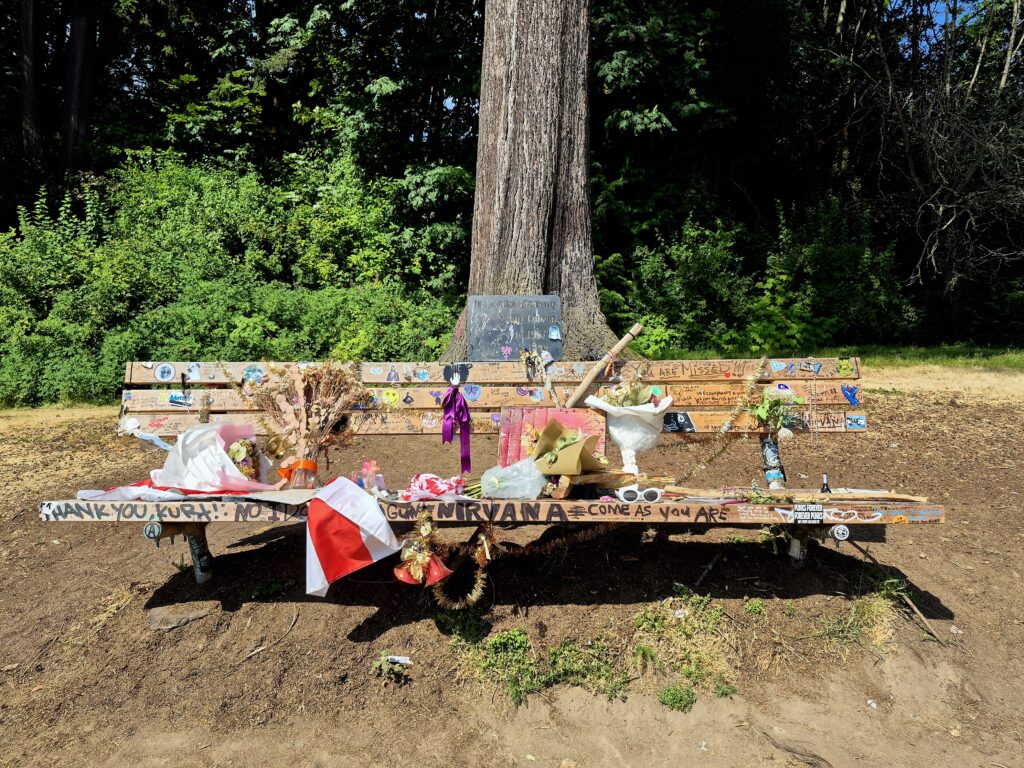
Kurt Cobain Memorial Bench is at Viretta Park, a small park in the east central part of Seattle. As Kurt’s place of death is within a stone’s throw from here, Nirvana fans quickly started meeting and mourning at Viretta Park after his passing.

The wooden bench sits underneath a large tree and fans from near and far have left gifts, condolences, song lyrics, poems, and stickers on it with time. When I visited recently, there were flowers, painting, sunglasses, pearl necklace, and a maple leaf scarf on the bench.

I think this place comes very close to a burial place (Kurt’s ashes were spread in several places after his death). Nirvana fans still meet at this spot every year on Kurt’s anniversary of death and his birthday (February 20).

The bench overlooks Lake Washington that adds a lovely breeze to the peaceful vibe. So I assume that Kurt would have been very happy with this memorial site and that his fans still come here to pay tribute after more than 30 years!

Look at Kurt Cobain’s House

Address: 171 E Lk Washington Blvd, Seattle, WA 98112, United States

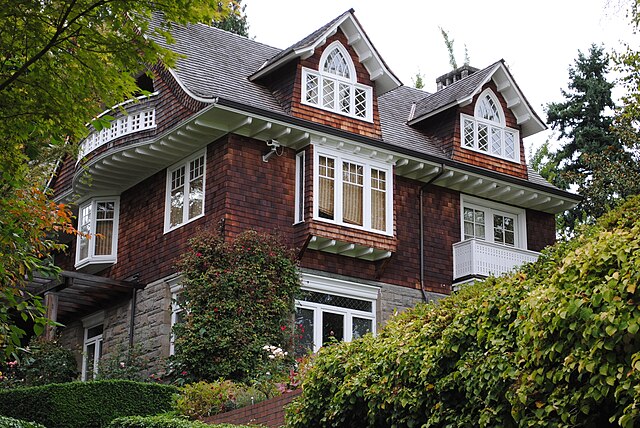
Kurt Cobain’s House was a 7,000 sq foot (650 sq meter) house within the Denny Blaine neighbourhood that Kurt and his wife Courtney Love bought in January 1994. This is where Kurt spent his last months and took his life on April 5, 1994.

Kurt’s body was found by an electrician on April 8, 1994 in the on-site greenhouse above the garage (which was demolished in 1997).

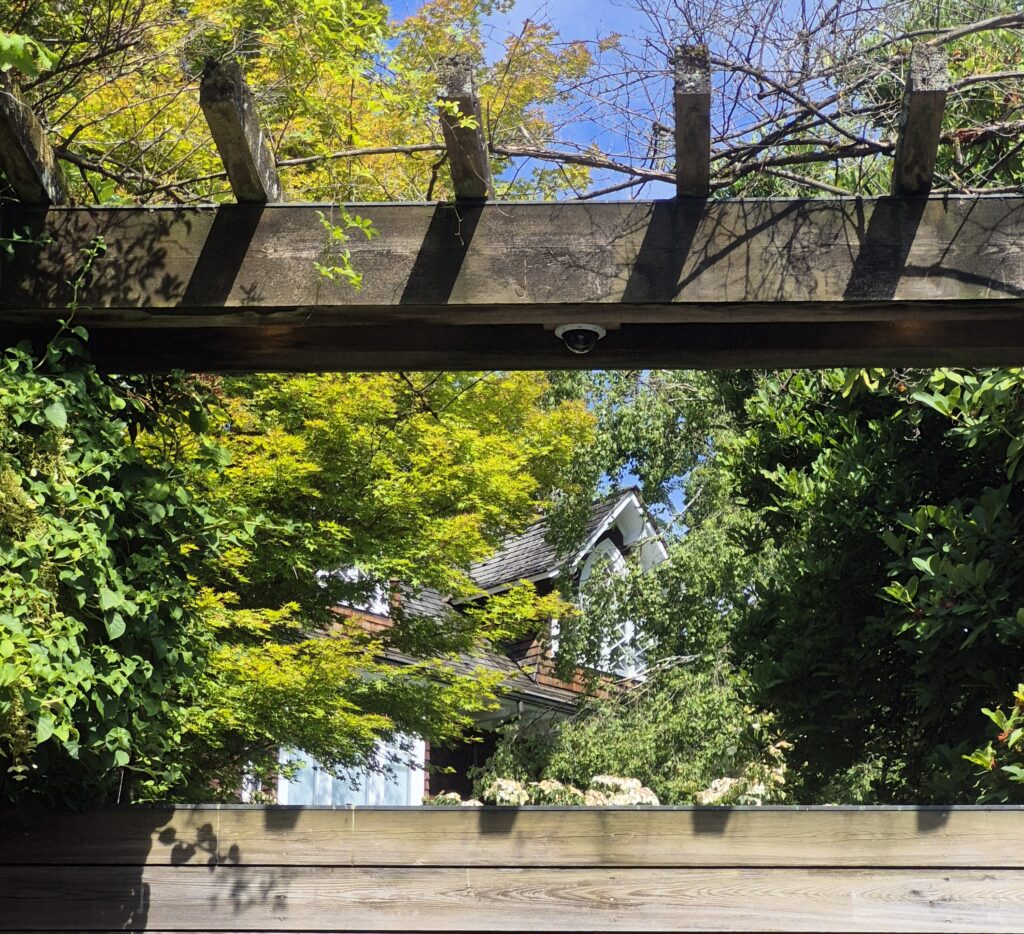
Kurt Cobain’s house was later sold and renovated and is a private property now, so it’s not open to the public. But Nirvana fans are welcome to check out the place from the outside through a wooden gate in front of the house today.

Left: Kurt Cobain’s house in the past (Photo credit: Etsy Ketsy on Wikimedia Commons). Right: The upper part you can see through the wooden gate today.

The Crocodile

Address: 2505 1st Avenue, Seattle, WA 98121, United States

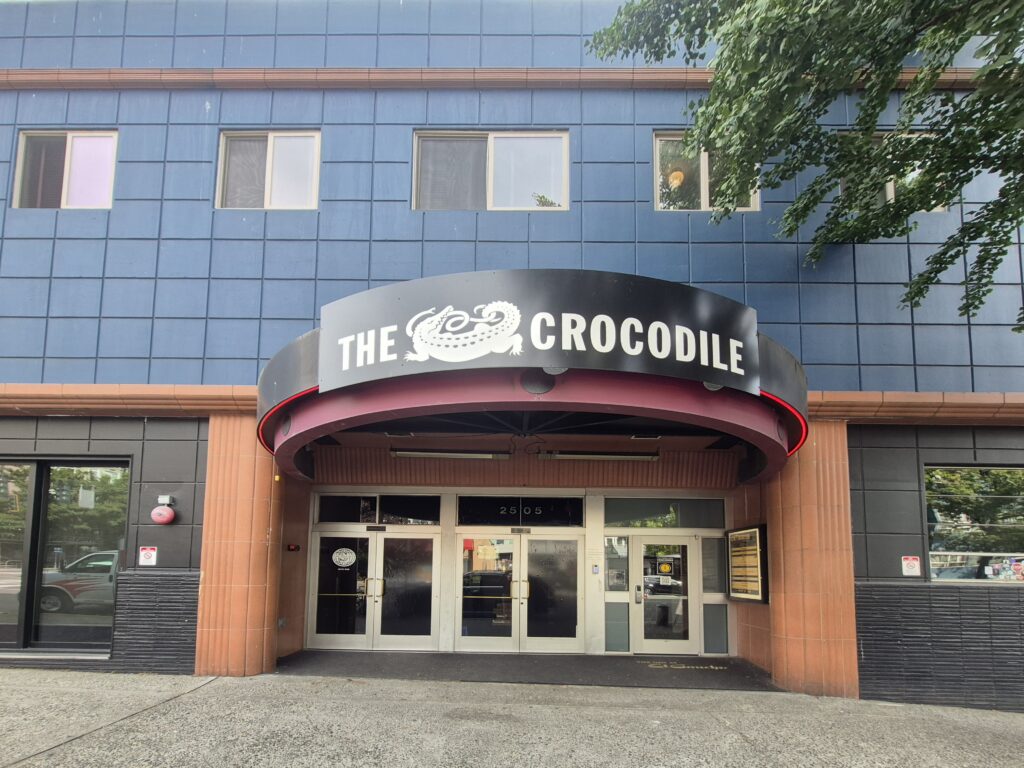
If you want to stand inside a music club that hosted Nirvana as a surprise in 1992, check out The Crocodile (also called The Croc). Opened in 1991 and built on Seattle’s grunge legacy, this venue still plays an important role in the local music scene today.

The Croc has also hosted other famous artists, e.g. Pearl Jam, Social Distortion, The White Stripes, Billie Eilish, and The Beastie Boys with time. Finally, Rolling Stone magazine ranked it as the 7th best club in the United States in 2013!

After changing their location several times, the Croc now has three floors with a 750 capacity state of the art showroom, concert venue, sit down theater, as well as a restaurant and a small hotel! Local and famous artists alike still share the stage today at the Croc.

Aberdeen

After chasing Nirvana and Kurt Cobain around Seattle, I had to go to Aberdeen. This is where Kurt and Krist Novoselic grew up, so it’s a must to go here at least once as a Nirvana fan! Aberdeen is a smaller city west of Seattle and it takes about 2.5 hours to drive here.

I took three buses to Aberdeen (from Seattle via Tacoma and Olympia), which took about four hours. Buses to Aberdeen only run a few times a day, so it’s important to plan ahead of time. But in 2025, riding buses of Grays Harbor transit covering Tacoma to Olympia and Olympia to Aberdeen is free of charge!

The Come As You Are sign

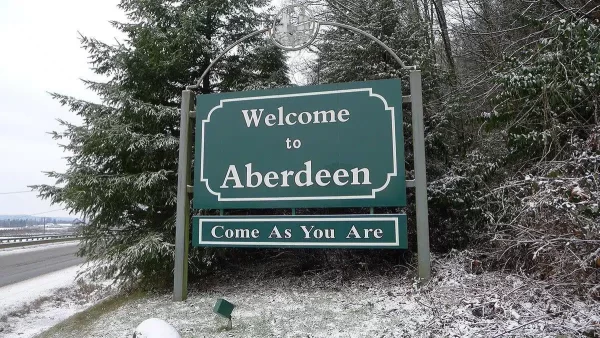
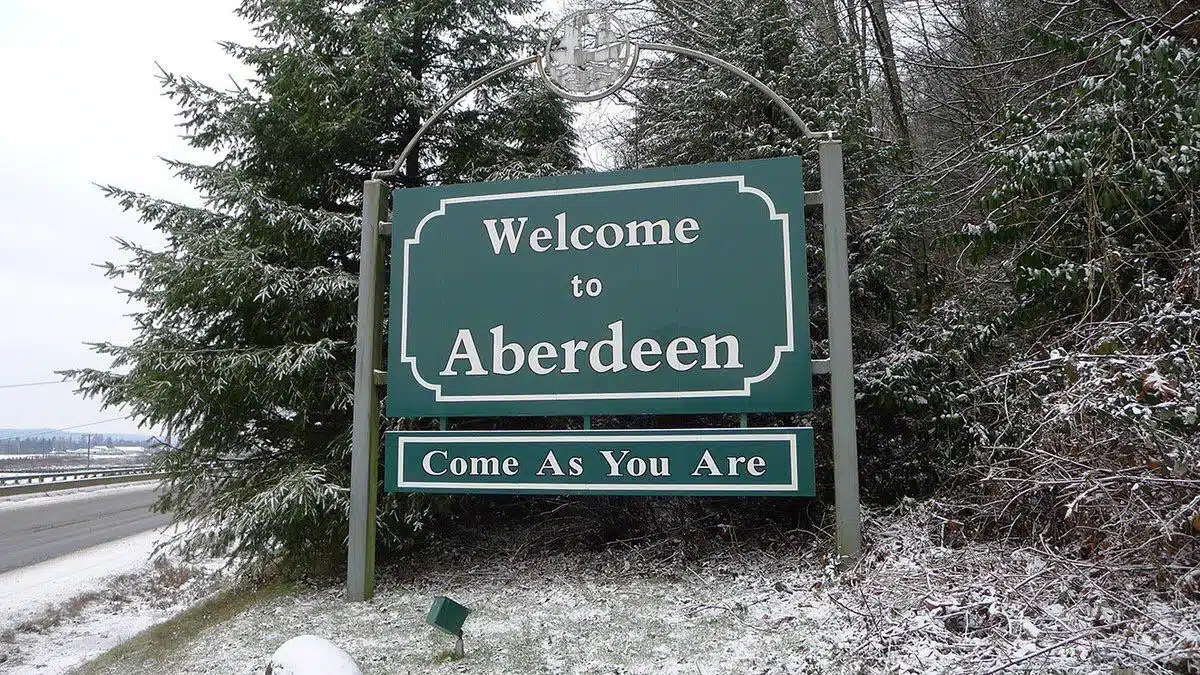
The very first Nirvana-related attraction just outside of Aberdeen is the Come As You Are sign. The title (also one of Nirvana’s most popular songs) was added to the Welcome to Aberdeen sign in 2005 by the City of Aberdeen to pay their respects to Kurt Cobain.

The Olympic Highway (Highway 12) is the main road from Seattle to Aberdeen and the sign is on your right. So whether you’re driving or taking a bus to Aberdeen, you can’t miss it! There’s also a small pull off available, so feel free to park and walk up to the sign for a few photos.

Picture provided by Reddit.

Kurt Cobain’s Childhood Home

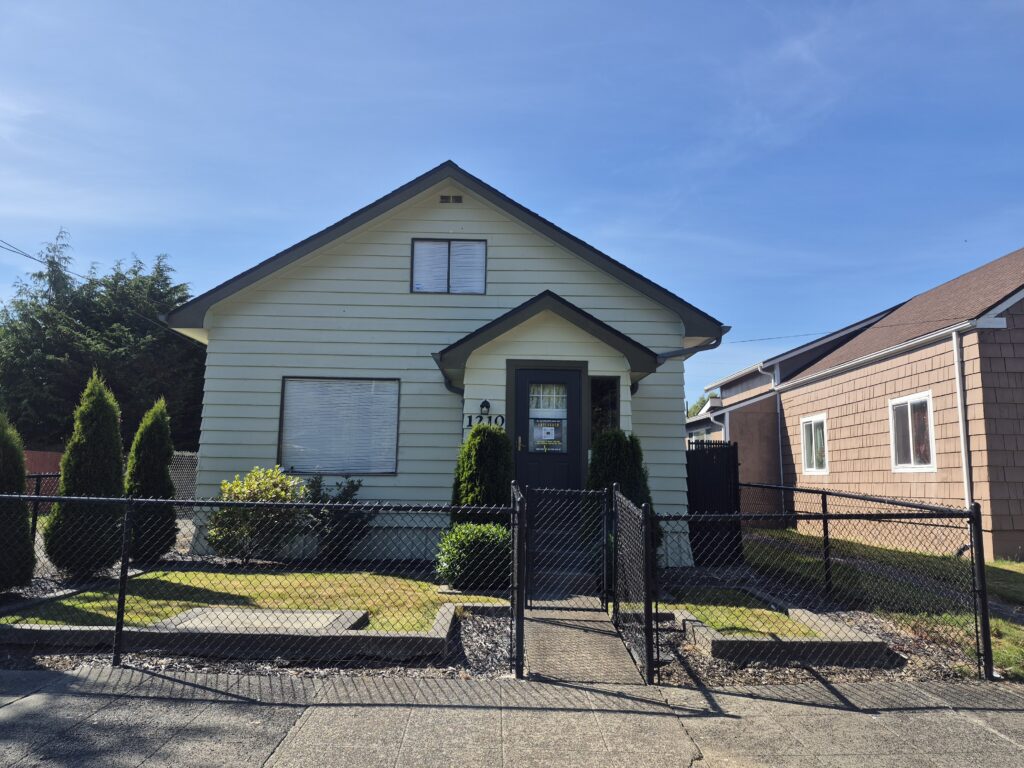
Address: 1210 E 1st St, Aberdeen, WA 98520, United States

Kurt Cobain’s Childhood Home is a 4-bedroom house within a quiet residential neighbourhood close to downtown Aberdeen. Kurt lived here from his time as a toddler until his parents divorced when he was nine years old. He also lived here for a while as a teenager.

Kurt and Krist also used to practice during the early Nirvana days in the house’s garage in the 1980’s. It was in the hands of Wendy O’Connor (Kurt’s mother) until 2018 when she sold it to Dani and Lee Bacon.

In 2021, Washington authorities approved Kurt Cobain’s Childhood Home as a historic landmark. Besides, the new owners have been restoring the house to the years when Kurt lived there.

Starting July 26, 2025, special recognition markers will welcome fans and visitors to walk through the interior of the house! It’s supposed to include furnishings, photographs, audio recordings, and videos of Kurt’s early life.

Pay Tribute to Kurt at Kurt Cobain Memorial Park (Kurt Cobain Landing)

Address: Young St, Aberdeen, WA 98520, United States

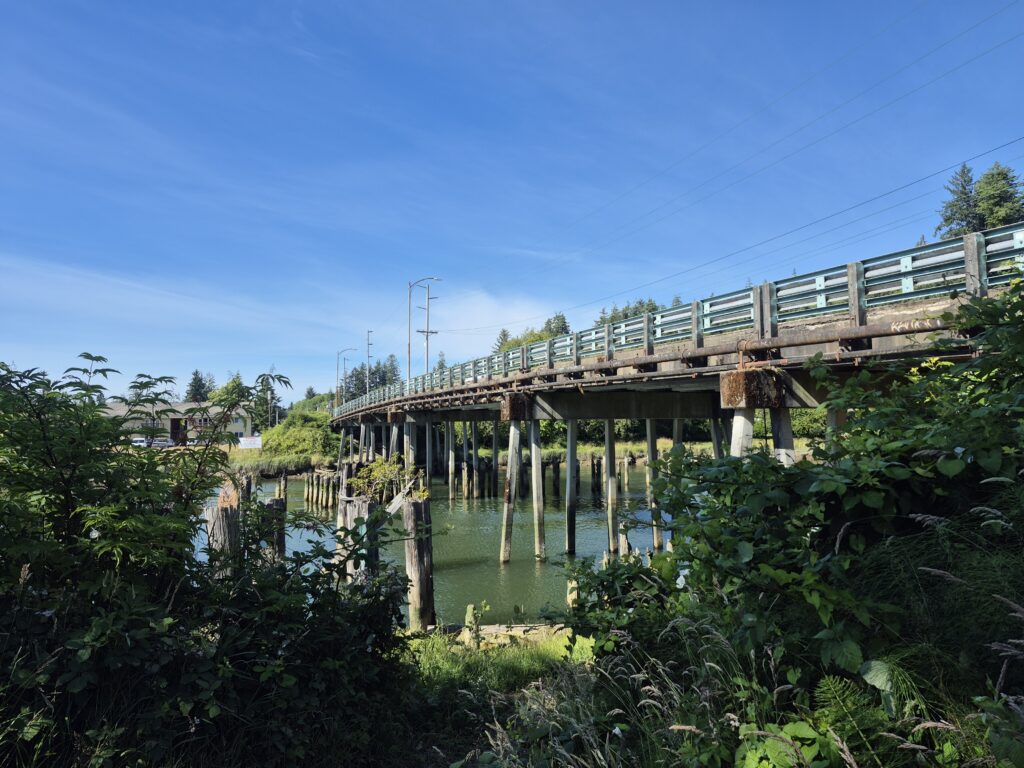
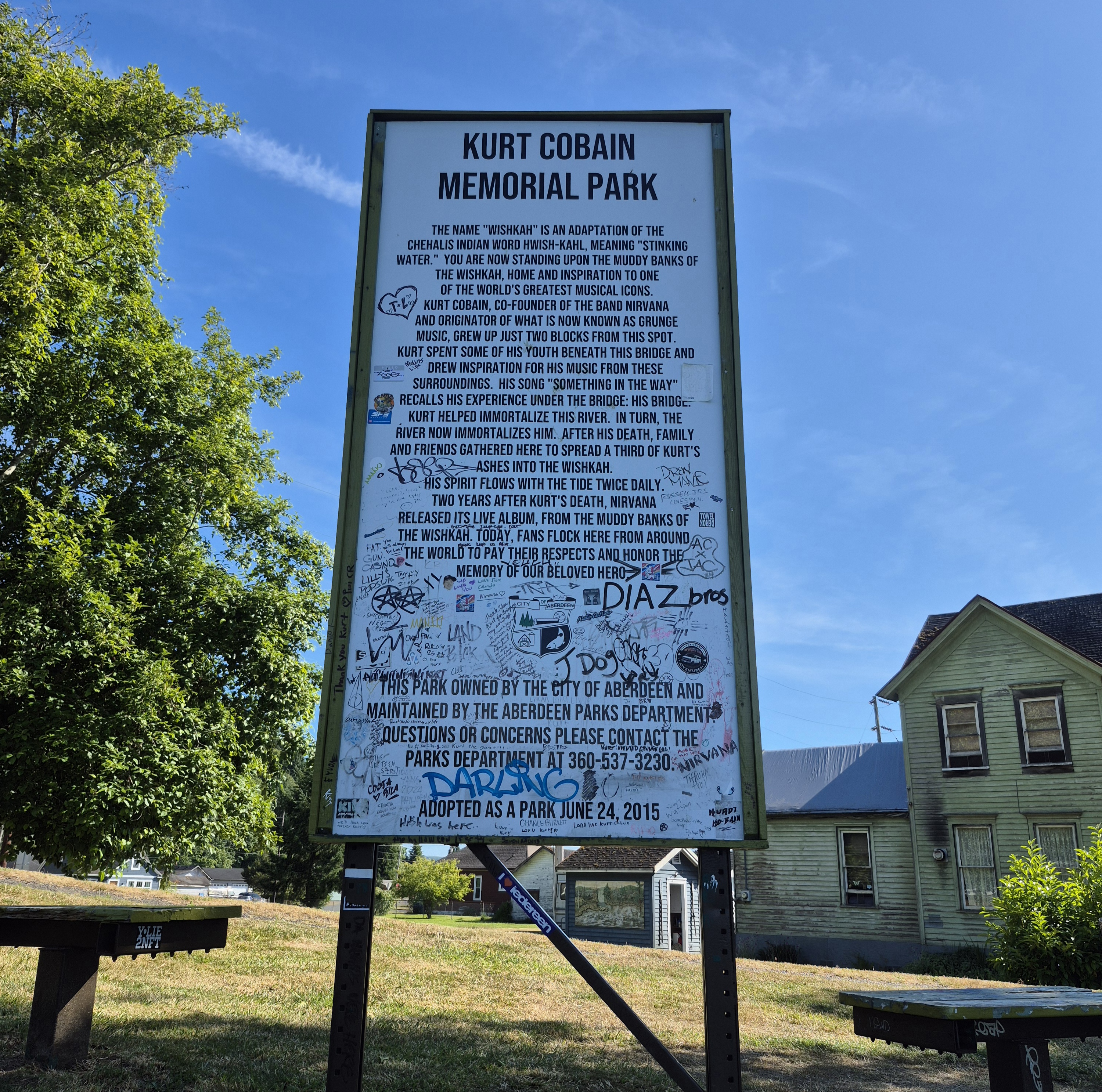
Just a few minutes from Kurt’s Childhood Home you’ll find Kurt Cobain Memorial Park. This peaceful park overlooks the Wishkah river and sits next to Young Street Bridge.

Kurt claimed that he lived underneath this bridge when he was homeless. While this may not be true, people close to him confirmed that Kurt often liked to hang out here during his teenage years.

This place also inspired Something in the Way, one of Nirvana’s most melancholic songs. Finally, Nirvana’s live album From the Muddy Banks of the Wishkah (1996) was named after the Wishkah river.

So it’s pretty clear that this spot meant a lot to Kurt. His family also spread a third of his ashes into the Wishkah river in 1999, five years after his death.

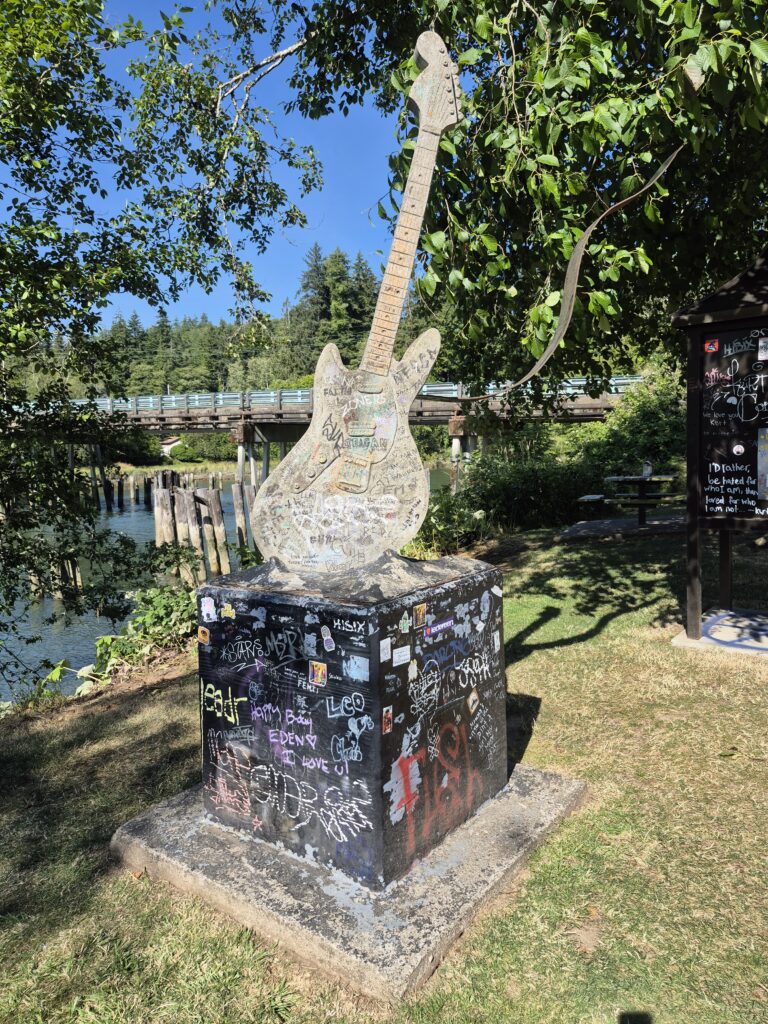
There are graffiti murals on the right side of the bridge, as well as a memorial wall for fans to leave messages, guitar sculpture, memorial plaque, “air guitar” sculpture, and an info board about Kurt’s life and legacy. Kurt Cobain Memorial Park has been here since 2015.

Although Kurt often spoke negatively about his hometown, the City of Aberdeen has put an effort to honour him in several ways. The most obvious examples are the Come As You Are sign and Kurt Cobain Memorial Park.

They also introduced Kurt Cobain Day to celebrate his birthday every year on February 20 and the Aberdeen Museum of History featured a small Nirvana exhibit. Unfortunately, the museum burned down several years ago and is permanently closed.

Olympia

Kurt Cobain’s Home in Olympia

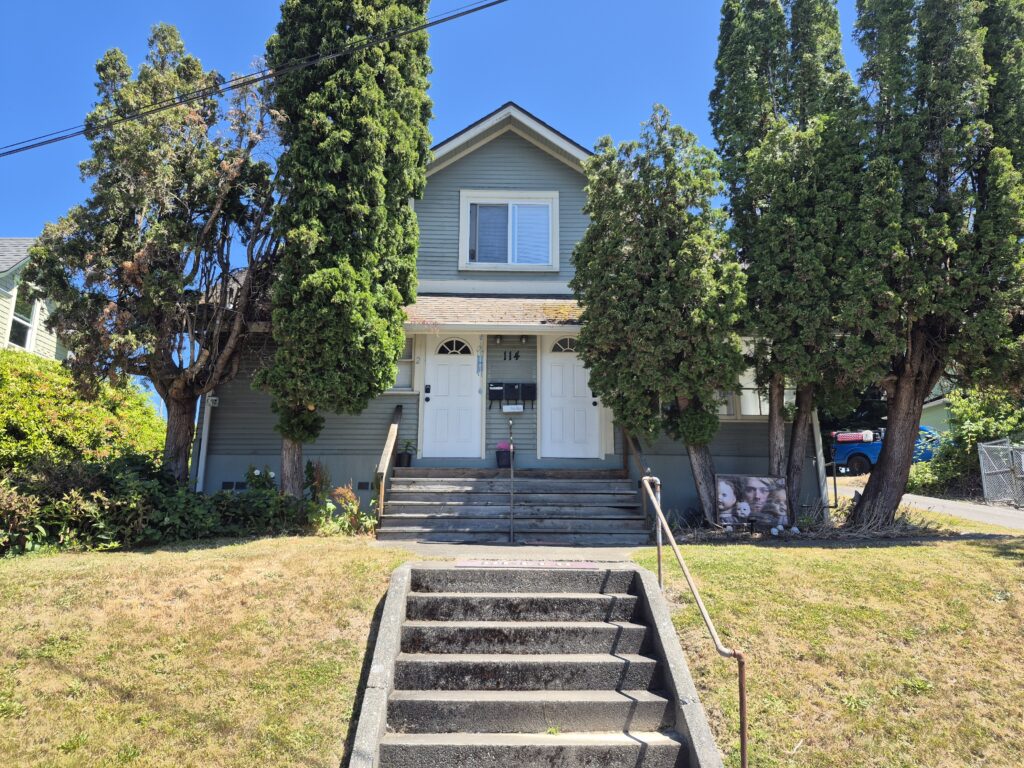
Address: 114 Pear St NE, Olympia, WA 98506, USA

The third city I recommend checking out as a Nirvana fan is Olympia. While there are less places connected to the band here than in Seattle and Aberdeen, Kurt Cobain’s Home in Olympia is quite a special place.

The house has three apartments and Kurt lived in Apartment #2 and #3 between 1989 and 1991 (first with then-girlfriend Tracy Marander and later Dave Grohl).

As per various sources, Nirvana created 75% of their work in this house, including many songs from Nevermind.

Besides, Kathleen Hanna of Bikini Kill, a friend of his, sprayed a graffiti saying “Kurt Smells like Teen Spirit” on the wall inside Apartment #3 at the back of this house. This gave Kurt the idea for writing Smells like Teen Spirit!

Today Apartment #2 is an Airbnb. Inside there are photos of Kurt, Nirvana books, as well as a guitar tab poster of the song About a Girl. The owners also tried to keep things as they were from back when Kurt lived here. How cool is that?

Other Nirvana locations to Visit in Washington State

If you have more time during your trip to Washington State, there are a few more places connected to Nirvana you can visit:

Seattle

Linda’s Tavern

Address: 707 E Pine St, Seattle, WA 98122, United States

Linda’s Tavern is a bar and restaurant that still plays a part in the grunge/alternative music scene in Seattle. Opened in February 1994, this is where Kurt was last seen alive before committing suicide in April 1994. This is why Linda’s Tavern is also called the “Grunge Cheers”.

Today this Cowboy-themed bar and restaurant is known for their weekend brunch, burgers, Mac and Cheese (Kurt’s favourite food, BTW), sandwiches, tacos, and of course, lots of drinks!

International Fountain

Address: 305 Harrison St, Seattle, WA 98109, United States

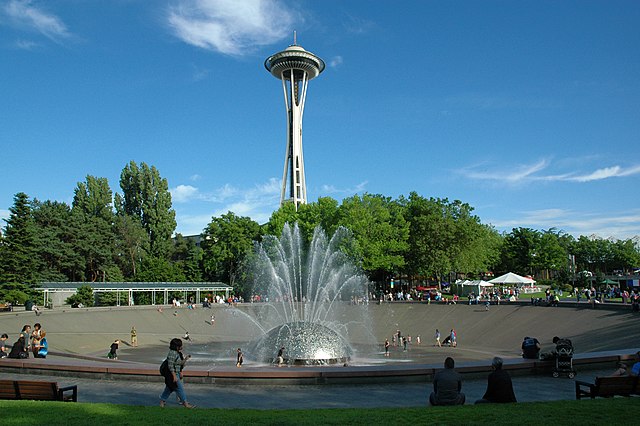
This is where Kurt Cobain’s public Funeral Service was held on April 10, 1994. 7,000 Nirvana fans met here to say goodbye to their idol and a recording of Courtney Love reading his suicide note was played.

International Fountain with the Space Needle in the background. Photo credit: DimiTalen on Wikimedia Commons.

Aberdeen

Krist Novoselic’s House

Address: 1120 N Fairfield St, Aberdeen, WA 98520, United States

Nirvana’s bassist Krist Novoselic lived in this house during his time in Aberdeen. It’s on the right side of the Wishkah river and is a quick walk from Young Street Bridge on the top of a hill. It’s inside a wealthier neighbourhood than Kurt’s former homes.

Look at Kurt’s other Homes in Aberdeen

After moving out of his childhood home, Kurt lived at four other addresses in Aberdeen before moving to Olympia in 1989. All houses were close to Aberdeen’s downtown area. Besides, Kurt lived in Hoquiam and Montesano, which are just a short drive or bus ride from Aberdeen.

Check out the Pacific Northwest Music Project

Address: 121 West Wishkah Street, Aberdeen, WA 98520, United States

The Pacific Northwest Music Project is a non-profit organization that was founded by music enthusiasts Dani and Lee Bacon. They offer guided Nirvana walking tours around Aberdeen and the Green Room, which celebrates musicians and their legacy from the Pacific Northwest.

Besides, you can book a tour of Kurt’s Childhood Home here and they plan to open a Kurt Cobain Tribute Gallery in 2026. At this time, they are open Thursday-Sunday from 11 am to 5 pm. Finally, Dani and Lee call Aberdeen the “Cradle of Grunge Music” which I think is pretty awesome!

Conclusion: 8 Places in Washington State a Nirvana fan should Visit Once in a Lifetime

If you’re a Nirvana fan, chasing the band and Kurt Cobain around Washington State should be on your bucket list! From former homes, legendary music clubs, Kurt Cobain memorials in Seattle and Aberdeen, to the Nirvana exhibit at MoPOP, there’s so much to see here.

Thousands of Nirvana fans head to Washington State every year. And even as a hardcore fan, you might still learn something new about Nirvana on your trip. For example, I had no idea that 75% of their work was created at Kurt’s Home in Olympia!

I could still feel a faint grunge vibe in the air while walking around Seattle, Aberdeen, and Olympia, and found some awesome Nirvana merch in Seattle. But I can’t wait to join a tour of Kurt’s Childhood Home or stay at his former place in Olympia someday!

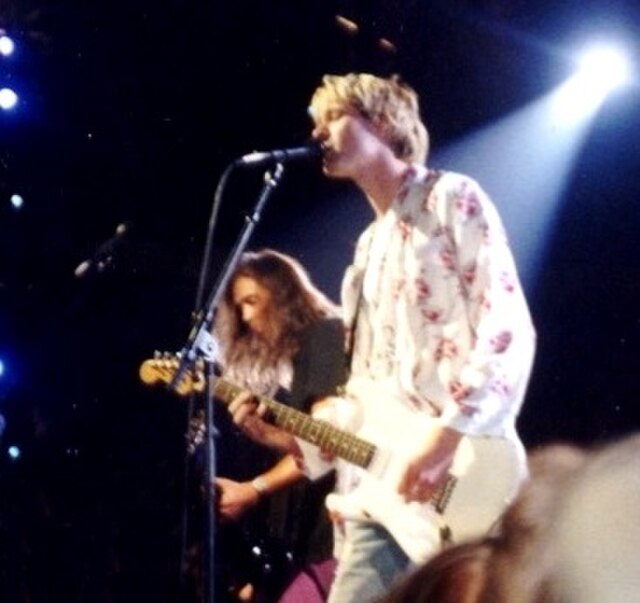
Kurt and Krist at the MTV Video Music Awards in 1992. Photo credit: P.B. Rage on Wikimedia Commons.

IS A DAY TRIP AROUND ICELAND’S SNAEFELLSNES PENINSULA WORTH IT?

Snæfellsnes Peninsula in West Iceland is right next to the North Atlantic Ocean, about two hours from Reykjavik. It takes about 10-12 hours to go around it, so it’s a great idea for a trip from Iceland’s capital. So is a Day Trip around Iceland’s Snaefellsnes Peninsula Worth it?

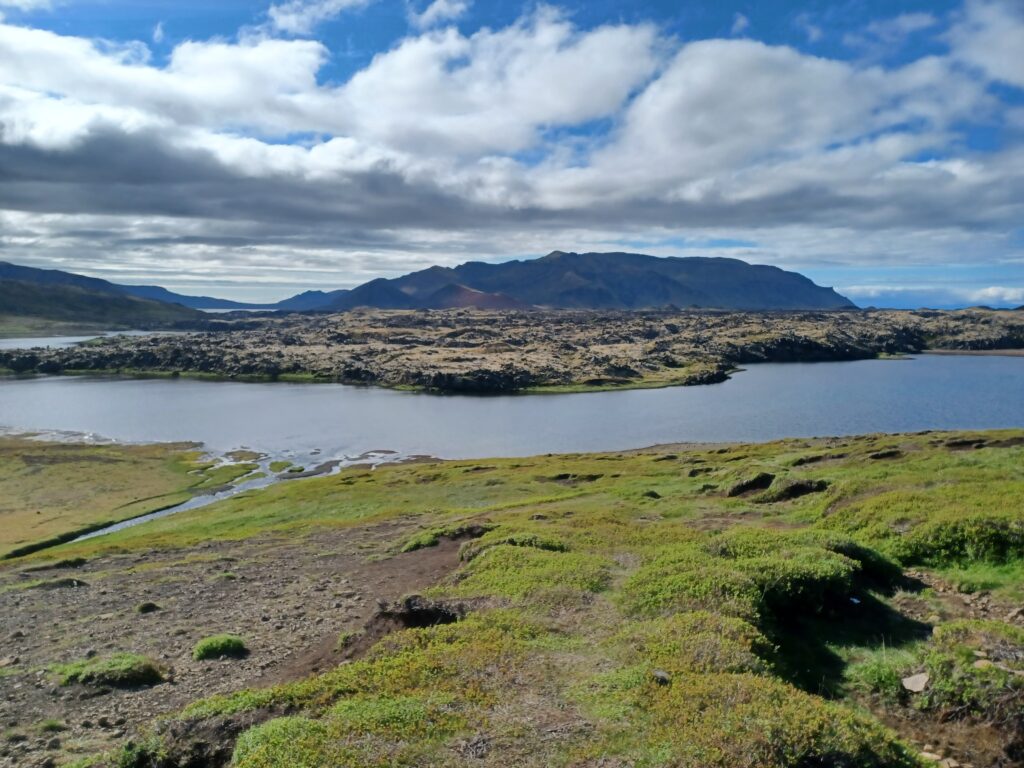
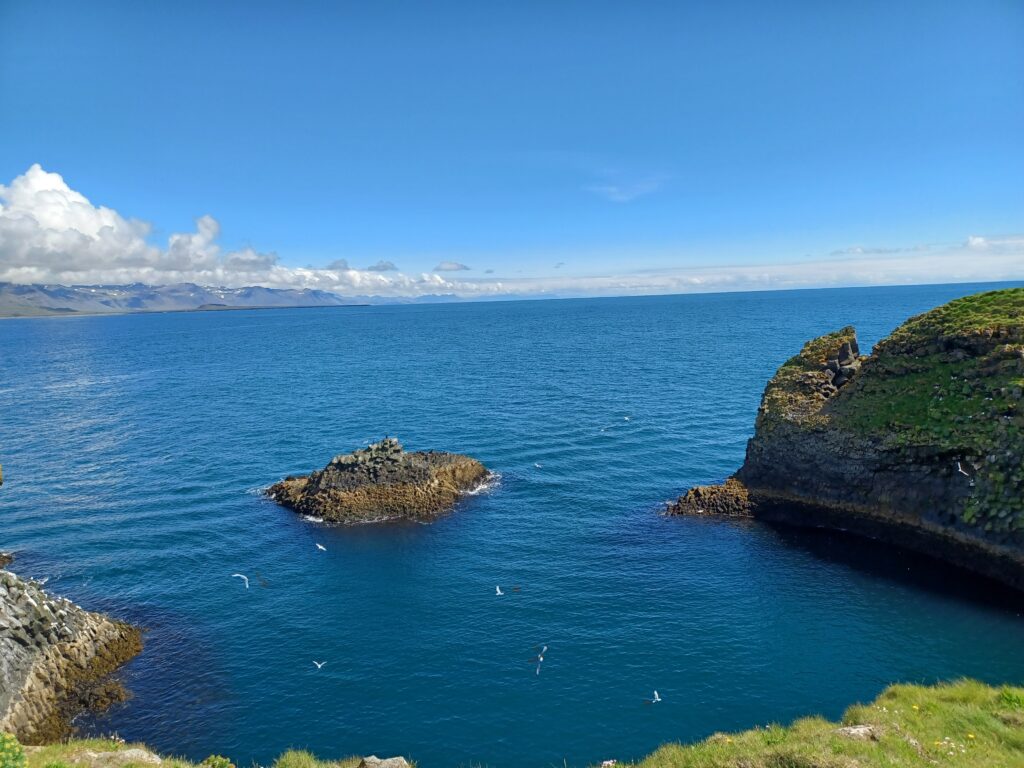
Well, this region is famous for tons of breathtaking attractions in a small area, from rugged cliffs, wildlife, lava fields, majestic Mount Kirkjufell, beaches, waterfalls, and more! That’s why it’s known as Iceland in Miniature.

Besides, Snæfellsnes Peninsula inspired Jules Verne’s book “Journey to the Centre of the Earth” during his travels around Iceland.

After seeing a few of Iceland’s most popular (and stunning) tourist attractions, I was eager to visit some less crowded spots. So to find out if Iceland’s Snæfellsnes Peninsula is worth it, I booked a Day Trip from Reykjavik with Bus Travel Iceland to this region in June 2024.

Here’s a map of Snæfellsnes Peninsula so you can follow along:

Disclosure: I only recommend products that I’ve used in the past, and all opinions expressed in this post are my own. This post contains affiliate links. If you use one of the links throughout the page to buy something, I may earn a small commission at no extra cost to you. Thank you!

Ytri Tunga Beach

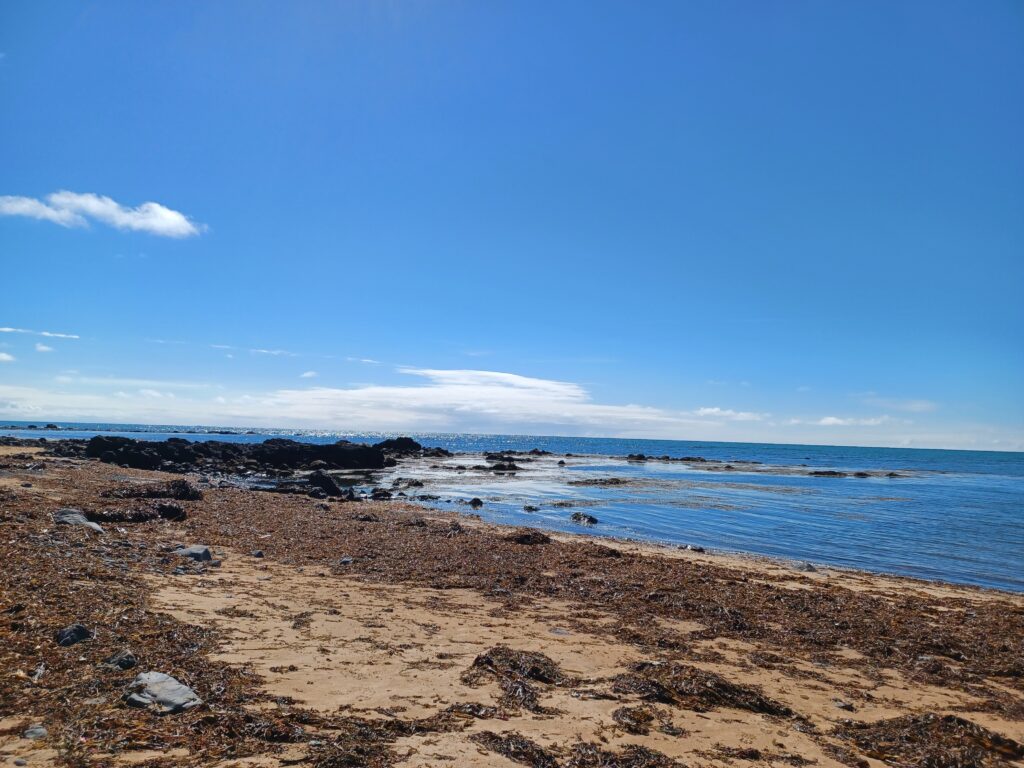
Ytri Tunga Beach, the first stop on our trip, already turned out to be amazing! After a quick walk from the parking lot and climbing on rocks that led to the beach, we were rewarded with stunning scenery and seals sunbathing on the rocks in the water!

Ytri Tunga Beach is one of the most reliable places in Iceland for seal-watching all year, but the best time to see them is during low tide in June and July.

Mostly harbour seals show up here, while grey seals are seen less often. Visitors are strongly encouraged to look at them from a respectful distance and it’s forbidden to feed the seals.

Ytri Tunga Beach is one of the few golden sand beaches in Iceland, as black sand beaches are way more common. It’s open 24 hours a day and there are no admission or parking fees.

Búðakirkja

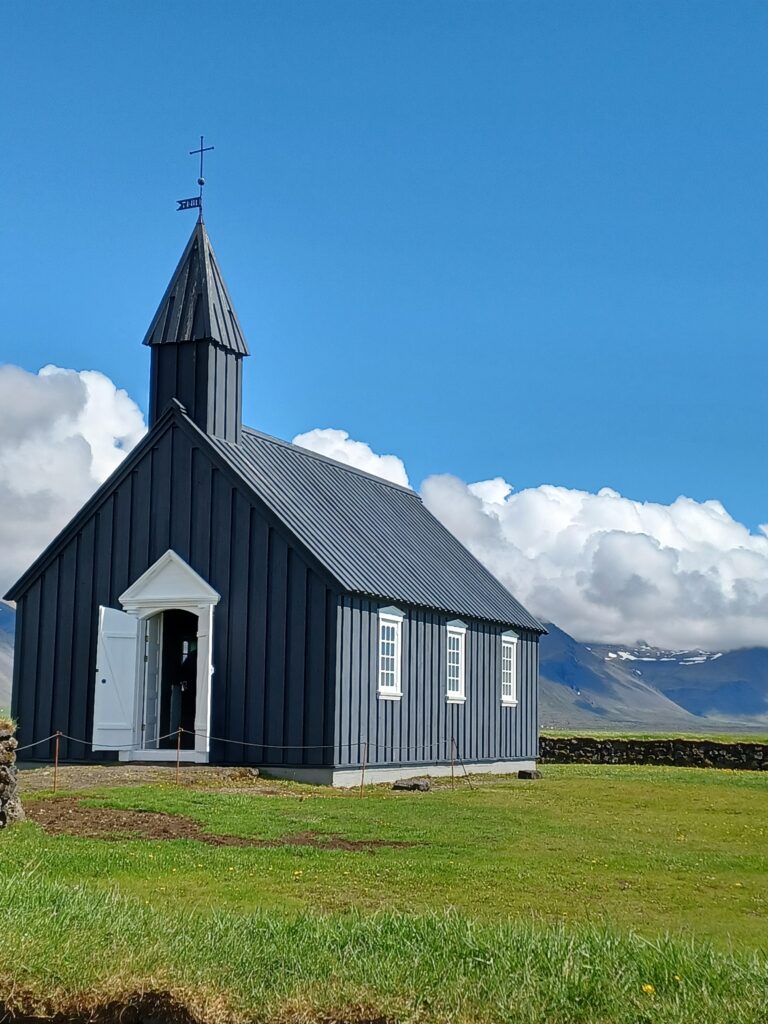
Next, we stop at Búðakirkja, a small wooden church by the tiny village of Búðir. Thanks to its black exterior and location inside a lava field, with nothing else around it, it’s one of Iceland’s most photographed buildings.

The original Búðakirkja dated back to 1703 and was built out of turf. After a while, it fell into despair, and was demolished in 1816. But in 1847, Steinunn Sveinsdóttir, a wealthy widow from Búðir, fought for Búðakirkja to be rebuilt.

The current church was completed in 1848 and has stood here ever since.

Búðakirkja was painted black because the exterior wood is coated in pitch. This was a common solution in the past to protect the wood from the harsh weather in Iceland.

Today Búðakirkja is a popular wedding and concert location, but it’s usually not open to the public. It has an organ and seats up to fifty people. There are two church bells in the tower and a cemetery is right next to the church as well.

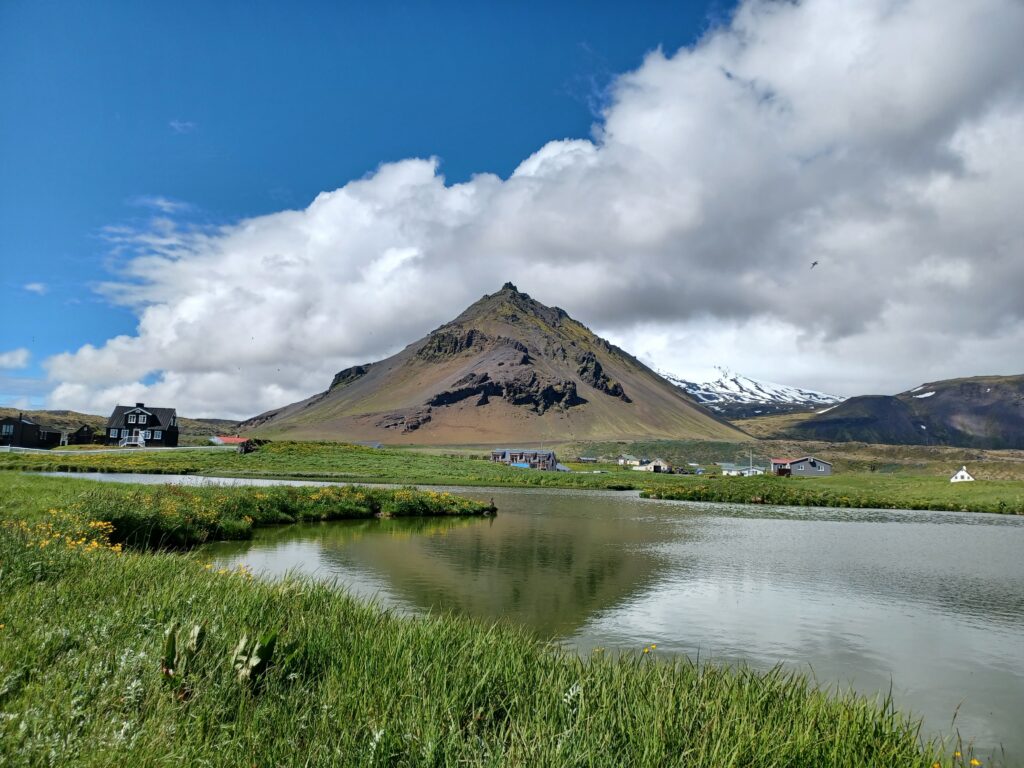
Arnarstapi Cliffs

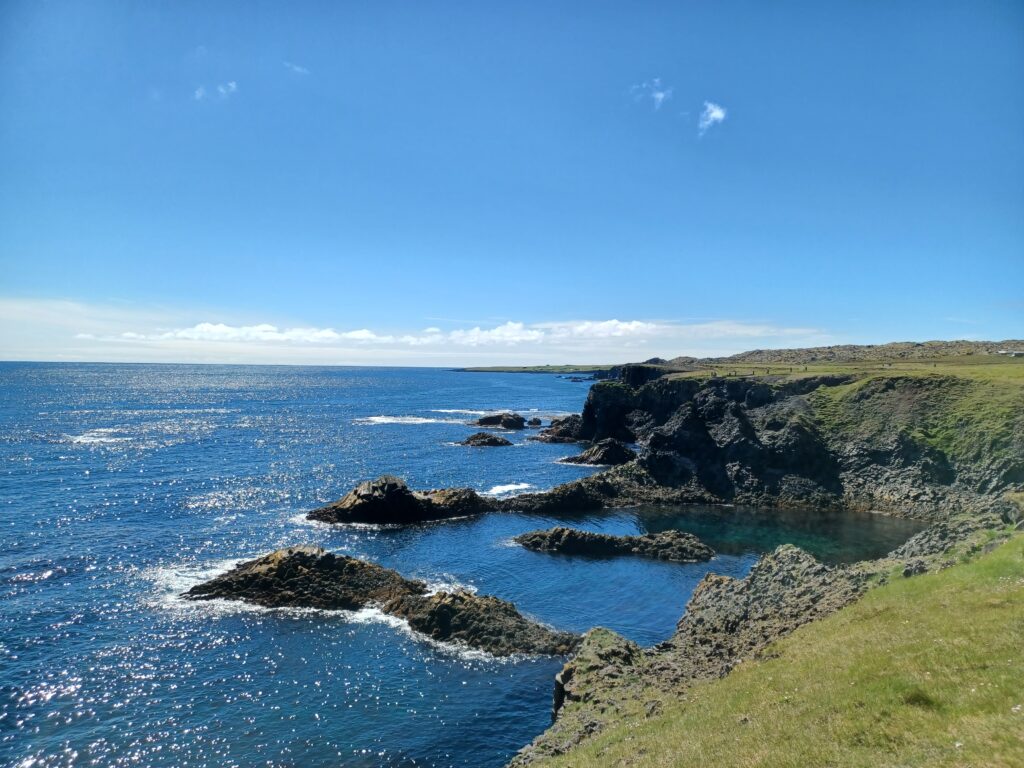
The peaceful Arnarstapi Cliffs pathway along the Atlantic Ocean are what makes the village of Arnarstapi very special! While walking around the trail, be sure to stop for a couple minutes and take in the picturesque views from pretty much every angle.

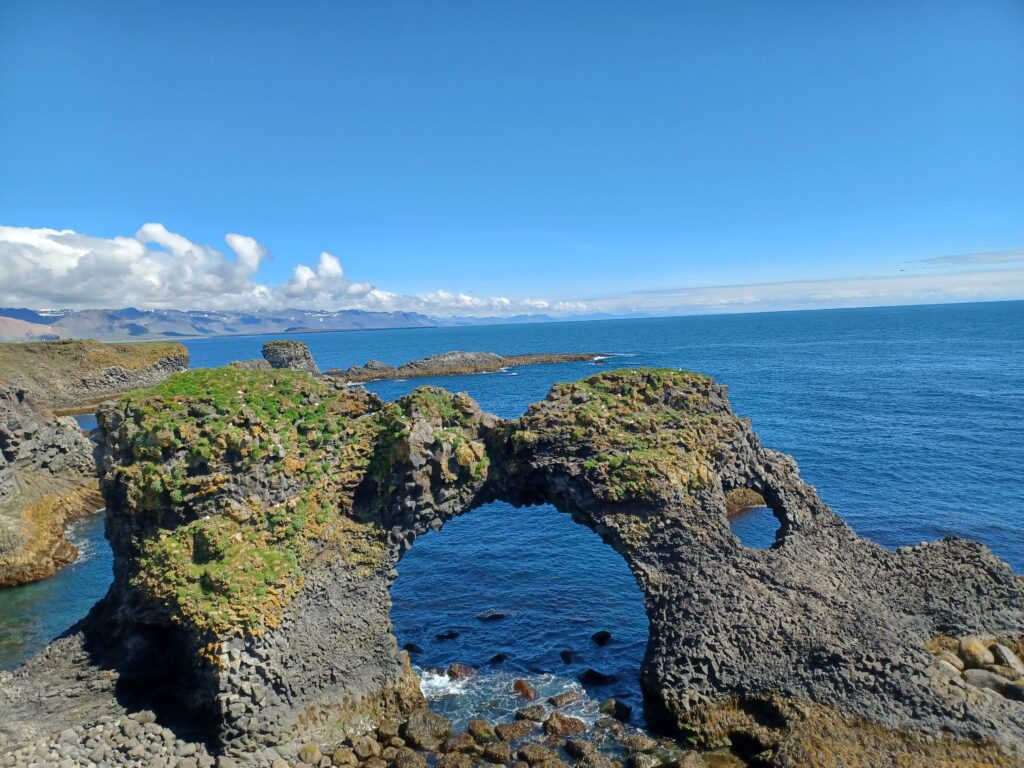
For example, the most unique attraction is Gatklettur, a rock formation that looks like an arch, so it’s a popular photo spot! Besides, many seabirds, like arctic terns, kittiwakes, and gulls, like to nest at Arnarstapi Cliffs. So it’s a great spot for bird watching and there are basalt columns as well.

You can’t miss the impressive Mount Stapafell volcano and there’s a stone bridge, too. Besides, Arnarstapi Cliffs has a marina and is one of Iceland’s most beautiful natural harbours.

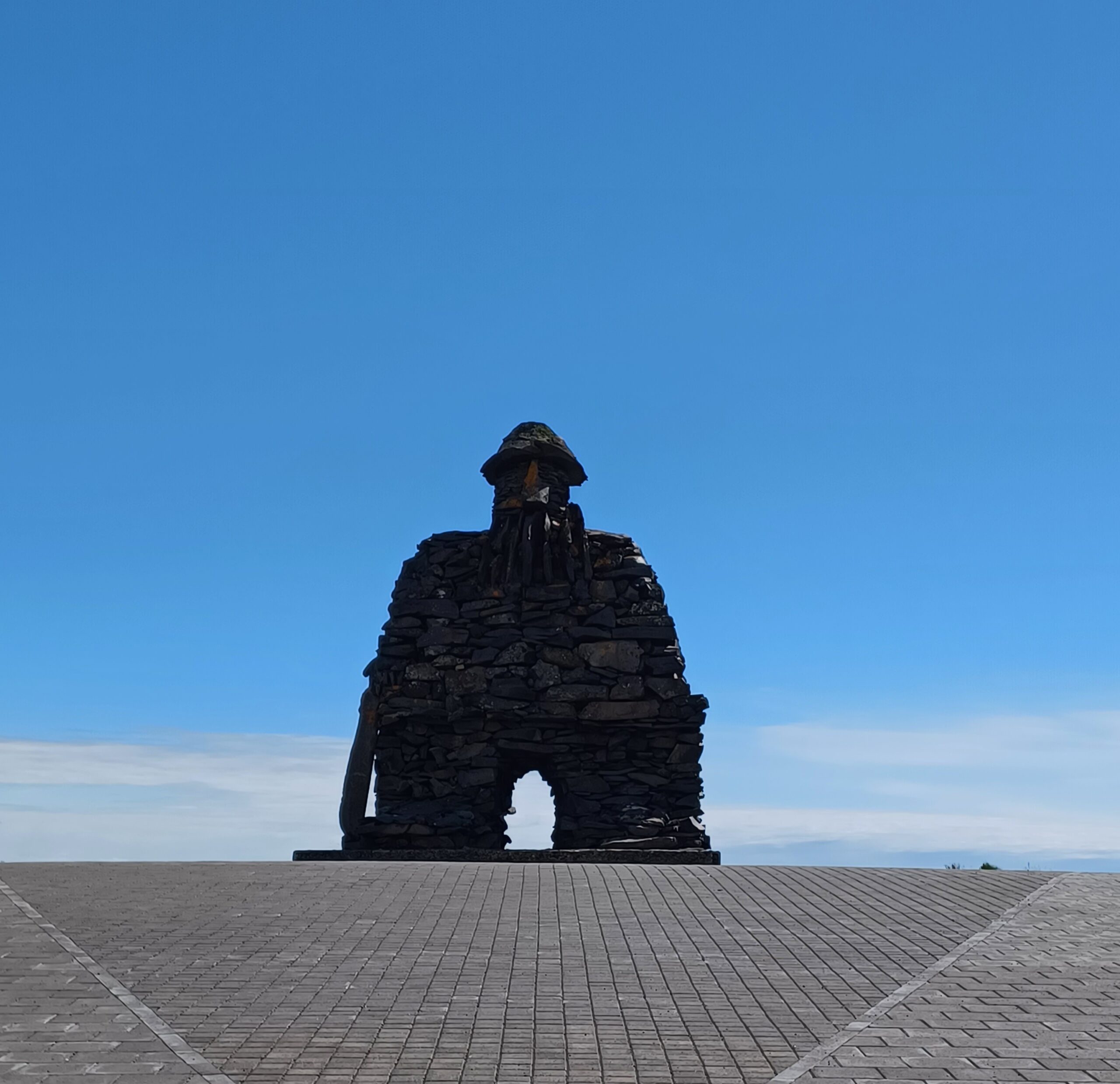
Finally, we checked out the Bárður Snæfellsás statue, which was created by Icelandic sculptor Ragnar Kjartansson in 1978. This impressive stone sculpture is 6 meters (19 ft) tall. It depicts the saga of Bárður Snæfellsás, a mythical guardian who was half-human, half-giant, and lived on Snæfellsnes Peninsula.

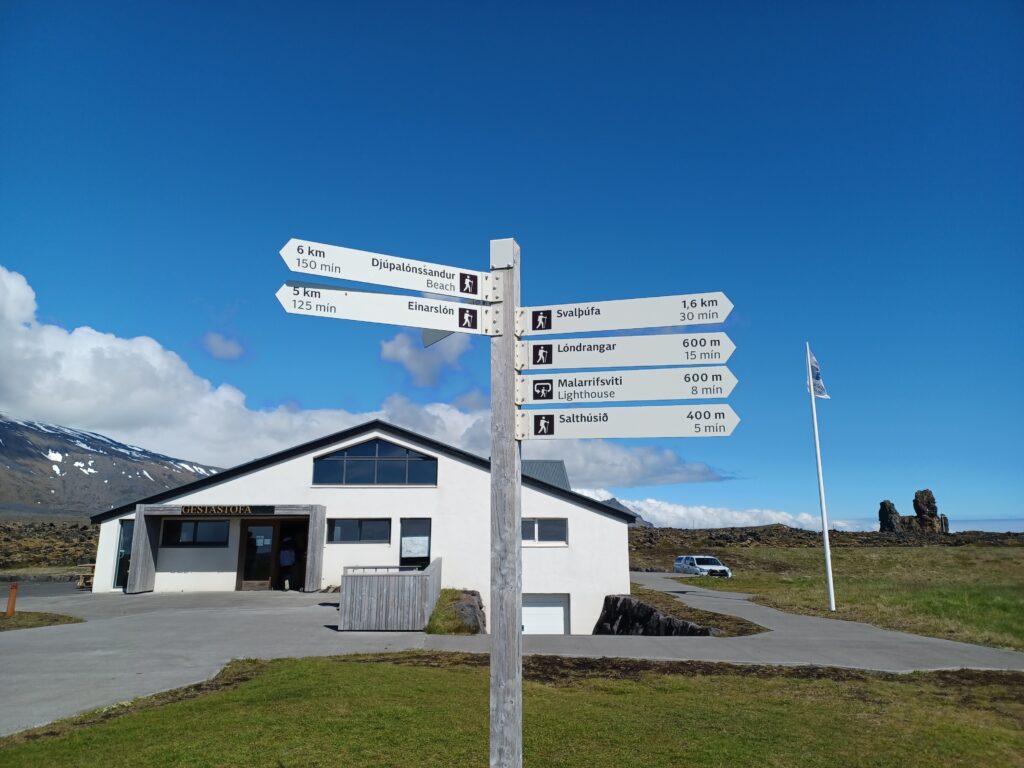
Snæfellsnesjökull National Park Visitor Centre & Malarrifsviti Lighthouse

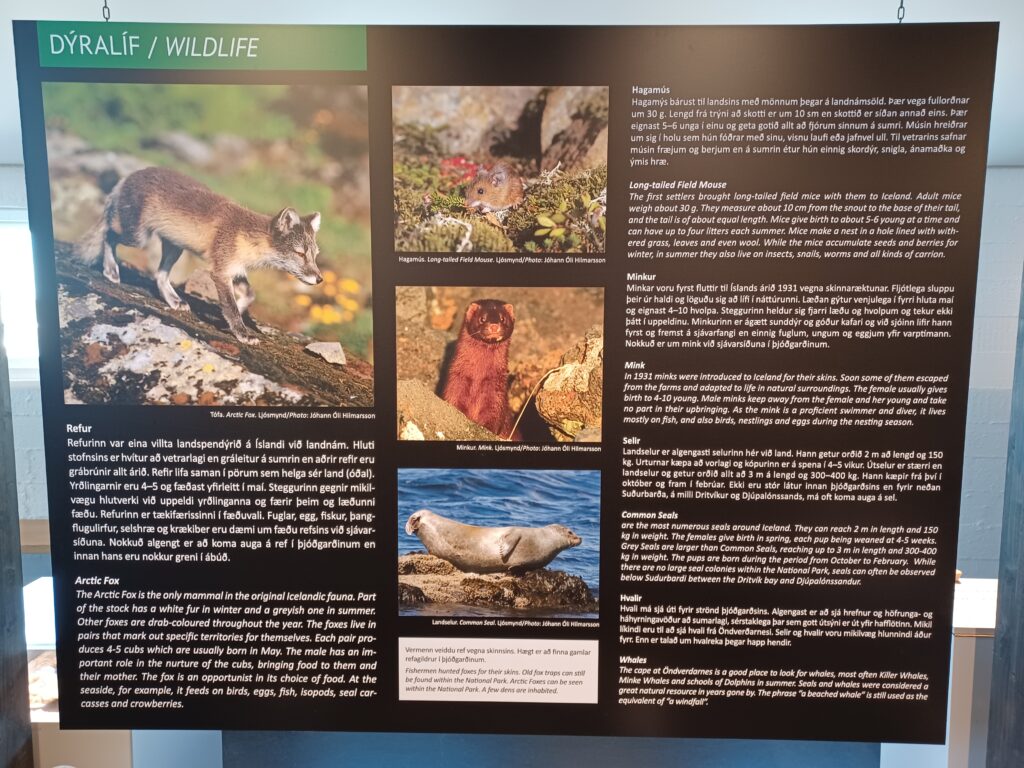
After entering Snæfellsnesjökull National Park, we stopped at the Visitor Centre. Here you can learn about animals and plants that live in this region, such as arctic foxes, minks, seals, whales, and seabirds (e.g. guillemots, cormorants, and razorbills).

There’s also bathrooms, water fountains, a gift shop, indoor play area for kids, and a playground and picnic tables outside. The Visitor Centre is open daily from 11 am to 4 pm.

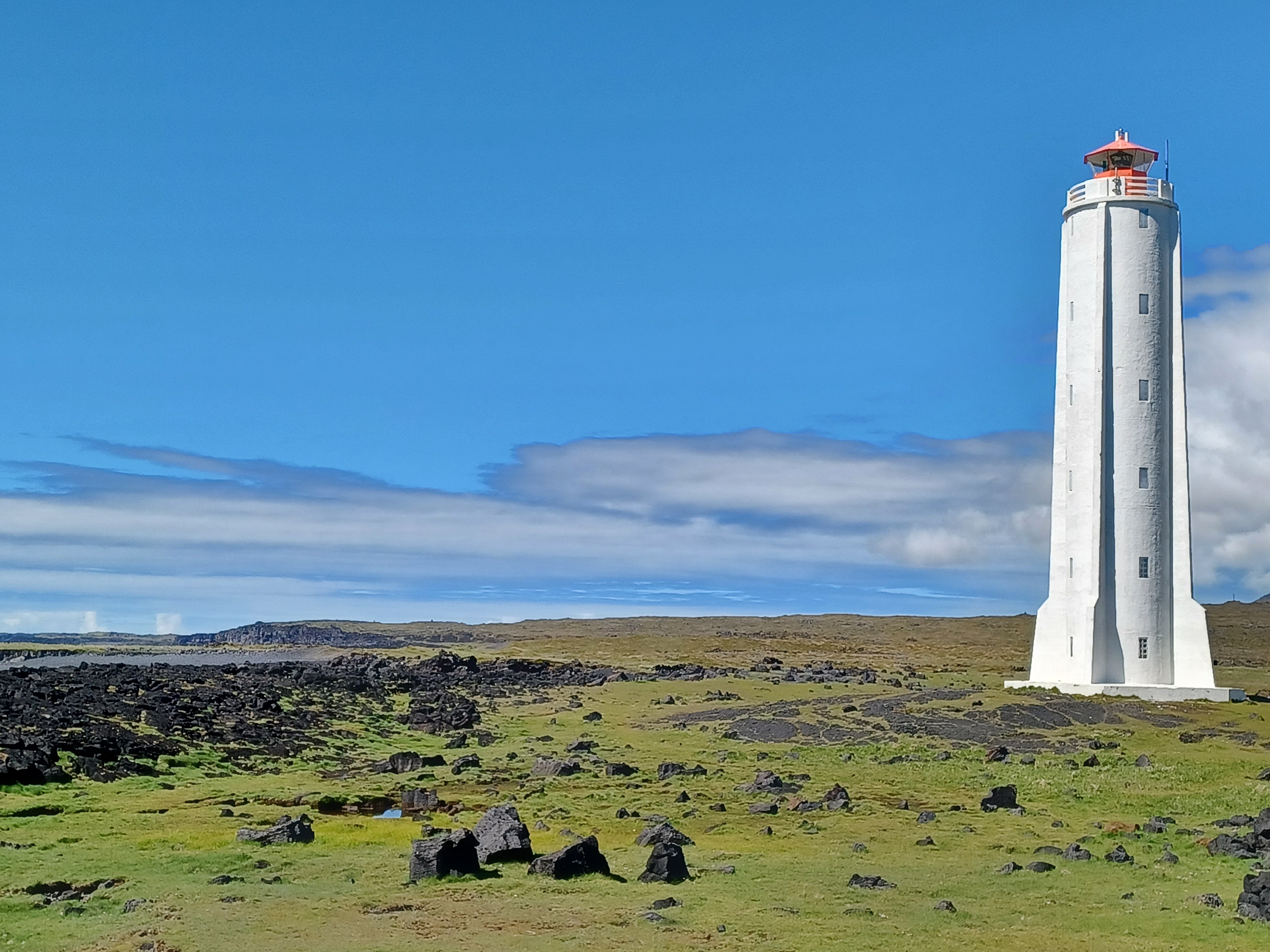
Just a few steps from the visitor centre is the beautiful Malarrifsviti Lighthouse. First built in 1917 (and rebuilt in 1947), it played an important role in guiding local fishermen around the shores.

The lighthouse is 20 meters (65 ft) high and its light reaches up to 28 km (18 miles) into the sea. Similar to Búðakirkja, Malarrifsviti Lighthouse is surrounded by lava fields and lush green landscapes, which makes it a great photo scene!

Lóndrangar Basalt Cliffs

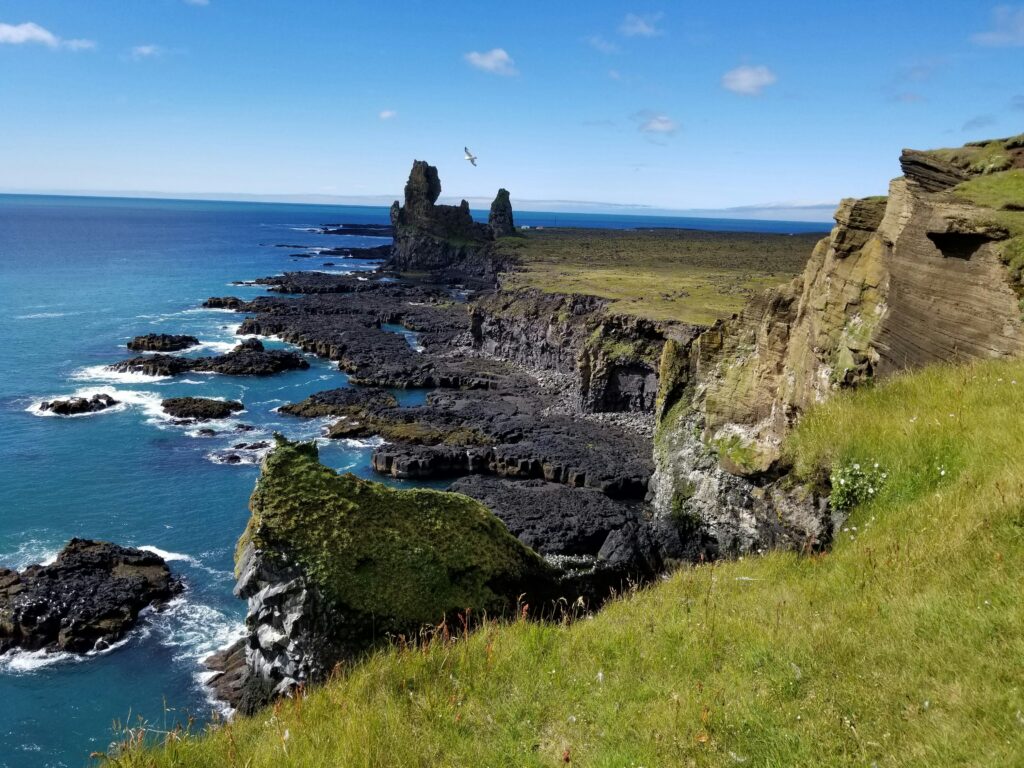
Just a few minutes down the road are the truly stunning Lóndrangar Basalt Cliffs. These two rugged rock columns sit upon a cliff and are 75 meters (246 ft) and 61 meters (200 ft) tall. They used to be a volcanic crater and are the result of erosion and ocean waves hitting the crater for thousands of years.

Many people come here to learn about the area’s geology.

Since the columns create a great contrast to the rather rugged landscape, many visitors also stop here for an Instaworthy shot of the cliffs and the breathtaking scenery around them. It’s best at sunrise or sunset, when the golden light hits the stacks! Lóndrangar’s nickname is “the rocky castle”.

Lóndrangar Basalt Cliffs. Photo by Tanner Crockett on Unsplash.

According to Icelandic folklore, the two columns used to be trolls who wanted to pull a ship to the shore. But then they were hit by sunlight and transformed into stone.

Djúpalónssandur Beach

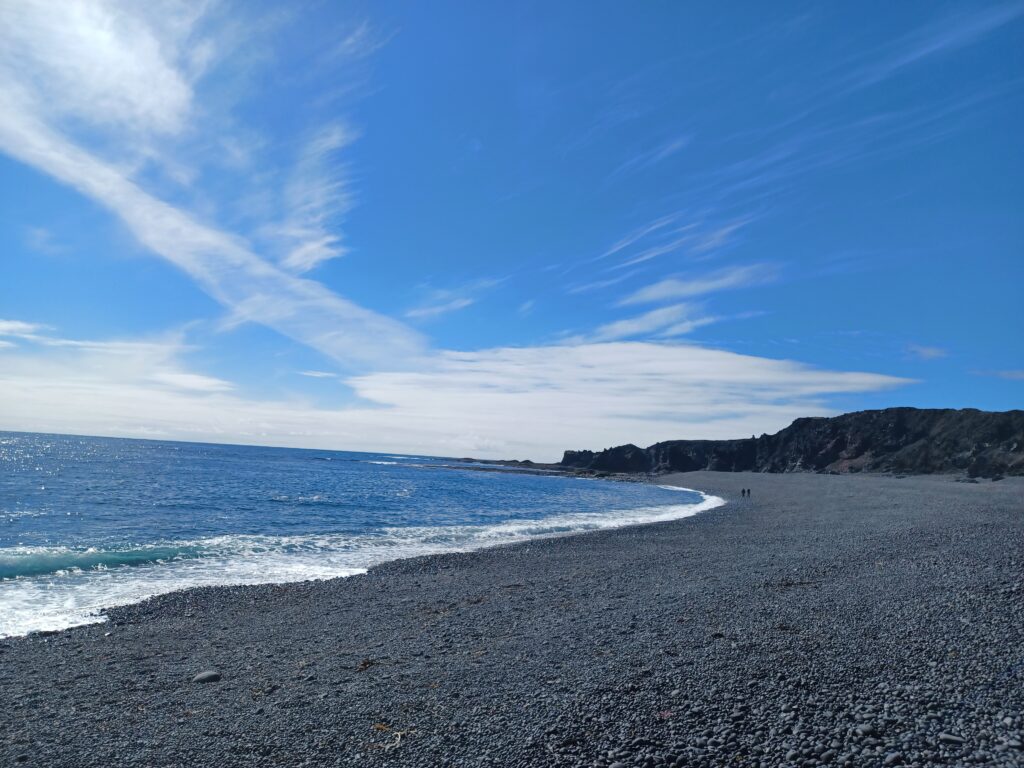
Then we spent some time at Djúpalónssandur Beach. It’s a beautiful black pebble beach that shouldn’t be missed when visiting Snæfellsnes Peninsula.

Djúpalónssandur Beach originated due to volcanic activity and is surrounded by rugged cliffs and lush green landscapes. So it’s quite similar to Reynisfjara Beach along Iceland’s South Coast. It’s not as crowded though, because not as many tourists come to this area.

Djúpalónssandur Beach is also known for the four lifting stones on the right side of the beach.

When someone applied as a sailor in the fishing industry back in the day, he first had to prove his strength by lifting these stones. They range from 23 to 53 kg (50 to 116 lbs)! Visitors are welcome to test their strength by lifting them as well.

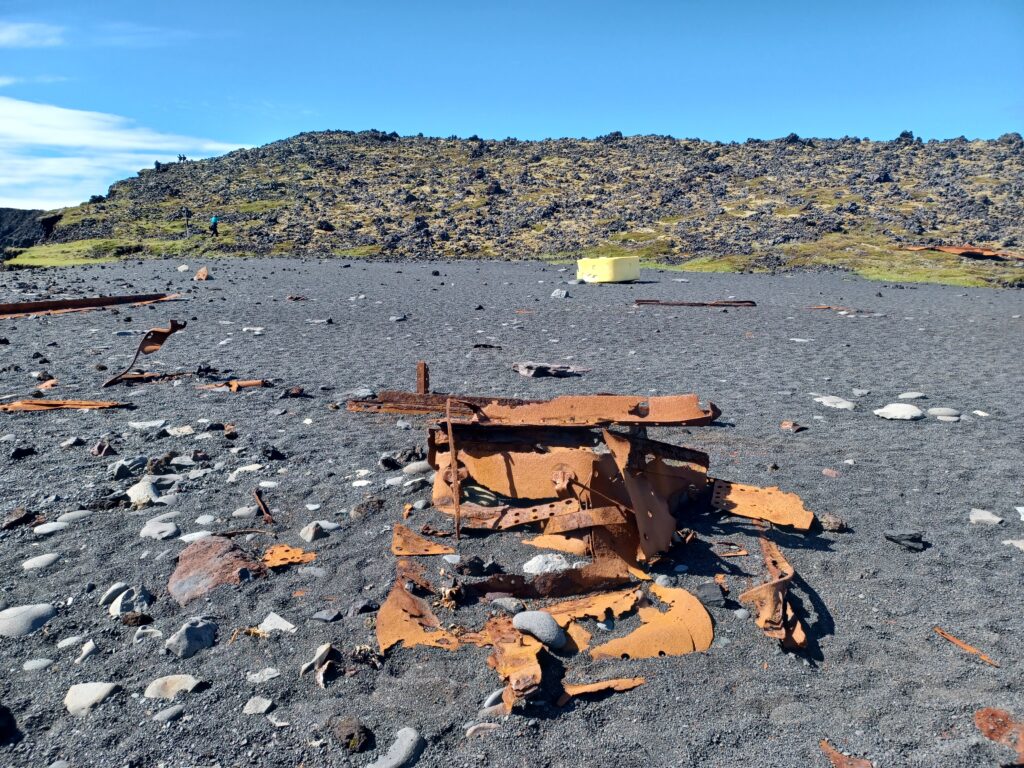
While walking on Djúpalónssandur Beach, you may be wondering about the rusty iron chunks scattered all over the place. Well, these are the remains of the Epine GY7, a British trawler that shipwrecked on March 13, 1948. 14 of the 19 crew members on board died in this accident.

Visitors are strongly advised not to touch the shipwreck remains.

Mount Kirkjufell and Kirkjufellsfoss Waterfall

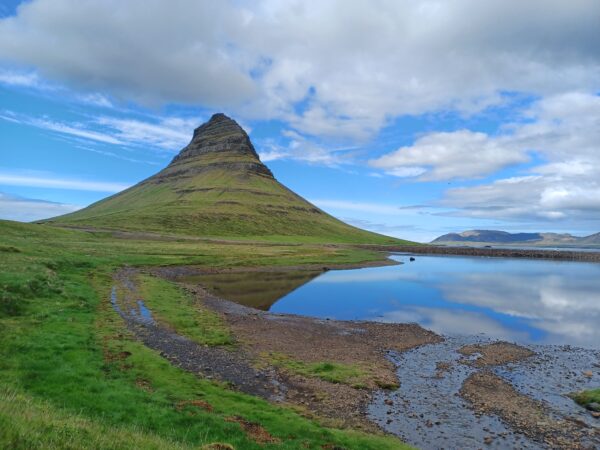
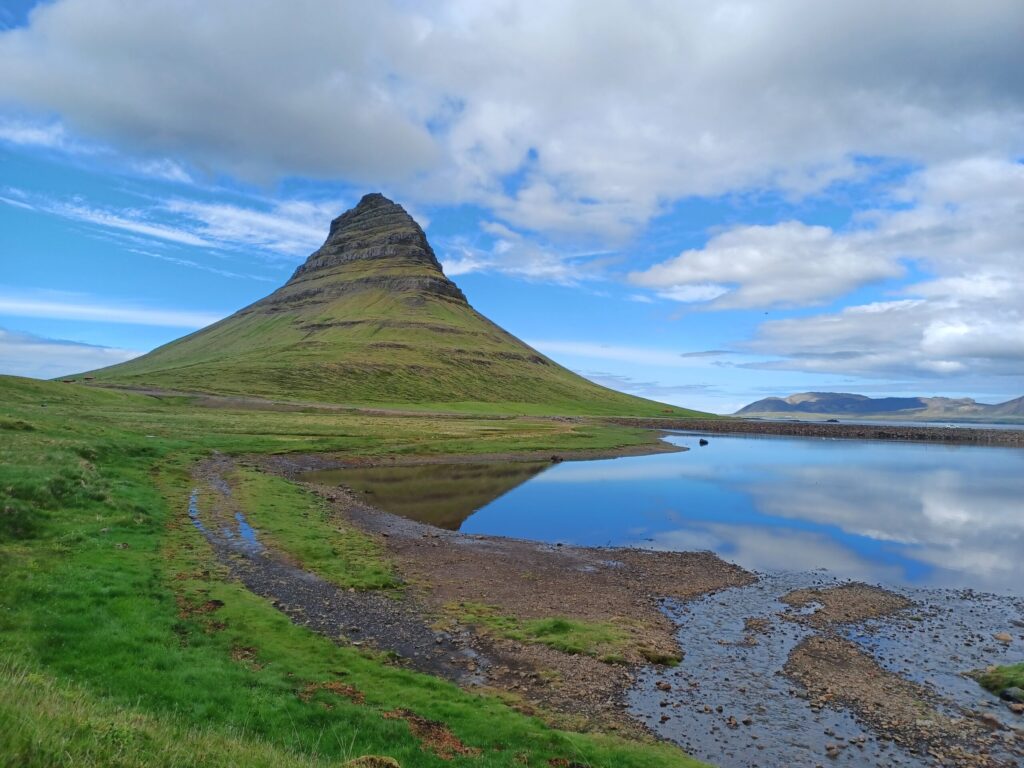
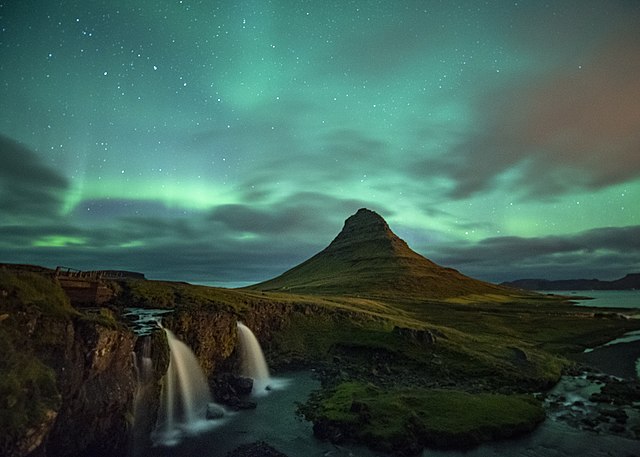
Mount Kirkjufell is another of Iceland’s most famous sites, especially thanks to its presence in the Game of Thrones series. While it’s only 463 meters (1,519 ft) high, Kirkjufell is unique thanks to its church steeple shape. That’s why it translates to Church mountain.

For an even more breathtaking scenery, try to include beautiful Kirkjufellsfoss Waterfall while taking photos of Kirkjufell! No matter what time of the year you’re visiting, these two Icelandic hotspots are guaranteed to knock your socks off!

Left: Mount Kirkjufell on its own in the summer. Right: Mount Kirkjufell with Kirkjufellsfoss Waterfall in the foreground during aurora borealis. This photo is courtesy of vaidyanathan on Wikimedia Commons.

Climbing up Mount Kirkjufell is possible during the summer months, but it’s very steep and dangerous, so only experienced hikers with a guide should do this. It takes about three hours roundtrip to complete.

It’s not allowed to hike up Mount Kirkjufell from November 1 to June 15 because of the perilous conditions. Visiting Mount Kirkjufell and Kirkjufellsfoss Waterfall is free, but there may be a small parking fee in some areas during the busy tourist season (June to August).

Selvallafoss Waterfall

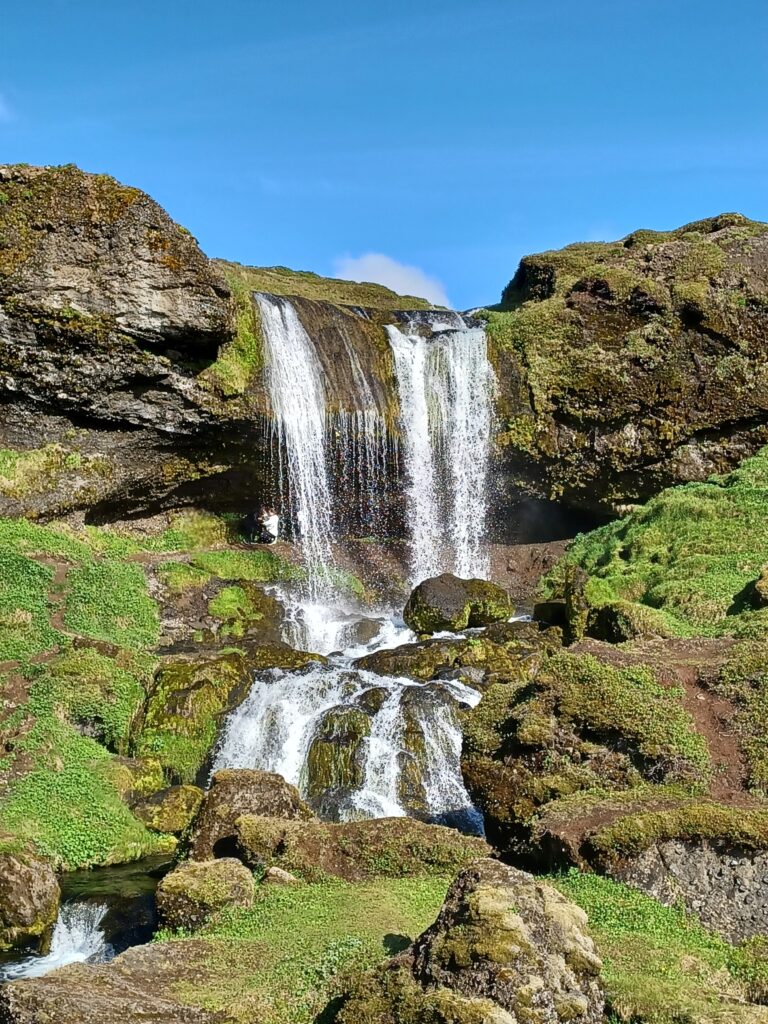
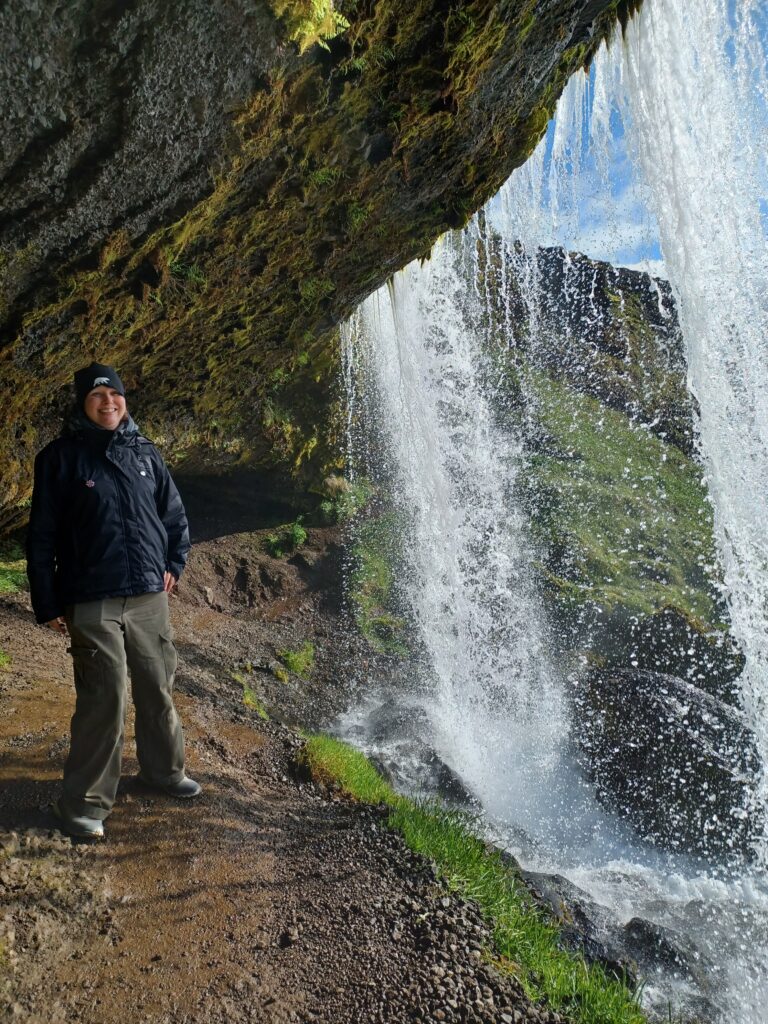
Our final stop of the day was Selvallafoss Waterfall. While not as famous as Skogafoss or Gullfoss Waterfall, its three cascades and the fact that you can walk behind it make it stand out! Just be careful, as the trails around it are narrow and can be slippery.

The longest of the cascades is 35 meters (11 ft) tall. Selvallafoss is also known as the sheep’s waterfall, because lots of sheep like to graze in the nearby lush green spaces and drink the fresh water.

Although Selvallafoss is not visible from the road, it’s just a short hike to get there. The views of the surrounding region make visiting this waterfall even more worth it! You can also walk to the top of the waterfall to appreciate the scenery even more.

Wrap Up: Is a Day Trip along Iceland’s Snæfellsnes Peninsula Worth it?

Yes, a Day Trip along Iceland’s Snæfellsnes Peninsula is Worth it! No matter what time of the year you visit, there’s a great variety of attractions to see in a compact area. Some of them, like a golden sand beach and harbour and grey seals, can be hard to find elsewhere in Iceland.

The day tour with Bus Travel Iceland from Reykjavik was really good! Our guide was friendly and knowledgeable, and went above and beyond to make sure everyone had a great time. We also stopped for a breaks in Ólafsvík and Borgarnes along the way.

If you’re self driving, Snæfellsnes Peninsula has a few more attractions that the bus didn’t stop at. It’s also possible to stay here for two days or longer, as there are accommodation options along the way.

If you visit Snæfellsnes Peninsula, you can see some of the best of Iceland’s highlights in just one day! So whether you’re into stunning nature, photography, beaches, or geology and history, I highly recommend adding Snæfellsnes Peninsula to your Iceland itinerary!

9 REASONS TO VISIT LEIPZIG, GERMANY FOR A DAY

Leipzig is the largest city in the east German state of Saxony. After it was founded in the 11th century, Leipzig quickly became an important economic centre. This is thanks to two major medieval trade routes meeting here, the Via Imperii and the Via Regia.

Similar to Berlin, Leipzig played an important role during the German Democratic Republic era from 1949 to 1990. For example, the peaceful Monday Demonstrations, which led to the fall of the Berlin Wall and Germany’s reunification, started here in 1989.

Today Leipzig is known as a hip and youthful city thanks to its many university students. Besides, it offers tons of old and newer architecture, such as unique churches, museums, and the New and Old Townhall.

This charismatic city has been a centre for music for hundreds of years, especially classical music. Some composers who lived and worked in Leipzig include Johann Sebastian Bach, Richard Wagner, and Felix Mendelssohn.

Nowadays, there’s a large Punk music scene in Leipzig, which is most apparent in the Connewitz district.

I had a blast during my visit to Leipzig in May 2024! So in this post, I’m sharing 9 Reasons to Visit Leipzig for a day on your Germany trip.

Disclosure: I only recommend products that I’ve used in the past, and all opinions expressed in this post are my own. This post contains affiliate links. If you use one of the links throughout the page to buy something, I may earn a small commission at no extra cost to you. Thank you!

Nikolaikirche (St. Nicholas Church)

Address: Nikolaikirchhof 3, 04109 Leipzig, Germany

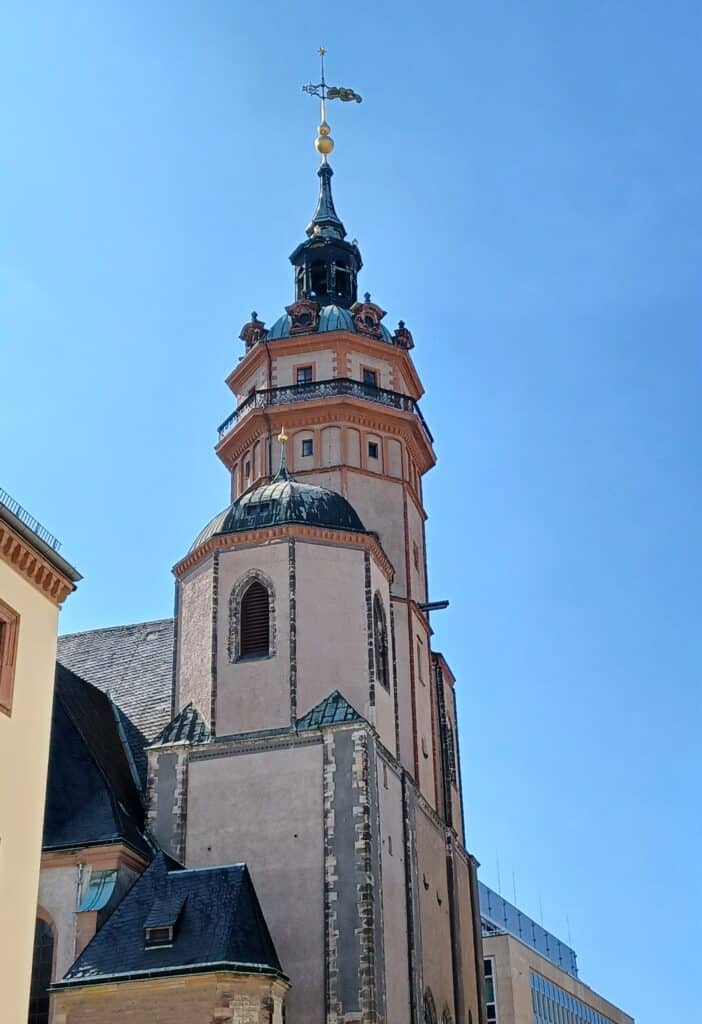
One of Leipzig’s famous historical landmarks is Nikolaikirche in the city centre. It was completed in 1165, soon after Leipzig was founded, and is the oldest church in the city.

At 63 meters (207 ft) high, it’s also Leipzig’s tallest church and more than 1,400 people can sit in here.

This Protestant church was first built in a Romanesque style, but was turned into a Gothic hall church in the 16th century. Baroque elements, like the tower, were added in the 18th century.

Johann Sebastian Bach was responsible for composing its church music during his time in Leipzig.

Prayers for Peace started at Nikolaikirche every Monday in 1982. So it’s no surprise that the church was the starting point of the Peaceful Revolution against the GDR Communist rule in 1989. Protesters met here every Monday at 5 pm, which, contributed to the fall of the Berlin Wall in the same year.

Today there’s still a Prayer for Peace at Nikolaikirche on Mondays at 5 pm.

One of the Peaceful Revolution protests in 1989 near Nikolaikirche in Leipzig. Photo credit: Friedrich Gahlbeck on Wikimedia Commons.

Check out the Bild zur Deutschen Einheit (Mural of a United Germany)

Address: Willy-Brandt-Platz 7, 04109 Leipzig, Germany

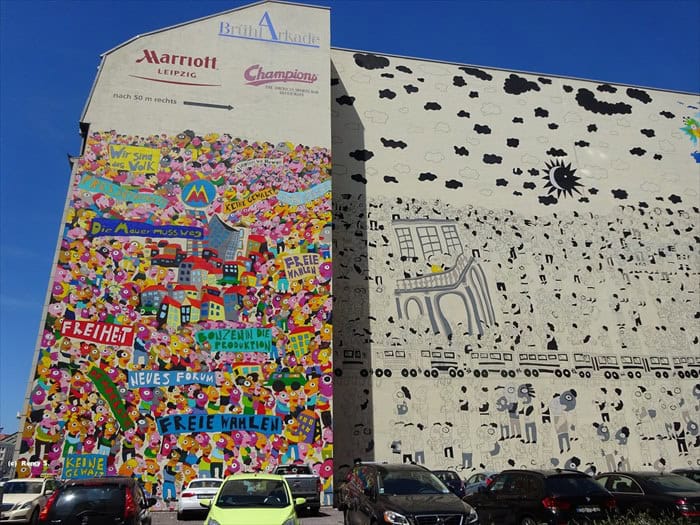
Only a few steps further, you can’t miss the colourful and expressive Bild zur Deutschen Einheit. Until recently, this acrylic painting was a part of the wall of the Marriott Hotel. It was painted by local artist Michael Fischer-Art in September 2009, almost 20 years after the fall of the Berlin Wall.

Michael Fischer-Art painted this large mural to deal with his experiences as a participant of the Monday Demonstrations in 1989 and growing up under the oppressive GDR regime. He also designed his own banners during the protests.

The Bild zur Deutschen Einheit mural on the Wall of the Marriott Hotel. Photo Credit: Waymarking.com.

The Bild zur Deutschen Einheit mural is 100 meters (328 ft) long and 30 meters (98 ft) wide. On the left side it shows the peaceful demonstrations of 1989, in the middle are pictures of the theme “escape to freedom”, and on the right side is the Berlin Wall. 

Michael Fischer-Art painted this unique artwork so the terror of the GDR dictatorship and the Peaceful Revolution of 1989 will never be forgotten.

The Bild zur Deutschen Einheit mural was recently removed from its original spot because of the Marriott Hotel’s reconstruction projects. But fortunately, this important piece of history could be saved. You can currently admire it at the Promenaden in Leipzig’s Hauptbahnhof (central train station) until May 18, 2025.

Check out the “Unzeitgemäße Zeitgenossen” Sculpture (Untimely Contemporaries)

Address: Grimmaische Strasse, 04109 Leipzig, Germany

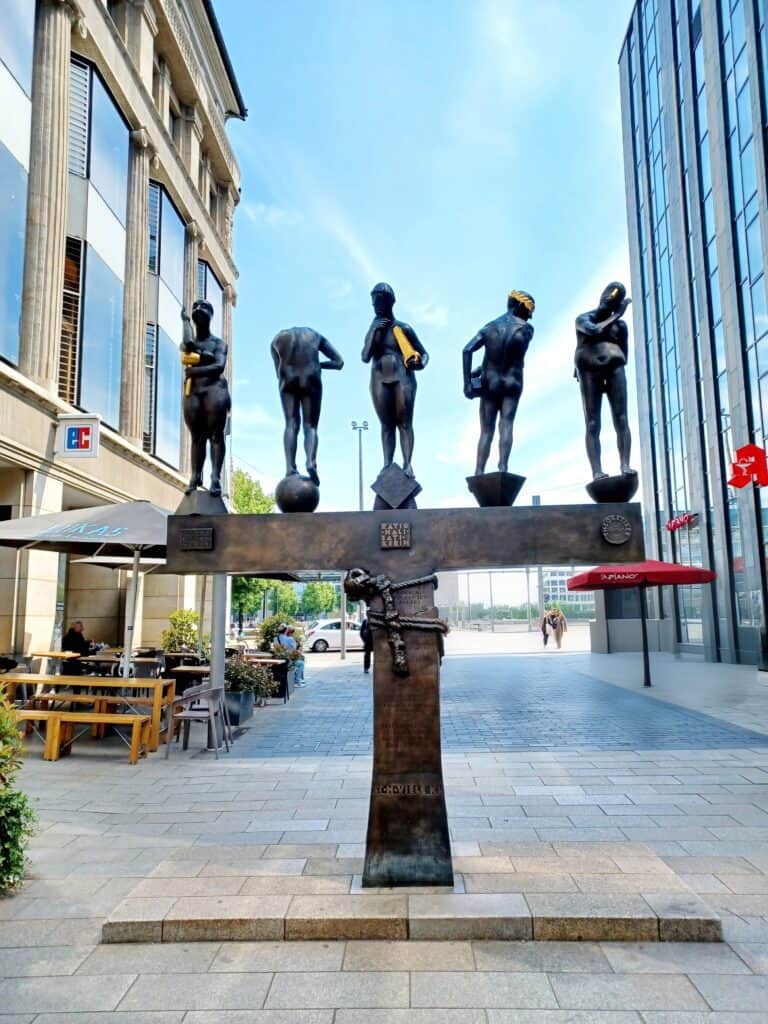
A very unusual, but eye-catching attraction sits right inside a pedestrian walkway in Leipzig’s city centre: The Unzeitgemäße Zeitgenossen sculpture. Back in the late 1970’s, Bernd Göbel, a sculptor of the nearby city of Halle (Saale) was unhappy with certain people who were part of GDR society.

Soon after, he decided to create a sculpture of five people. Two examples of these are a female teacher who uses the sledgehammer method and a city planner who demolishes a spot before starting to build something. It’s supposed to represent the hypocrisy of the GDR regime.

After several years of negotiating with the City of Leipzig, the Unzeitgemäße Zeitgenossen sculpture was finally put up in its current spot in 1990.

It’s a 1.9 meter (6.2 ft) square column, which is connected to a 2.9 meter (9.5 ft) cross-piece. That way, an average height adult cannot walk underneath the sculpture without hitting their head. It’s supposed to be a thought-provoking impulse.

The bronze statues are naked and each one balances on a different kind of shape. This is supposed to be a symbol for them being self involved at first. Besides, if you look closely on the vertical column, you can find 14 mottos, such as by German writers Johann Wolfgang von Goethe and Berthold Brecht.

Wander around Connewitz

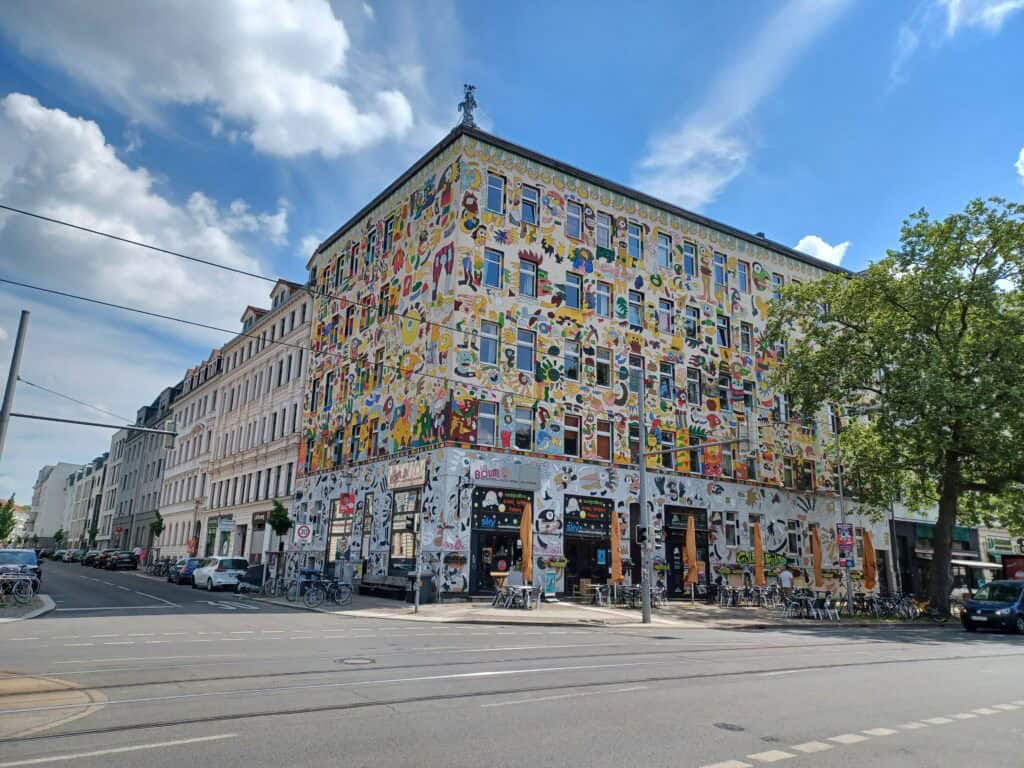
Connewitz is Leipzig’s most alternative neighbourhood. It’s a popular spot for the Punk and squatter scene and left-wing politics. But don’t worry, Connewitz is a lively, colourful district full of art, culture, (vegan) restaurants, concert venues, cafés, bars, and nice people.

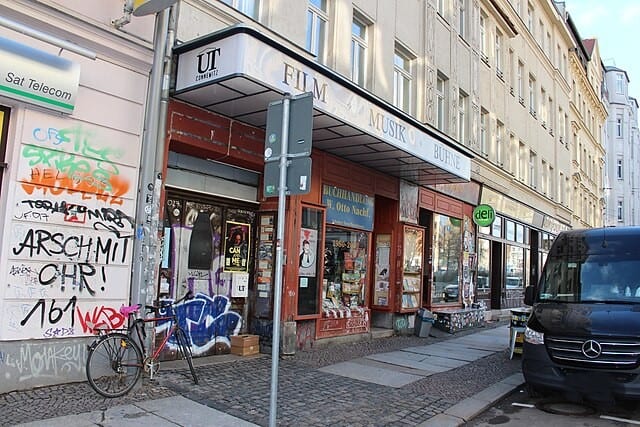
While walking around Connewitz, we stumbled upon a bunch of cool stores. We browsed through record stores, a fair trade store, secondhand stores, and No Borders, a punk/left-wing politics apparel store on Wolfgang-Heinze-Strasse.

UT Connewitz (concert venue) and a bookstore on Wolfgang-Heinze-Strasse in Connewitz.

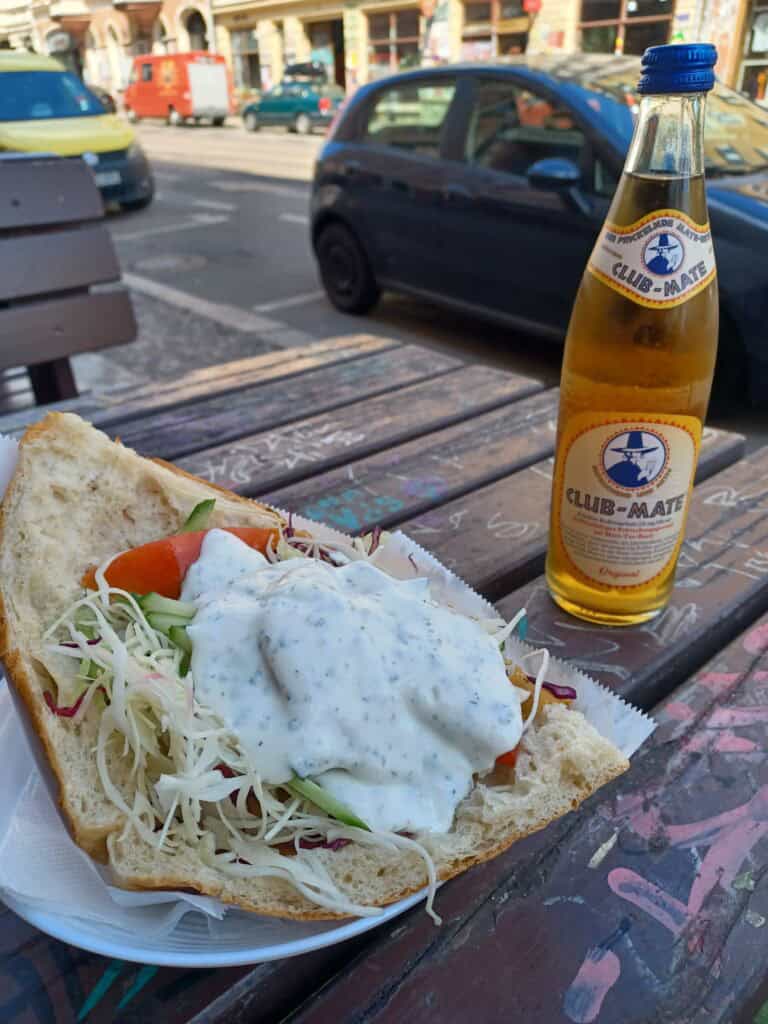
Then we had lunch at Shahia II, a small fast food bistro serving Döner Kebap, schnitzel, nuggets, and pizza dishes. They have lots of veggie options, such as the Vegan Döner with seitan! It was so yummy and sitting outside on their patio on this nice day was just another bonus.

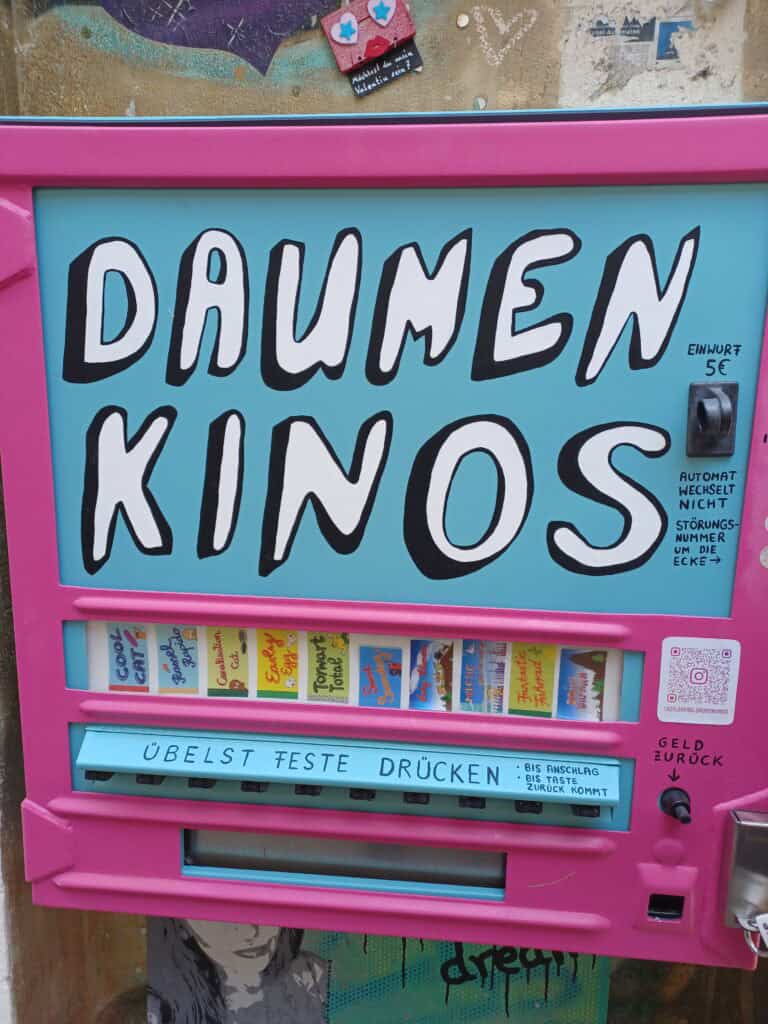
We also saw a random vending machine for Daumenkinos (flipbooks), that we used to play with as kids in the 1990’s! 😀

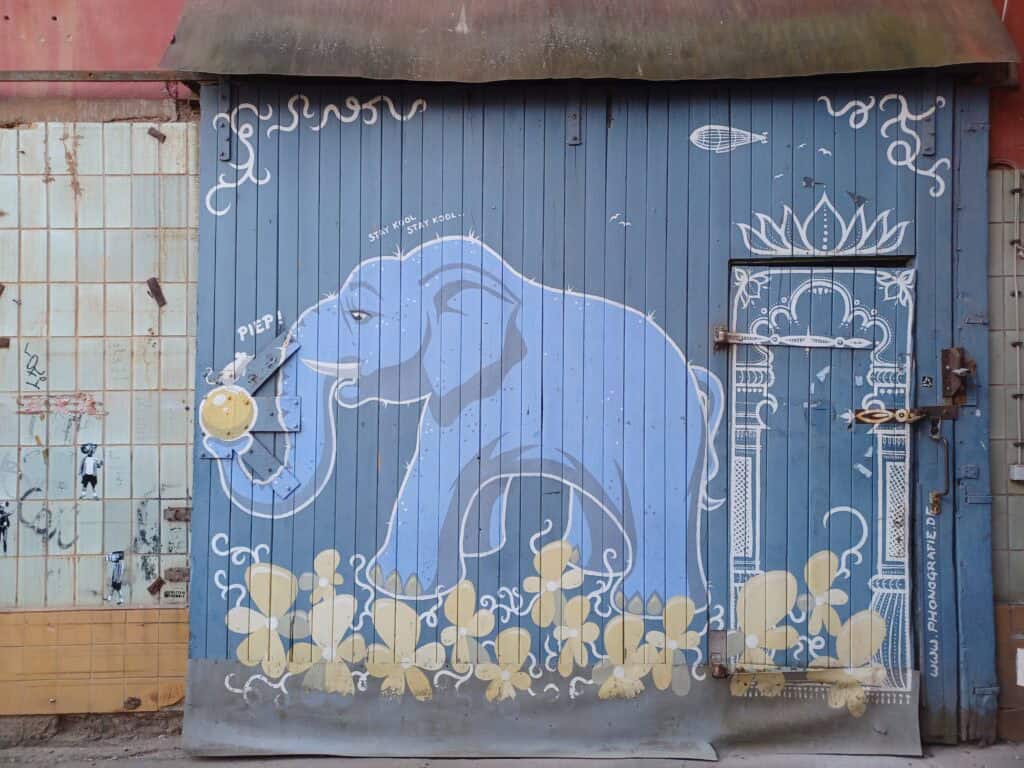
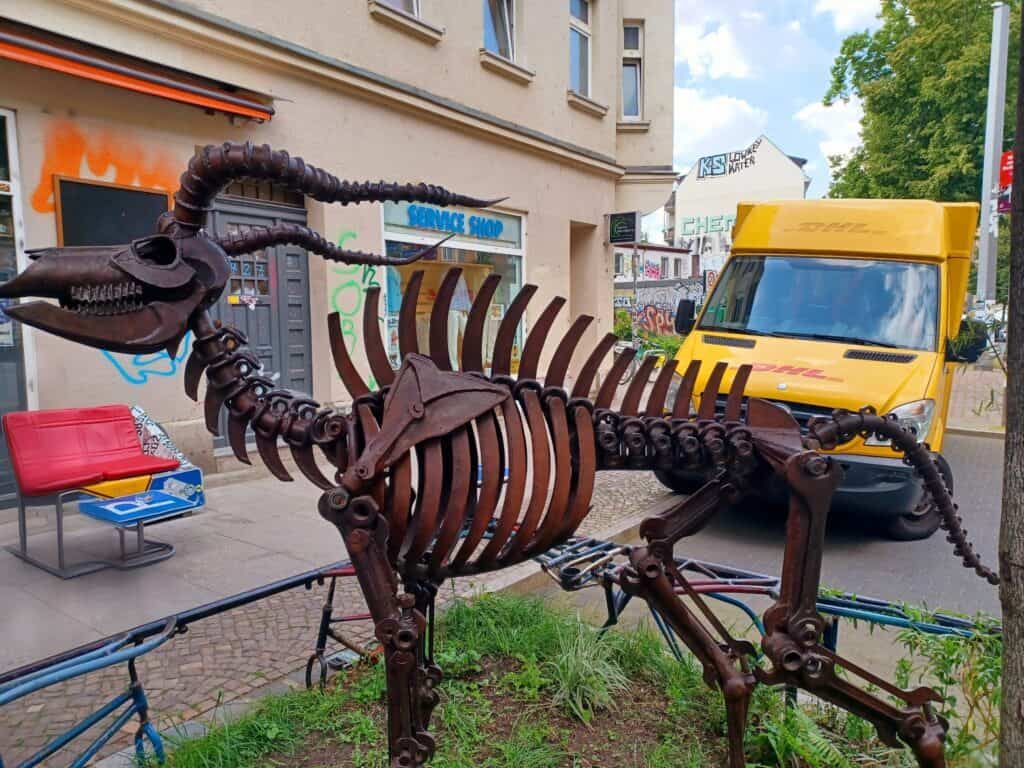
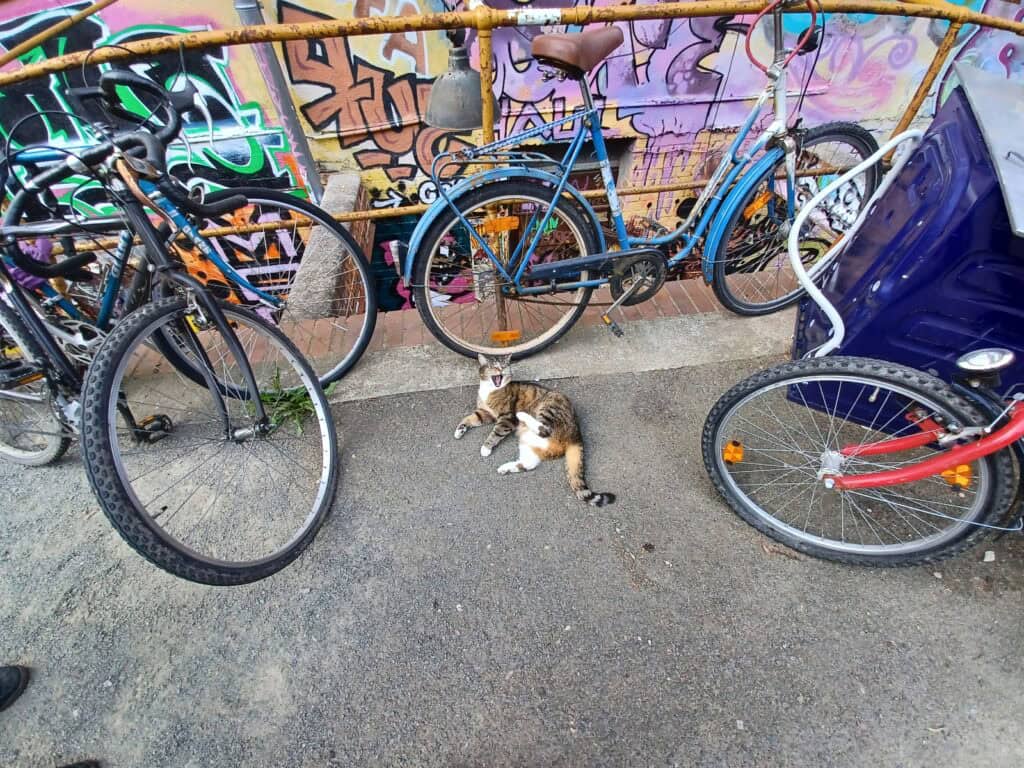
We also spotted colourful graffiti and (street) art pretty much everywhere in Connewitz. I think they match perfectly with the unique charm of this neighbourhood! We also met a friendly cat in the inner courtyard of ZORO (a concert venue)!

If you’re into punk concerts and left-wing events, check out Liwi and Manfreds on Stockartstrasse! Or chill at Herderpark for a bit, which also has a large playground if you’re traveling with kids. 🙂

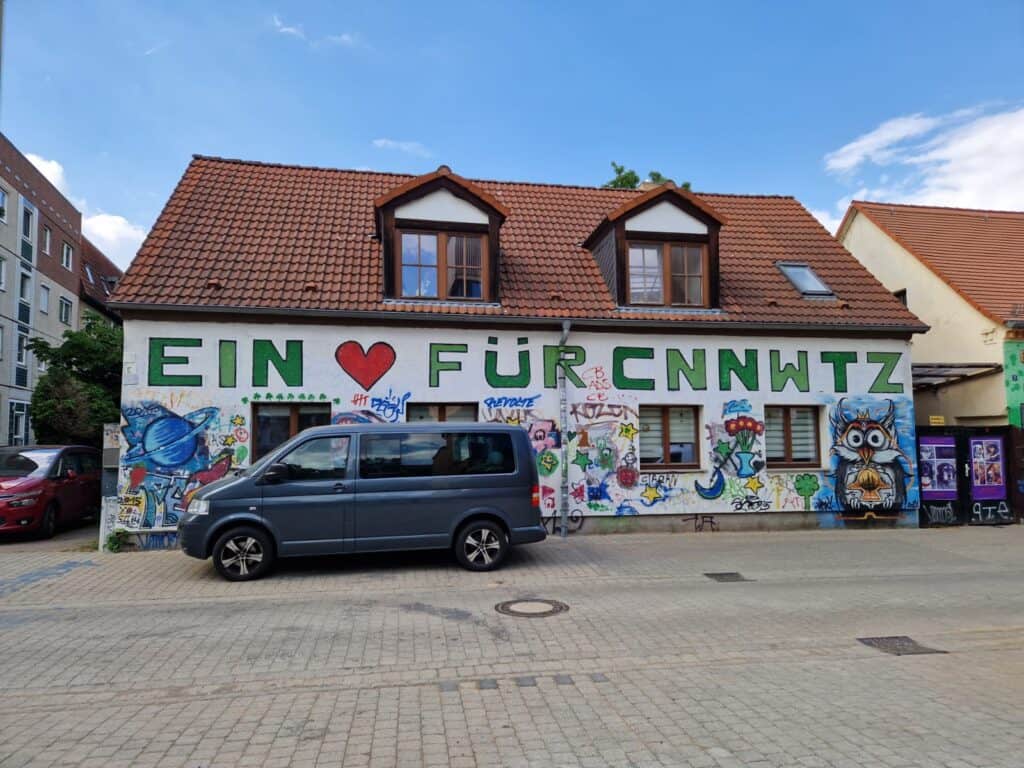
More street art 😉 It says “A heart for Connewitz”.

Visit the Altes & Neues Rathaus

Altes Rathaus (Old Town Hall)

Address: Markt 1, 04109 Leipzig, Germany

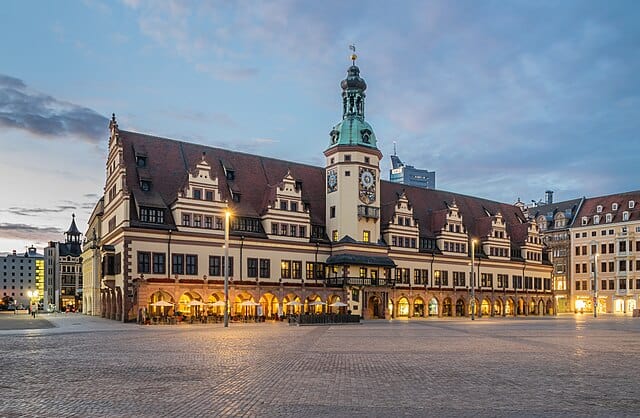
The stunning Altes Rathaus in Leipzig’s city centre sits on the historic Markt (Market Square) and was built in 1556 and 1557 by Hieronymus Lotte. It’s one of the best examples of Renaissance architecture in Germany.

Besides, it’s decorated with gables, mullioned windows, and a tower which slightly leans to the left side.

The Altes Rathaus of Leipzig. Photo credit: Krzysztof Golik on Wikimedia Commons.

The Leipzig city administration worked here until the early 20th century and since 1909 it’s been the home of the Stadtgeschichtliches Museum (City History Museum).

Attractions of the museum include the inside of the Altes Rathaus, a dungeon, old jail cells, and an exhibit of Leipzig’s 1,000-year history from the Middles Ages until the present day. The City History Museum is open Tuesday-Sunday and holidays from 10 am to 6 pm (except December 24 and 31). Admission is free.

Neues Rathaus (New Town Hall)

Address: Martin-Luther-Ring 4, 04109 Leipzig, Germany

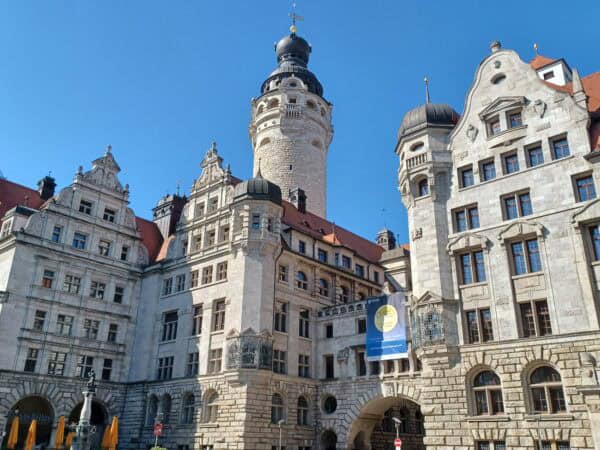
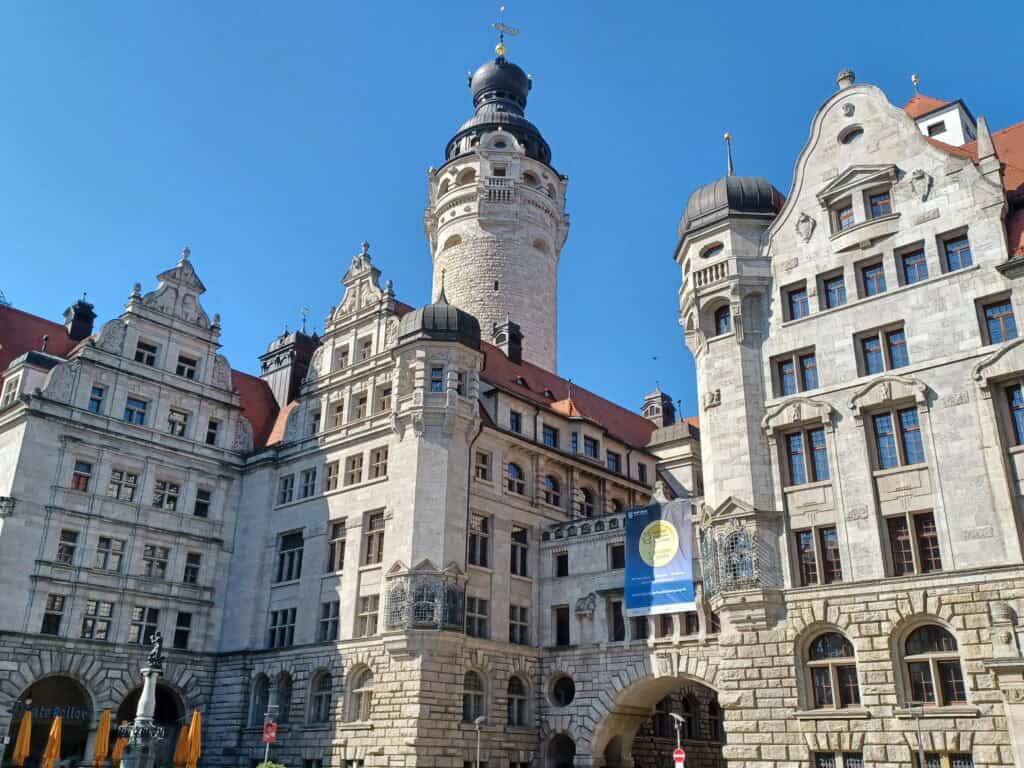
In 1905, Leipzig’s city administration moved from the Altes Rathaus to the newly built Neues Rathaus, because the former spot had become too small for the growing city. Thanks to its irregular pentagon shape, it looks more like a fortress than a town hall.

The Neues Rathaus was built in the style of historicism and its main tower is with 114.8 meters (376 ft) the highest city hall tower in Germany. The Pleissenburg Castle stood at this spot from the 13th century until it was demolished in 1897.

Besides, many people committed suicide by jumping down the tower at the end of the Third Reich.

From Monday to Friday at 2 pm, visitors can walk up the 250 stairs to the city hall tower, which offers a great view of Leipzig. Besides, on Sundays at 10:30 am, you can join a guided tour around the Neues Rathaus that includes going up the stairs to the tower and a visit of the casemates. These are 8 meters (26 ft) below the castle square.

Thomaskirche (St. Thomas Church)

Address: Thomaskirchhof 18, 04109 Leipzig, Germany

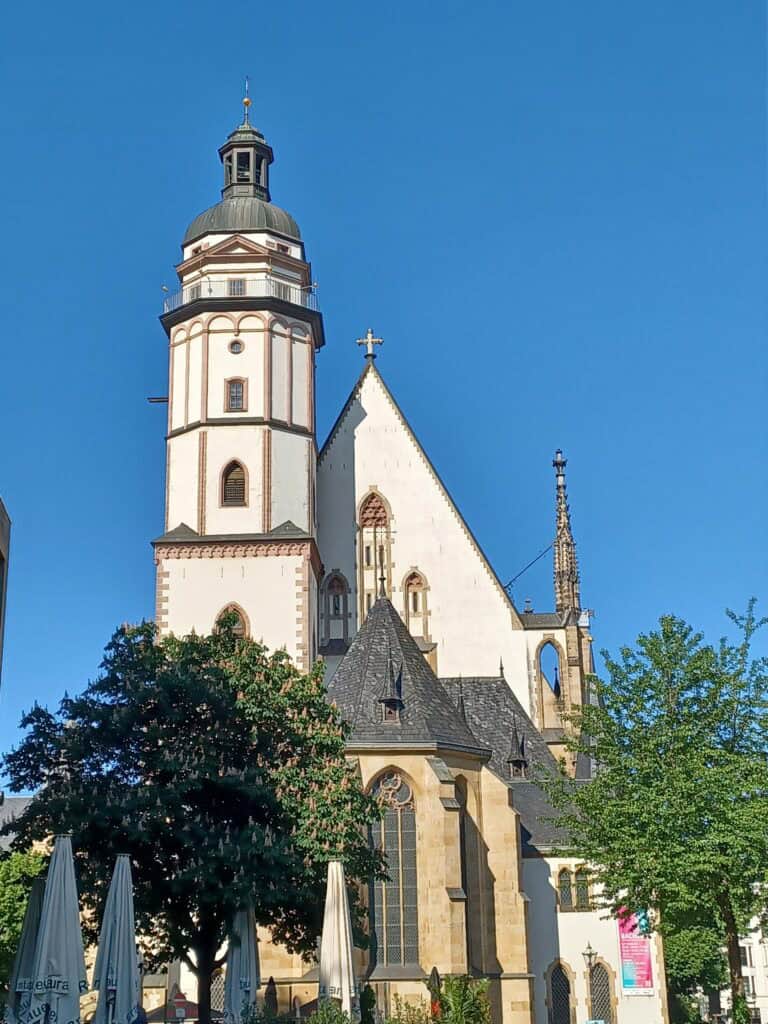
The impressive Thomaskirche has been a part of Leipzig’s city centre since the 13th century. Several celebrities have been in this Gothic church over time. For example, Martin Luther preached a sermon here in 1539 and Wolfgang Amadeus Mozart played the organ at Thomaskirche in 1789.

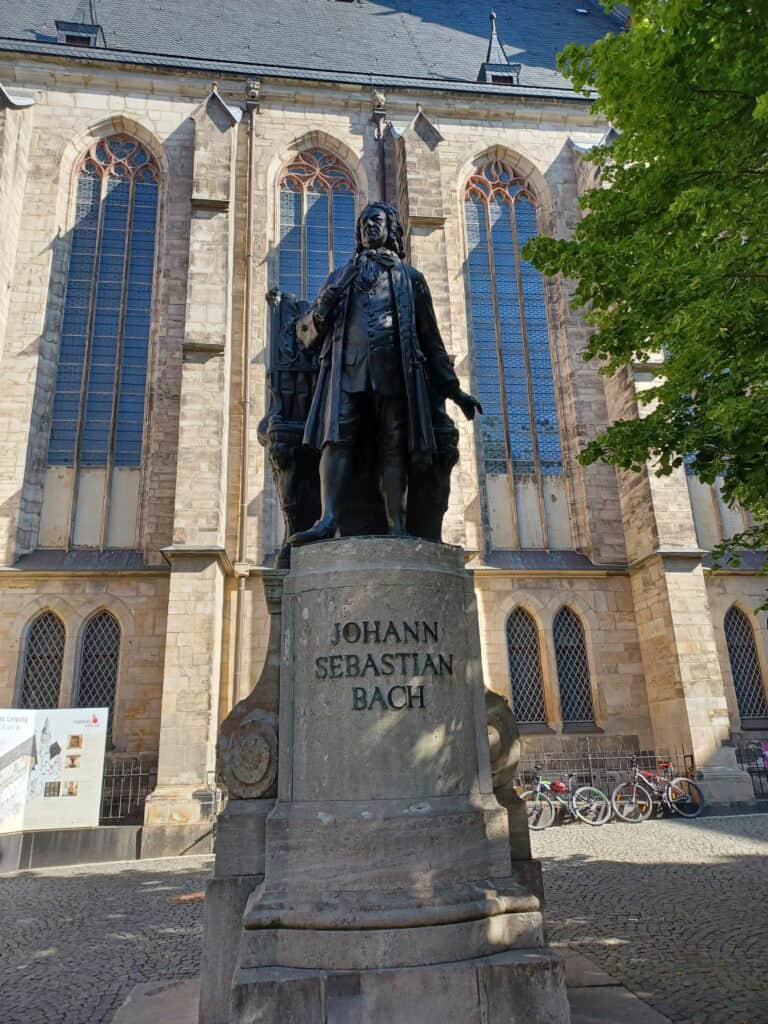
Besides, Johann Sebastian Bach was the cantor (music director) of the Thomanerchor from 1723 until 1750. It’s an internationally known boys’ choir that was founded in 1212. To honour Bach for his hard work of so many years, it was decided to make Thomaskirche his burial place. There’s also a Bach statue in front of Thomaskirche.

Today Visitors can listen to the Thomanerchor on Fridays, Saturdays, and Sundays. You can also book a tour of the Baroque tower (completed in 1702) from April to November. Thomaskirche is open daily from 9 am to 6 pm.

The Bach Museum

Address: Thomaskirchhof 15/16, 04109 Leipzig, Germany

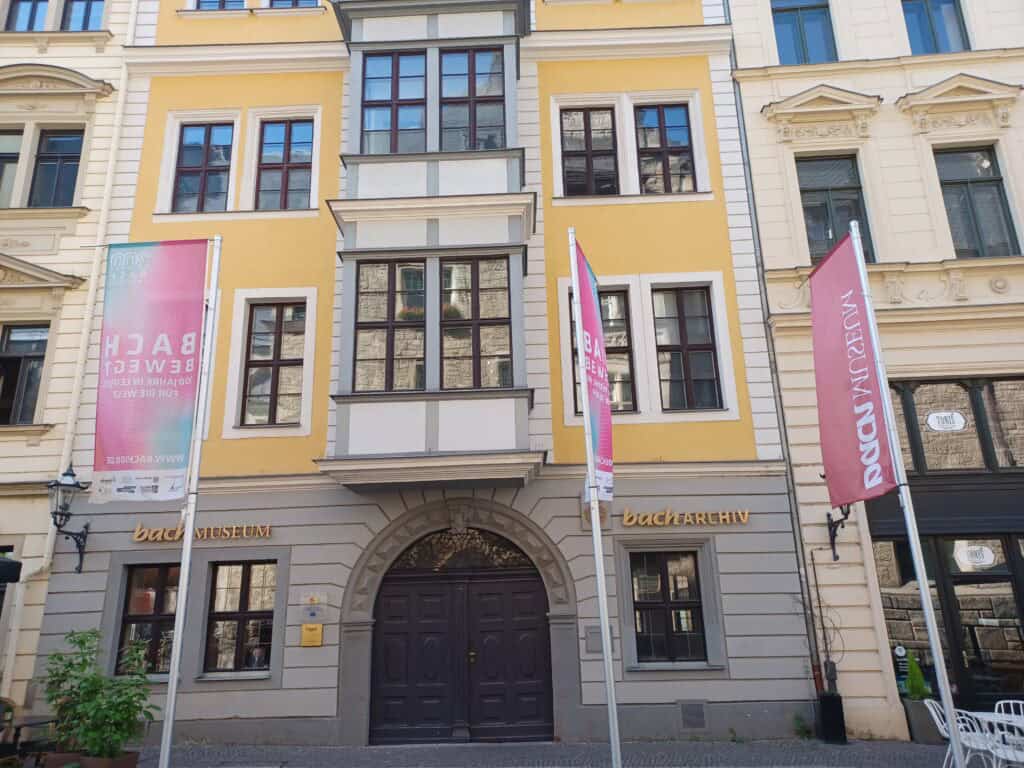
As you can probably tell by now, Johann Sebastian Bach was an important Leipzig resident! So it’s no surprise that the Bach Museum across from Thomaskirche opened to celebrate his life and work.

There’s a lot of things to see and do at the Bach Museum. For example, visitors can look at Bach’s original manuscripts and listen to a rehearsal of the St. Matthew Passion. Besides, check out the interactive composer’s room or the virtual orchestra to feel like a real composer!

Or listen to stories about Johann Sebastian Bach by 33 women in his family – from his mother to great-granddaughters! Visitors can download a free app to guide them around the museum, which is available in 11 languages. It’s also accessible for handicapped guests.

The Bach Museum is open Tuesdays to Sundays from 10 am to 6 pm and admission is 10 EUR. There’s also a café next door.

Völkerschlachtdenkmal

The Völkerschlachtdenkmal (Monument to the Battle of the Nations) was put up in 1913 to remember the historic Battle of Leipzig (also known as Battle of the Nations) from October 1813.

After many fights, Napoleon’s French troops were defeated right here, which slowly led to the end of the Napoleonic rule. But more than 90,000 soldiers lost their lives, which makes it one of the deadliest battles from this time.

The Monument to the Battle of the Nations in Leipzig. Photo credit: Jojoo64 on Wikimedia Commons.

Besides, it was used as a battlefield in World War II, when Nazi forces in Leipzig stood up to U.S. troops (and lost) in 1945. There’s an exhibit at the Völkerschlachtdenkmal’s Hall of Fame from April 13 to June 29, 2025, to commemorate the battle that happened here 80 years ago.

The Völkerschlachtdenkmal is 91 meters (299 ft) high and more than 500 steps take you to a viewing platform at the top. It offers a great view of Leipzig and its surrounding areas. There’s an elevator as well. It was built out of concrete and granite and is lit up at night!

The Völkerschlachtdenkmal is open daily from 10 am to 6 pm (April to October) and 10 am to 4 pm from November to March (closed on December 24 and December 31). Admission is 10 EUR.

Shop ’til you Drop in Leipzig’s City Centre

Last but not least, Leipzig’s city centre is a great spot for shopping! Several streets are for pedestrians only and there are stores for every taste. For example, we browsed through chains stores like Lush, dm Drogeriemarkt, antiquarian bookstores, and the EMP store, which sells goth/punk/metal clothing.

Leipzig’s Hauptbahnhof (Central Station) features 142 stores on three floors, and some are open on Sundays, too. We also walked around the Höfe am Brühl shopping mall, which has more than 130 stores, such as H&M, Zara, pharmacies, Intersport, Reno (shoe store), and more!

Conclusion: 9 Reasons to Visit Leipzig, Germany for a Day

If you’re traveling around East Germany, Leipzig should be on your must-see list! It offers a great mix of culture, GDR history, architecture, music (both old and modern, lol), great food, and a laid back vibe!

While it’s not as popular with tourists as Berlin or Munich, Leipzig doesn’t need to hide at all. It’s cheaper as well and the restaurant and bar scene is just as awesome, according to my friends who live in this region.

My favourite things to do in Leipzig are exploring Connewitz (it’s just so different than the rest of the city!), but also learning about Nikolaikirche’s important role during the Monday Demonstrations. The Bild zur Deutschen Einheit was super impressive as well.

If you know any more reasons to visit Leipzig, feel free to share them in the comments. Danke 😀

Traveling around Germany for a while? Then check out these posts:
One Day in Heidelberg, Germany Itinerary: The Best Things to Do

The Ultimate Travel Guide to Bamberg, Germany

ONE DAY IN ANCONA, ITALY: THE 6 BEST THINGS TO DO IN 2026

Last Updated: November 7, 2025

Do you want to visit one of Italy’s underrated destinations during your trip in 2026? Then spending a day in the charming city of Ancona is a a great start! Same as Rimini, Ancona nestles along the breathtaking Adriatic Coast in the east of Italy.

Ancona is the capital of the Province of Ancona. The Picentes tribe (ancient Italic people) first settled here from the 9th to 3rd century BC before the Greek took over around 387 BC. Later the Romans occupied Ancona as a naval station during the Illyrian War in 178 BC.

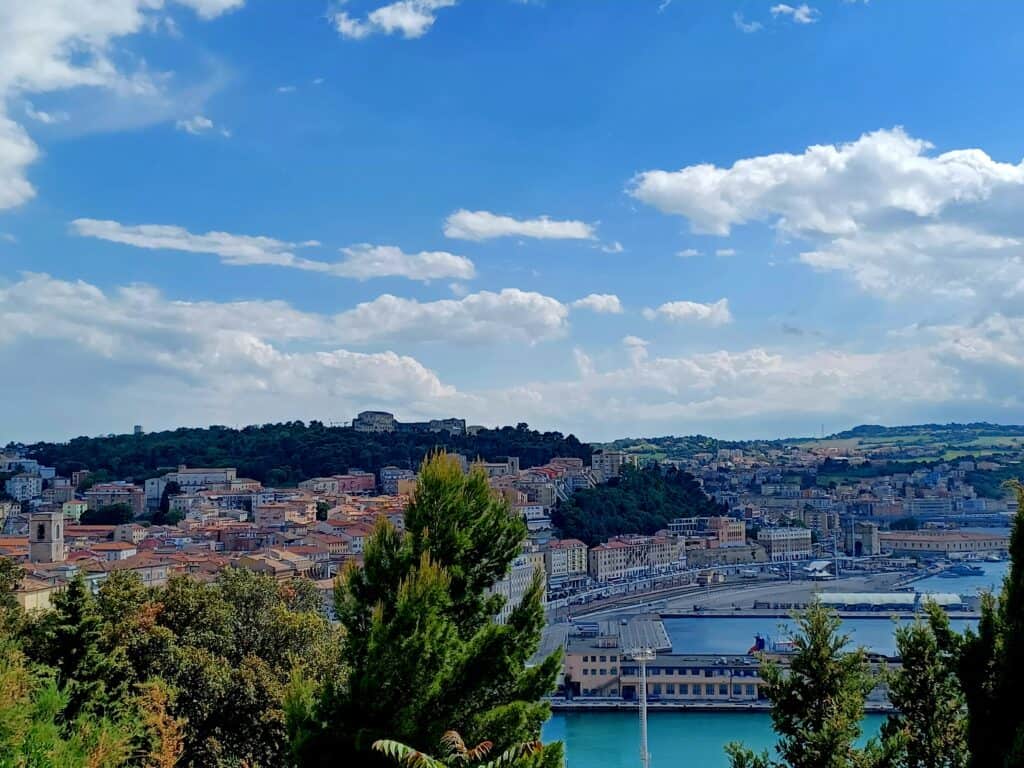
Today this city offers a mix of historic attractions, culture, stunning sea views, yummy food, and unique accommodations. This travel guide will show you how to make the most of your time during One Day in Ancona, Italy.

Ancona is also a popular port city, where you can easily hop on a cruise ship or ferry to Croatia or Albania.

Disclosure: I only recommend products that I’ve used in the past, and all opinions expressed in this post are my own. This post contains affiliate links. If you use one of the links throughout the page to buy something, I may earn a small commission at no extra cost to you. Thank you!

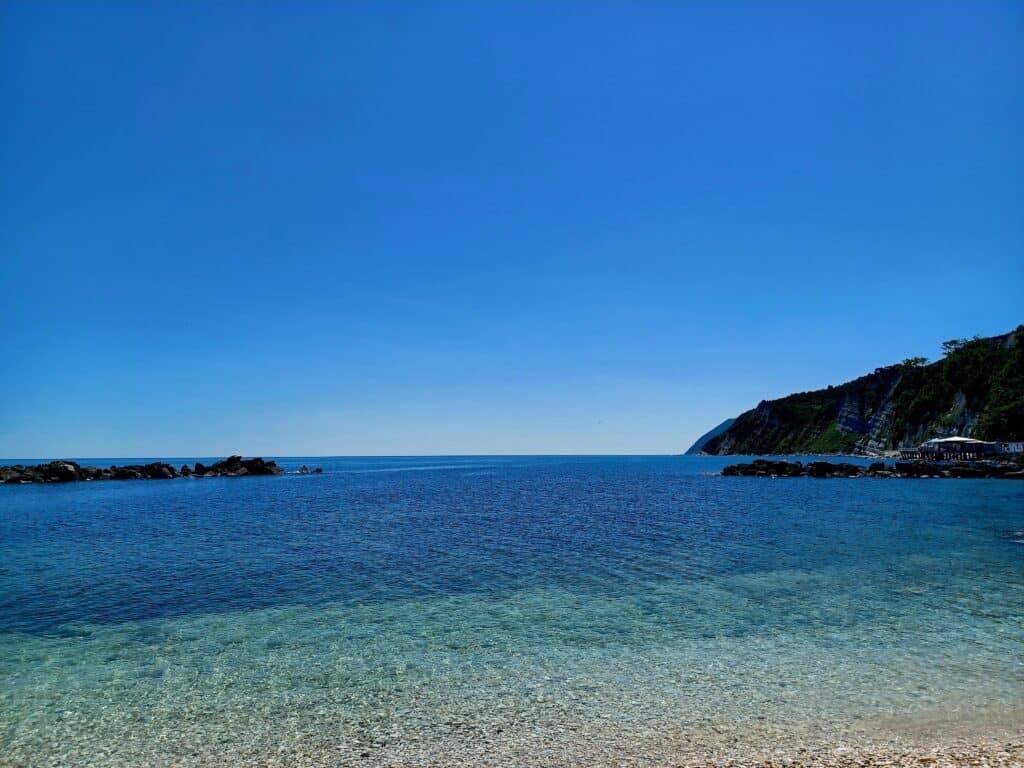
Walk along Spaggia del Passetto (Passetto Beach)

Address: Via Panoramica, 60123 Ancona AN, Italy

Without a doubt, one of Ancona’s most picturesque spots is Spaggia del Passetto. While there’s just a small sandy beach area, many locals come here for sunbathing, swimming, and the beautiful scenery. In fact, Passetto Beach is in the Top Ten of the most Beautiful City Beaches in Italy!

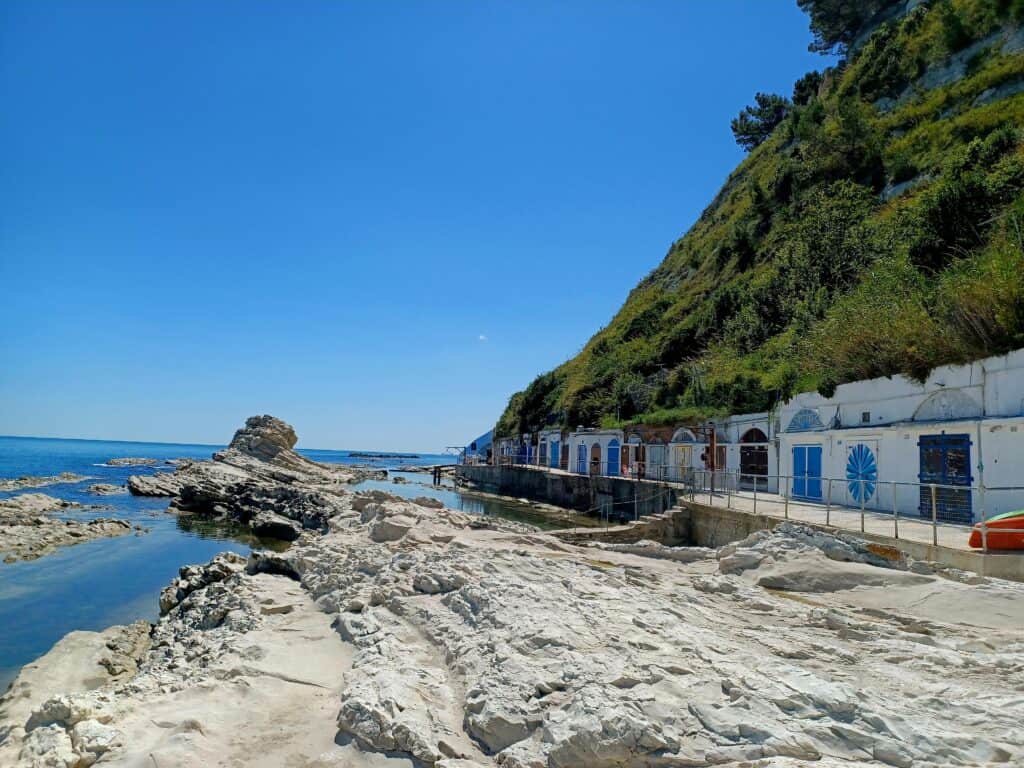
You can’t miss the rugged cliffs and Passetto Caves with their colourful doors here. They were built by local fishermen from the mid 19th century to the 1960’s to store fishing equipment and boats. Another highlight of Passetto Beach is an amazing rock formation called Seggiola del Papa (the Pope’s Chair).

The Passetto Caves and Seggiola del Papa (the Pope’s Chair).

You can either take an elevator or walk down a bunch of steps down to the scenic beach. If you’re walking, watch out for cute little lizards, who often like to run around on the rocks. If you’re lucky, they may even pose for a picture for a few seconds! 😀

Can you spot the cute little lizard? 😉

Monumento ai Caduti (World War I Monument)

Address: Piazza IV Novembre, 60123 Ancona AN, Italy

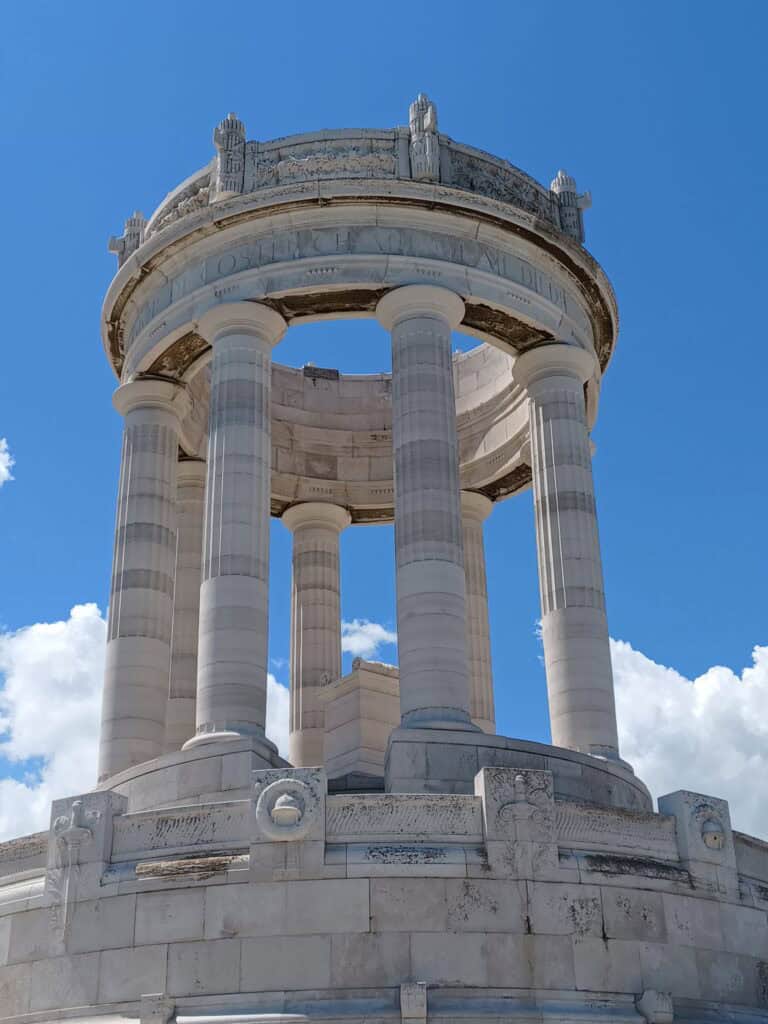
The impressive World War I Monument is only a few steps from Passetto Beach. It was completed by the local architect Guido Cirilli in 1930 and was unveiled in 1932. The monument honours the soldiers who lost their lives during World War I.

The World War I Monument was built out of Istrian stone and has eight fluted columns. Its base features helmets and swords, which are symbols for defense and attack. A small altar lies in the middle of the monument as well.

If you look closely, you’ll find verses of the poem “All’Italia” by Giacomo Leopardi written on the monument. It’s a patriotic poem representing the Italian soul from the 1800s.

Finally, many people come here to celebrate the most important Italian holidays, such as Liberation Day (April 25) and Republic Day (June 2).

Hike Up to Cattedrale di San Ciriaco (Ancona Cathedral)

Address: Piazzale del Duomo, 9, 60121 Ancona AN, Italy

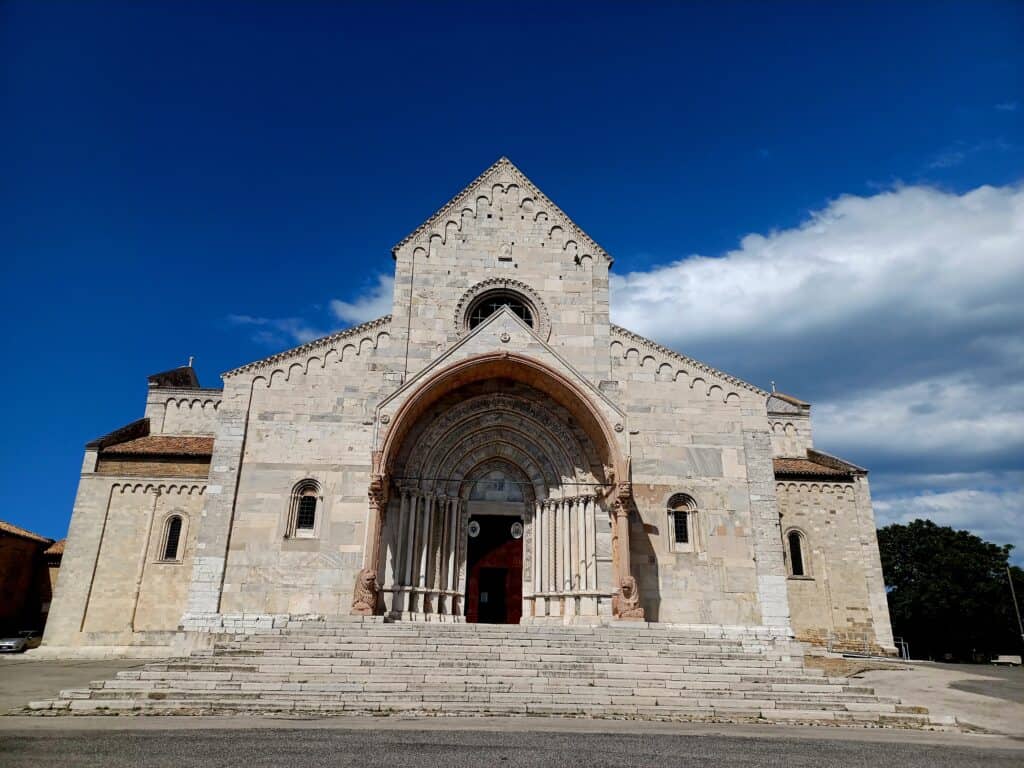
If you can’t get enough of historic landmarks, there’s no way to miss the beautiful Cattedrale di San Ciriaco. It sits proudly on Monte Guasco (Guasco Hill) and overlooks Ancona’s Old Town and port district. Its origins date back to the 6th century, but a new church was built here between 995 and 1015.

Bombings damaged Cattedrale di San Ciriaco during World War I and II, but it was rebuilt right after. It also had to be restored after an earthquake happened here in 1972.

Two marble lions guard this stunning Roman Catholic church that is known for its Byzantine, Romanesque, and Gothic elements. Besides, Cattedrale di San Ciriaco was built to honour Saint Cyriacus and is the seat of the Archbishop of Ancona.

While I worked up quite a sweat during the 20-minute hike up to Cattedrale di San Ciriaco, it was so rewarding to finally arrive at the top! I highly recommend wearing sturdy shoes and bringing a water bottle and sunscreen. Alternatively, you can take bus #11 from the city centre up to the cathedral.

Check out the Anfiteatro Romano ruins (Roman Amphitheatre)

Address: Via Birarelli Giuseppe, 3, 60121 Ancona AN, Italy

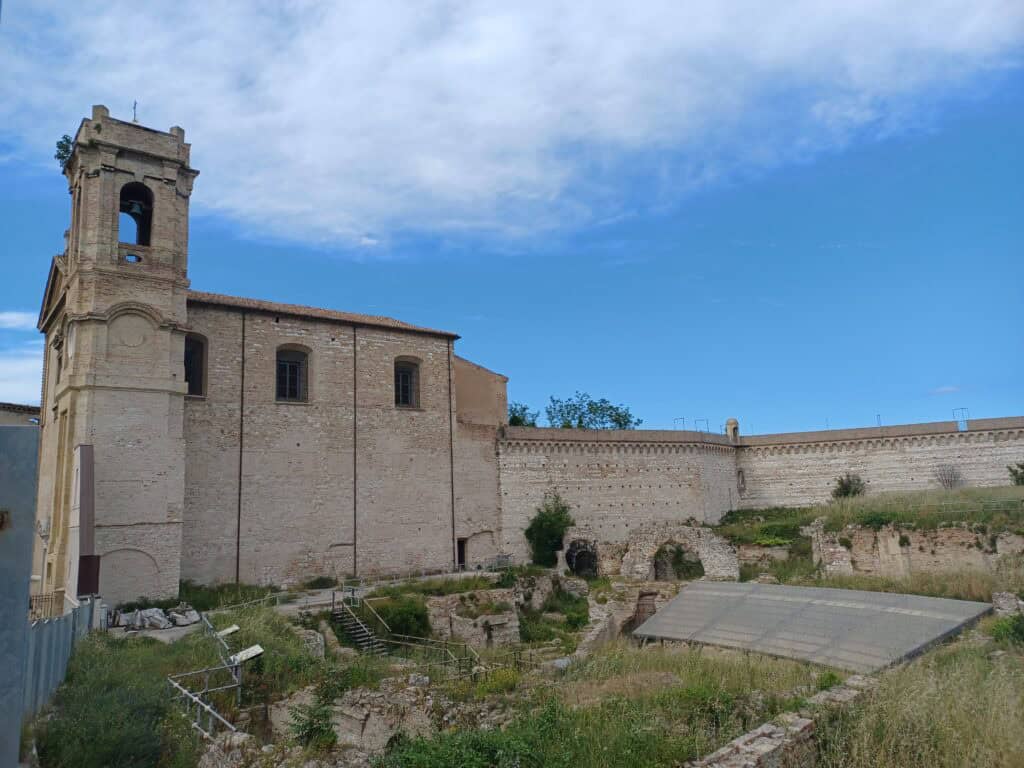
Another historical attraction of Ancona are the remains of the Roman Amphitheatre only a few minutes from Cattedrale di San Ciriaco. It was built between the 1st century BCE and the 1st century CE during the rule of Emperor Augustus.

Although not as well preserved as the Colosseum in Rome or the Verona Arena, the Roman Amphitheatre in Ancona is worth visiting. Back in Roman times, it was a place of the arts, but also a gladiatorial school.

The Roman Amphitheatre was first discovered in 1810 and more parts of the theatre appeared during excavations in the 1930’s and after the Ancona earthquake in 1972.

While you can look at the Roman Amphitheatre from the outside year-round, guided inside tours are available in the summer months (June to August). Tours start at the nearby National Archaeological Museum and regular admission is 8 EUR.

Stay at the Charming B&B Arts and Music

Address: Corso Giuseppe Garibaldi, 110, 60121 Ancona AN, Italy

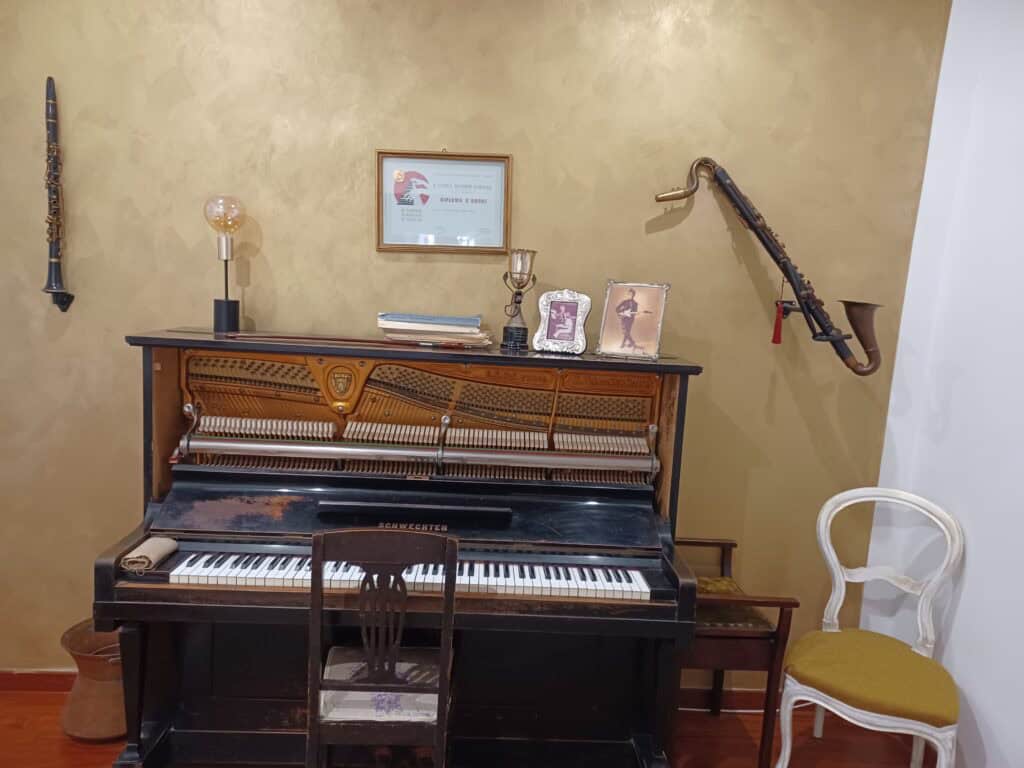
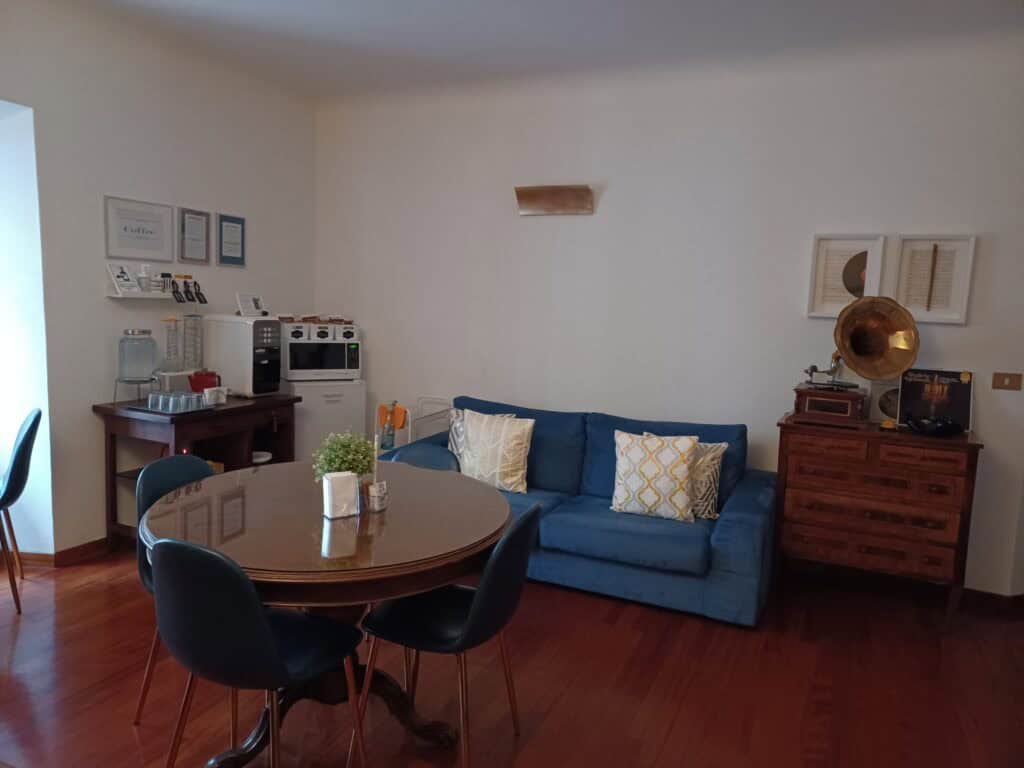
If you’re an art lover spending the night in Ancona, staying at the B&B Arts and Music is a must! Pretty much everywhere you look, you’ll find some cool artsy or musical decor (I had to look twice sometimes to find them all 😉 )

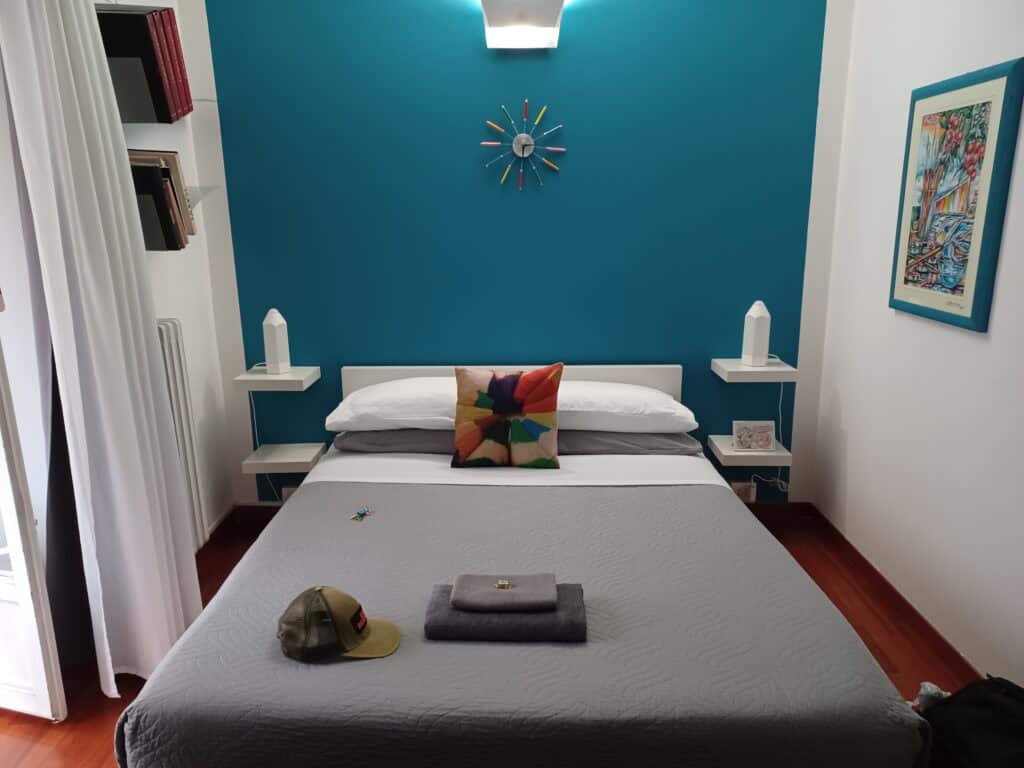
For example, there’s a piano in the lobby, a gramophone, violin, paint tubes and drumsticks in a bowl in the breakfast room, and music-themed mugs! Each of the three rooms has a different art theme. Mine was the paint room with crayon-shaped bedside lamps, crayon clock, and a pillow with crayons on it!

I loved staying at the cozy B&B Arts and Music. It’s right in the city centre and I would have loved to meet the owners in person to compliment them on the effort they put into this place. They quickly responded to any questions though and the B&B was super quiet and clean.

I just wasn’t a fan of the packaged up breakfast in the morning, because it felt less personal. This didn’t match with the warm vibe of this place, in my opinion. But this wouldn’t stop me from staying at the B&B Arts and Music again! 😀

Try out Ancona’s versatile Restaurant scene

Ancona has tons of awesome restaurants and cafés to offer to locals and visitors.

Here are two places I ate meals during my time in Ancona:

Rosa Cremeria Food

Address: Corso Giuseppe Mazzini, 61, 60100 Ancona AN, Italy

Rosa Cremeria Food is right in Ancona’s city centre. While they are known in town for their ice cream, the menu also offers homemade pizza, pasta, seafood dishes, sandwiches, and burgers! They have some vegan and gluten-free options, too.

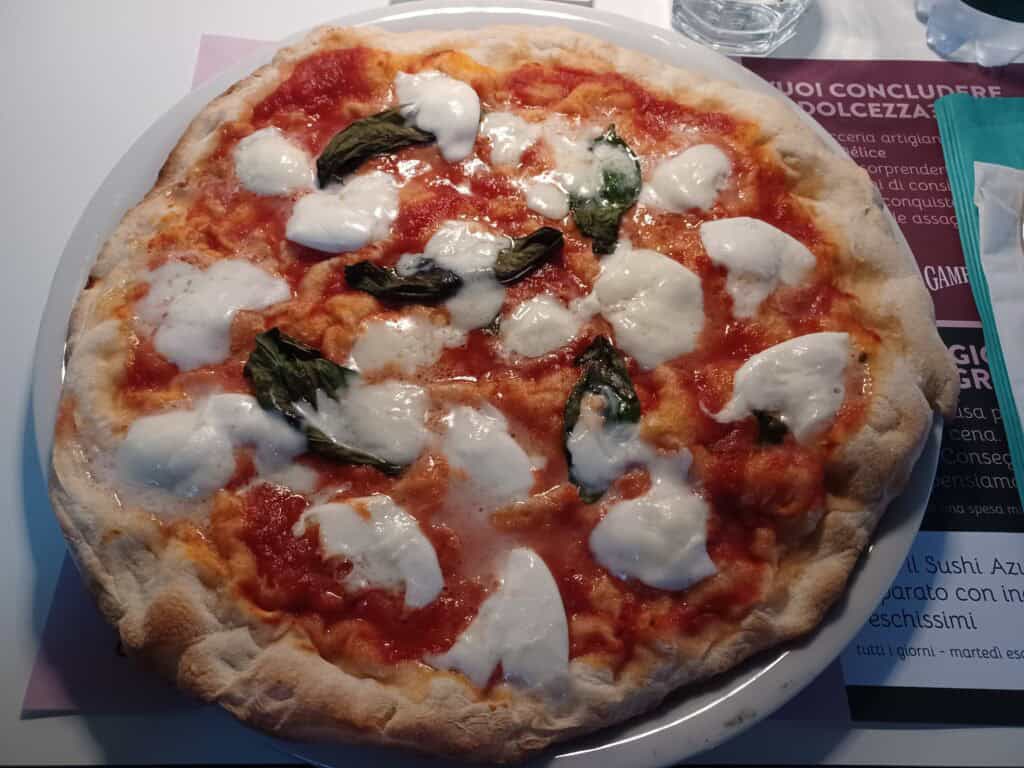
I really loved their Pizza Margarita Super (with buffalo cheese) and the service was quick and friendly. The prices were also very reasonable. Unfortunately, I was too full to try their ice cream this time!

Rosa Cremeria Food is open daily from 7 am to 12 am.

Zucchero a Velò Café

Address: Via Mario Torresi, 18, 60127 Ancona AN, Italy

If you’re into cycling and yummy veggie food, stop by Zucchero a Velò Café! The first thing I noticed was the awesome bike-themed decor inside this cute café!

It has a cafeteria with homemade sweet pastries and they serve savory dishes for breakfast, lunch, and dinner! There’s a brunch on Saturdays and Sundays as well. Zucchero a Velò Café is open daily (except Mondays) from 10 am to 11 pm.

The menu features international cuisine, such as New York Cheesecake, Buddha bowls, vegan Chicken Nuggets, tapas, and more! I tried their vegan burrito, which is filled with broccoli, leeks, walnut cream, and chickpeas. While the fillings were quite unusual, it was very good and kept me full for a long time!

Wrap Up: One Day in Ancona, Italy

Whether you’re visiting Ancona for a day or spending the night, this charming city along the Adriatic Coast will surely knock your socks off on your Italy trip in 2026! It’s a great spot to escape tourist crowds and Ancona has many stunning and unique attractions to offer.

My favourite thing to do in Ancona is Passetto Beach, where I hung out for several hours, just walking around, sitting on the rocks, and watching the ocean. Climbing up one of small cliffs was a great workout and it was fun watching locals spending their free time here.

I also had a blast while hiking up the path to Ancona Cathedral and watching the city from the top of Monte Guasco. Staying at the cozy B&B Arts and Music and feasting on some tasty food at Rosa Cremeria and Zucchero a Velò Café were just another bonus.

Need more inspiration for your Italy trip? Then check out these posts:

The Ultimate Guide to 48 Hours in Venice, Italy

Why Joining a Cooking Class in Italy should be on your Travel Bucket List

THE ULTIMATE SOUTH COAST OF ICELAND ITINERARY: THE PERFECT DAY TRIP FROM REYKJAVIK

One of the best things about making Reykjavik the base of your Iceland trip is that you don’t need to go far to experience some of Iceland’s rugged natural beauty.

One example is the South Coast of Iceland, which is the perfect day trip from Reykjavik, whether you’re self driving or joining a guided bus tour!

After having a blast along the Golden Circle on my Iceland trip in June 2024, I couldn’t wait to see more of this amazing country. So I booked a guided bus day tour along the South Coast of Iceland with Bus Travel Iceland from downtown Reykjavik and back. 

This South Coast of Iceland itinerary includes stunning Skógafoss and Seljalandsfoss Waterfall, mysterious Reynisfjara Black Sand Beach, Sólheimajökull Glacier, and Vík, Iceland’s southernmost village. This route is a part of the iconic Ring Road, the main highway that encircles the country.

Disclosure: I only recommend products that I’ve used in the past, and all opinions expressed in this post are my own. This post contains affiliate links. If you use one of the links throughout the page to buy something, I may earn a small commission at no extra cost to you. Thank you!

Skógafoss Waterfall

Address: Rangárþing Eystra, Sudhurland 861, Iceland

We first stopped at epic Skógafoss on the Skógá river, about two hours from Reykjavik. At a height of 60 meters (196 ft), it’s one of Iceland’s tallest waterfalls.

Besides, it’s likely to see a single or double rainbow inside the falls on a sunny day!

Tourists can walk to the base of the waterfall and climb up the 527 stairs built inside the mountain to the observation platform above the falls for a different perspective. Once you make it to the top, just stand still and enjoy the epic view of Skógafoss, but also the surrounding highlands of Iceland!

There’s an 8 km (4.97 miles) long hiking trail that meanders along the Skógá river for more amazing scenery and some smaller waterfalls as well.

Sólheimajökull Glacier

Another must-see spot along the South Coast of Iceland is Sólheimajökull Glacier. It only takes about 15 minutes of a walk from the parking lot to the glacier, so Sólheimajökull is one of Iceland’s most accessible glaciers.

Until not long ago, Sólheimajökull Glacier reached all the way to the parking lot. But sadly, this is not the case anymore because of climate change. The path to the glacier gets a bit longer every year and it’s expected that the glacier may completely disappear in just a few decades.

Sólheimajökull Glacier is about 8 km (4.97 miles) long and descends from Mýrdalsjökull, the country’s fourth largest ice cap. Mýrdalsjökull also sits on top of Katla Volcano, one of Iceland’s largest and most active volcanoes.

Lastly, you can spot some cool mini ice bergs inside the water by Sólheimajökull!

Once you get to the end of the path, there’s a warning sign to not go any further. But quite a few people continued on to the foot of Sólheimajökull Glacier, so it’s up to you, really.

Local tour operators like Arctic Adventures offer guided hikes or ice climbing of the glacier (and ice cave visits in the winter) as well.

There’s a parking fee of 750 ISK if you’re self driving to Sólheimajökull Glacier.

Lunch break in Vík

Vík (also called Vík í Myrdal), Iceland’s southernmost village, is the perfect spot for a break for many visitors while traveling along the South Coast of Iceland. Only 650 people live here year-round.

We stopped at a rest stop complex (Austurvegur 20, 870 Vík, Iceland) that features Krónan (grocery store), Ice Wear (souvenir store), and two restaurants: Ice Cave Bistro and Lava Bakery & Coffee. Ice Cave Bistro is proud to serve traditional Icelandic lamb stew, burgers, Fish & Chips, curries, salads, and more!

Back in June 2024, they had a Vegan Chickpea Curry and rice ready to serve, which was super yummy!

Reynisfjara Black Sand Beach

Address: Route 215, Vik, Suðurland 871, Iceland

As we approached our next stop, Reynisfjara Black Sand Beach, our funny guide suddenly got very serious. “Please stay away from the water at this beach, as the waves can pull you in and kill you! This is not a joke.”

In fact, five tourists were dragged into the water by these so-called killer waves or sneaker waves and died here since 2015. The waves often appear out of nowhere and can be up to 36 meters (120 ft) high! The ocean current is very strong and the water is freezing, too, so you’d get hypothermia within minutes.

Although Trip Advisor awarded Reynisfjara Beach Europe’s Best Beach in 2023, it’s also the world’s most dangerous. So while we were careful to remember our guide’s words, it was so relaxing to just sit and watch the waves come and go from a safe distance.

You may wonder where the black sand came from? Well, after multiple volcanic eruptions, cooled lava flowed into the water. As time went on, the strong waves broke down the lava fragments, which created the black sand we can admire today.

Another of Reynisfjara Black Sand Beach’s non dangerous, out-of-this-world highlights are the cliffs with many parallel basalt columns on the left side of the shore. Besides, you can see large rock formations in the water from the beach.

There’s a fee for passenger cars of 1,000 ISK at the lower parking area and 750 ISK at the upper level.

Seljalandsfoss Waterfall

Can’t get enough of Iceland’s iconic waterfalls? Then you gotta check out Seljalandsfoss Waterfall on your way from or back to Reykjavik!

Seljalandsfoss belongs to the Seljalandsa river that originates underneath Eyjafjallajökull Glacier. It sits on top of Eyjafjallajökull Volcano, which erupted in 2010 and caused flight cancellations and delays at many European airports.

While it’s as high as Skogafoss (60 meters or 196 ft), it’s much narrower, but just as spectacular! My favourite feature about Seljalandsfoss is that you can walk behind it. Also, it’s quite amazing how the water splits on the way down!

Just wear waterproof clothes, as you will get wet! Besides, the rocks along the pathway behind the falls are often slippery. Another cool thing about Seljalandsfoss is that there are floodlights on both sides of it, so when the summer midnight sun is not out, the falls are beautifully lit at night!

There’s a large parking lot only a few minutes from Seljalandsfoss. If you’re self driving, you’ll need to pay a parking fee of 800 ISK, which is good for the entire day. But visiting the waterfall is free!

Other Highlights along the South Coast of Iceland

Here are a few more awesome attractions to check out along the South Coast of Iceland:

Reyniskirkja Church

Address: Austurvegur 20, 870 Vík, Iceland

Reyniskirkja Church is just a short drive from Reynisfjara Black Sand Beach and Vík. This pretty Lutheran church was built in 1929 and is a classic example of a typical Icelandic church. I also liked that there’s a cemetery right in front of the church, which I hadn’t seen anywhere before!

Reyniskirkja Church is not far from Mýrdalsjökull Glacier and Katla Volcano. If the volcano would erupt, it would melt the glacier and cause a flashflood.

Since Reyniskirkja sits on a hill, it’d be the only building in the area to survive this. So local people were told to run to the church to save themselves if an eruption happens.

Dyrhólaey

Dyrhólaey is a promontory or peninsula, that is the perfect spot if you’d like to see some local wildlife on your Iceland trip: Puffins! This stunning natural attraction is only 20 minutes from Vík.

During nesting season (May to August) there’s limited access to see the puffins, so I’d recommend checking the situation before you leave. For example, the lower part of Dyrhólaey is open to car traffic but the higher part is then only accessible for foot traffic during the day.  

There’s stunning Dyrhólaey Lighthouse, cliffs, and a picturesque viewpoint as well. Visitors can see Mýrdalsjökull Glacier, the beautiful black lava seastacks Reynisdrangar, and Reynisfjara Black Sand Beach from the very top of Dyrhólaey.

A puffin at Dyrhólaey (Photo by Jonatan Pie on Unsplash) and one of the views from the top of Dyrhólaey. Photo by Diego Delso on Wikimedia Commons.

Sólheimasandur Plane Wreck

Address: Sólheimasandur, 871, Iceland

Finally, Sólheimasandur Plane Wreck sounds like one more special attraction to visit while exploring the South Coast of Iceland! Back in 1973, a United States Navy DC plane ran out of gas and crashed on Sólheimasandur black sand beach. Thankfully, everyone on board survived this accident.

Soon after, the plane wreck was abandoned and its remains are still sitting in the sand close to the water today. You can also check it out from the inside. The white plane wreck, black sand beach, and ocean waves create an awesome blend of colours, which is perfect for shooting photos!

Sólheimasandur Plane Wreck. Photo by Lance Anderson on Unsplash.

Vehicles are not allowed to drive to the site, as there’s a chance to get stuck in the soft sand. Instead, you can hike for about an hour each way from the parking lot by the main road to get to the plane wreck. Besides, there’s a parking fee of 750 ISK to park your car in the lot for the day.

Wrap Up: Is the South Coast of Iceland Worth it?

Yes, it’s worth taking a day trip along the South Coast of Iceland! Whether you’re self driving or joining a bus tour, you’ll have an adventurous day for sure! My favourites were Seljalandsfoss, Reynisfjara Black Sand Beach, and Sólheimajökull Glacier.

The trip along the South Coast of Iceland is suitable for solo travelers, couples, families with children, and friend groups. But sadly, some of the attractions are not made for people with mobility issues.

This route is not as busy as the Golden Circle and I liked that every attraction we visited was unique in its own way! Most of them are free as well, as they are on public land. But there are parking fees sometimes, such as at Seljalandsfoss Waterfall and Sólheimajökull Glacier.

The bus ride with Bus Travel Iceland was smooth and well organized. Our guide was also very entertaining and shared great stories about Iceland with us. Although there wasn’t enough time to see the puffins at Dyrhólaey and Sólheimasandur Plane Wreck, I got a great first impression of the South Coast of Iceland!

3 DAYS IN ROME TRAVEL GUIDE: THE BEST THINGS TO DO IN THE ETERNAL CITY

Last Updated: July 8, 2025

Rome (Roma in Italian) is Italy’s capital and largest city. It’s in the Lazio region in central Italy. It’s one of the most historic cities in the world and the second most popular city to visit in Europe (after Paris). Rome is well liked by history buffs, couples, families, friend groups, and backpackers alike.

Rome was founded in 753 BC, but there’s archaeological proof that people had settled here since c. 1200 – 1000 BC. That’s why Rome is one of the oldest continuously occupied cities in Europe! Besides, Rome has been the home of the Catholic Church since The Middle Ages.

Rome is often called The Eternal City, and for good reason! Just think of the epic Colosseum, Trevi Fountain, Pantheon, but also a few hidden gems, like Curia di Pompeo (Curia of Pompey) and Terme di Caracalla (Baths of Caracalla), that have been here for centuries!

But Rome is also known for its art scene, museums, mouthwatering food, nightlife, and great shopping. In this 3 Days in Rome Travel Guide, I’ll share famous attractions and hidden gems to visit, as well as where to stay and great restaurants, so you can make the most out of your time!

Disclosure: I only recommend products that I’ve used in the past, and all opinions expressed in this post are my own. This post contains affiliate links. If you use one of the links throughout the page to buy something, I may earn a small commission at no extra cost to you. Thank you!

The Best Things to See and Do in Rome

Explore the Colosseum

Address: Piazza del Colosseo, 1, 00184 Roma RM, Italy

For many tourists, visiting Rome’s famous symbol, the Colosseum, is at the top of their to-do list. This epic landmark was completed in 80 AD, so it’s almost 2,000 years old! It could host more than 50,000 spectators, so it was the biggest amphitheatre in ancient Roman times.

Entertaining events back then were exotic animal shows, executions, dramatic plays, and gladiator fights (similar to the Arena in Verona)! The Colosseum was open for more than 500 years, with the last games happening in the 6th century.

The Colosseum from the outside and interior. Photo #2 is by Ben Lee on Unsplash.

With time, the Colosseum fell victim to lootings, earthquakes, and bomb attacks during World War II. But it still stands proudly today! Besides, it was used as a storehouse, church, cemetery, and even a castle in the past.

In 2007, the Colosseum was added to the list of The Seven Wonders of the Modern World.

While the lines to see the inside of the Colosseum are often crazy long, I heard it’s worth the wait! Admission for a self-guided tour into the Colosseum is 18 EUR and guided tours are available as well.

In the winter months, the Colosseum is open daily (except December 25th and January 1st) from 8:30 to 4:30 pm. In the spring and summer, it’s open until 7:15 pm.

Check Out Fontana di Trevi (Trevi Fountain)

Address: Piazza di Trevi, 00187 Roma RM, Italy

Just a short walk further, you can’t miss another Rome landmark: The baroque Trevi Fountain, which is also Rome’s oldest fountain! It was designed by the Roman architect Nicola Salvi, and Giuseppe Pannini and others completed it in 1762.

Trevi Fountain stands for Rome’s important relationship with water. It was the ending spot of the aqueduct that brought water to ancient Rome from the countryside.

The beautifully carved sculptures include characters from Greek mythology and Roman history, e.g. the gods Oceanus and Triton, Agrippa, and Trivia. Besides, there’s a myth that if you throw a coin over your left shoulder in the fountain, you’re supposed to find your way back to Rome someday!

Trevi Fountain is very popular with tourists, especially couples, who often take a romantic photo in front of it. So similar to the Colosseum, it’s best to visit in the early morning for less crowds. There’s no charge to visit Trevi Fountain.

Get Lost in Trastevere

Looking for a more authentic Roman experience? Then spending time in vibrant Trastevere is a must! This former working-class, now artsy and alternative neighbourhood is known for its nightlife and restaurant scene. You can also book food and wine tours and not as many tourists come here.

While strolling on Trastevere’s cobblestone streets, I stumbled upon a bunch of cool things that I didn’t see anywhere else in Rome. For example, there was graffiti on pretty much every building, the awesome Radiation Records store, and tons of cool stickers on the door of a local bar!

If you like churches, Trastevere won’t let you down, either. You can’t miss the stunning Basilica di Santa Maria (Piazza di Santa Maria in Trastevere, 00153 Roma RM, Italy), which dates back to the 4th century AD. It is said to be the oldest Christian church in Rome.

Only a few minutes away, you can stock up at the Fresh Food market on Piazza di San Cosimato, which has been around since 900. It’s open Monday to Saturday from 6 am – 1:30 pm. Lastly, there are lots of performances on the streets of Trastevere in the warmer months and great shops!

Basilica di Santa Maria and a street in Trastevere. Photo #2 is courtesy of Alessandro Cossu on Wikimedia Commons.

Terme di Caracalla (Baths of Caracalla)

Address: Viale delle Terme di Caracalla, 00153 Roma RM, Italy

When I googled less touristy spots in Rome, Terme di Caracalla was one of the top recommended places. These are the ruins of ancient Rome’s largest public bathhouse complex, which was built in the 3rd century AD. It covered 11 hectares and could accommodate more than 2,500 guests!

The bathhouse was decorated with stunning mosaics, frescos and marble cladding, that still partially exist today. Terme di Caracalla had cold, warm and hot baths, sauna, pools, massage rooms, change rooms, receptions, and even libraries and brothels!

Sadly, the bathhouse couldn’t be used anymore in the 530’s after the Goths attacked Rome. This brought severe damage to the aqueducts that transported water to Terme di Caracalla. Afterwards, the bathhouse complex was left in ruins.

When I visited Terme di Caracalla in May 2024, there was a nice photography exhibit of the 35 most important photographers from the 20th and 21st century. What a great contrast to the Roman ruins! Italian operas happen here often in the summer as well.

Terme di Caracalla is open year-round (except Mondays, December 25th and January 1st) from 9 am to 4:30 pm (last entry at 3:30 pm).

The Pantheon

Address: Piazza della Rotonda, 00186 Roma RM, Italy

Another Rome highlight you shouldn’t miss is The Pantheon. Built between 25 and 27 BC as a temple for 12 Roman gods, it’s the only building from Ancient Roman times that has never been affected by natural or man-made disasters.

Pope Boniface IV turned the Pantheon into a Christian church in 608 AD. Its exterior and interior are equally impressive. For example, inside the building, you’ll see the largest unreinforced dome ever built. 

The Pantheon from the outside and inside. Photo #2 is by Nicholas Martinelli on Unsplash.

The Renaissance painter and architect Raphael was so impressed by The Pantheon that he asked for his remains to be buried here after his passing in 1520.

Admission to get inside the Pantheon (plus an audio guide) is 15 EUR and a guided tour is 25.50 EUR. On every first Sunday of the month, entry to The Pantheon is free!

The Pantheon is open daily (except January 1st, August 15th, and December 25th) from 9 am to 7 pm (last entry at 6:45 pm).

The Spanish Steps

Address: Piazza di Spagna, 00187 Roma RM, Italy

The iconic Spanish Steps in Rome were built in Rococo style between 1723 and 1726. The 135 steps start at Piazza di Spagna square and take you up to the French monastery church Trinita dei Monti (completed in 1587). There are three terraces referring to the Holy Trinity.

Before climbing up the steps, check out the Fontana della Barcaccia (Fountain of the Ugly Boat). Its sculptor, Pietro Bernini, chose this unusual name because the Tiber river flooded this area in 1598 and an ugly little boat stranded here.

Once you arrive at the top of the stairs, you’ll be rewarded with a beautiful view of Rome!

The Spanish Steps (Photo credit: Mike McBey on Wikimedia Commons) and the stunning Rome view!

Surprisingly, the French (under King Louis XII) commissioned the construction of the Spanish Steps. Besides, since the Spanish embassy was at Piazza di Spagna square in the 17th century, it was decided to call them the Spanish Steps.

In late April, Rome celebrates its anniversary, so the Spanish Steps are decorated with beautiful azalea flowers! There’s no fee to visit and climb up the Spanish Steps.

If you feel like going for a shopping tour after, there are plenty of stores in this area!

Curia di Pompeo (Curia of Pompey)

Address: Largo di Torre Argentina, 00186 Roma RM, Italy

Another less touristy, but historically significant attraction in Rome is Curia di Pompeo. Opened in 55 BC, it was one of the a meeting halls for the Senate members of Rome. What makes this place so important? Well, this is where Julius Caesar was stabbed 23 times by a group of senators on March 15, 44 BC!

But that’s not all. Curia di Pompeo is also the home of four Roman temples and an old theatre, all dating back to the Roman Republic. After Caesar’s death, the site was closed and walled up, and some say it was set on fire later!

Fast forward to the 1930’s, Italian dictator Benito Mussolini ordered for Curia di Pompeo to be excavated. Soon after, many of Rome’s stray cats chose this abandoned, but safe spot for laying around, strolling, and enjoying the sun!

From 1930 to 1993, so-called gattare (cat ladies) took care of the stray cats at Curia di Pompeo. In 1993, Lia Dequel and Silvia Viviani decided to help one of these ladies who fed, spayed, and neutered the cats. It didn’t take too long until Torre Argentina Cat Sanctuary was born!

Today this place is run by people taking care of the 130 cats and it’s the oldest cat shelter in Rome! Cat lovers are welcome to donate or adopt a cat at a distance, but it’s not allowed to feed them. Torre Argentina Cat Sanctuary is open daily from 12 pm to 4:30 pm.

One of the cats enjoying the shade of one of the ruins of Curia di Pompeo.

Last but not least, who knows what Julius Caesar, who was scared of cats, would say that a cat sanctuary now stands where he died all these years ago? I guess we’ll never find out! 😛

Visit Basilica di San Pietro (St. Peter’s Basilica)

Address: Piazza San Pietro, 00120 Città del Vaticano, Vatican City

The last attraction in this guide is St. Peter’s Basilica in the independent state of Vatican City. The city of Rome surrounds the smallest city-state in the world, which gained its independence in 1929.

The current St. Peter’s Basilica was completed in 1626 to replace the Old St. Peter’s Basilica, which stood here from the 4th century and was torn down in the 16th century. As the home of the Pope, St. Peter’s Basilica is one of the holiest temples for Christendom and it’s one of the largest churches in the world!

Up to 20,000 people can be accommodated inside the Basilica. If you’d like to see St. Peter’s Basilica from the inside, please cover your shoulders and knees. There’s stunning art in here, too, e.g. The Pietà, a sculpture by Michelangelo.

St. Peter’s Basilica from the outside and inside. Photo #2 is credit of Gary Todd at Wikimedia Commons.

Visitors can also climb to the top of the dome. It inspired the design of other buildings, like the Capitol in Washington D.C. Besides, there’s a great view of St. Peter’s Square from the dome, as well as a part of Rome if it’s a clear day!

St. Peter’s Basilica is open year-round from 7 am to 7:10 pm and it’s free to visit. There’s a fee to visit the dome though, which is open from 7:30 to 5 pm (in winter) or 6 pm (in summer).

Where to Stay in Rome

Same as other big European cities, Rome has accommodation options for any kind of budget.

I booked a dorm bed at Alessandro Palace & Bar Hostel (Via Vicenza, 42, 00185 Roma RM, Italy), which is pretty close to public transit, restaurants, bars, etc.

The dorm room was very clean and spacious and the staff was helpful as well. I also liked that it’s only 10 minutes walk from Rome’s Termini Station (the main train station). The bar sounds pretty cool, too, with karaoke, Italian Pizza Nights, Happy Hour, and Beer Pong!

But I didn’t like that there was no breakfast at the hostel and that I had to pay a fee for leaving my luggage in their storage room after check out. This was the only place in Italy where this happened though, so I’d give Alessandro Palace & Bar Hostel another chance. 🙂

Where to Eat & Drink in Rome

Of course, Rome also has tons of restaurants to choose from, and there are great vegan and vegetarian options! Here are my favourites:

Aromaticus Bistro Trastevere

Address: Via Natale del Grande, 6/7, 00153 Roma RM, Italy

Looking for a great vegan lunch spot while wandering around Trastevere? Then I suggest checking out the rather small, but very cozy and stylish Aromaticus Bistro. The vibe is super nice, with green painted walls, and healthy food, fresh juices, smoothies, and dessert on the menu.

A few examples are vegan burgers, tempeh wrap, cheesecake, rice bowls, and soba noodles. I tried their Red Velvet Smoothie, Falafel Plate with lettuce and hummus, and an Oat Cookie. It was quite busy, so the food took a bit to arrive, but it was so yummy! Especially the falafel were super crispy!

Aromaticus Bistro Trastevere is open daily (except Mondays) from 12 pm to 11 pm.

Flower Burger Roma

Address: Via dei Gracchi, 87, 00192 Roma RM, Italy

Only a short walk from Vatican City, trendy Flower Burger is perfect for travelers looking to try something different on their trip! There are two other locations of this restaurant chain in Rome.

They’re famous for their many colourful vegan burgers (green, purple, pink, yellow, grey, etc.)! The decor is very unique as well, and it’s obvious that lots of love and passion was put into this place! I went for the Cherry Bomb Burger with edamame beans on the side, and it was great!

This Flower Burger location is open daily from 12 pm to 3 pm and 7 pm to 10:30 pm.

Romeow Cat Bistrot

Address: Via Francesco Negri, 15, 00154 Roma RM, Italy

For a yummy vegan breakfast and making friends with a few cats (la dolce vita, literally!) check out Romeow Cat Bistrot. This is Rome’s first cat café and the vibe is super cozy and chill, with Jazz music playing in the background!

The cats have tons of hiding spots at this rather minimalist café. There’s also a second floor for the guests and cats to relax with couches, pillows, and books. Besides, you can let off steam by adding some colour to the colouring books on the tables. What a great pastime while waiting for your food!

I tried their Chocolate Smoothie and Pancakes, which were a perfect start to my day! Most of the kitties were sleeping, but it was nice watching them snooze and spending time at this place for a bit.

Strada Romana Restaurant

Address: Via Vicenza, 19, 00185 Roma RM, Italy

Right across from Alessandro Palace & Bar Hostel, Strada Romana is a traditional Roman restaurant and super convenient to go to after a long day of exploring Rome!

Their menu features meat and fish dishes, but also salads, vegetarian pasta, desserts, and local wines! I tried their homemade ravioli filled with ricotta cheese and spinach in tomato sauce. It was very tasty and they have an English menu as well.

Strada Romana is open daily from 5 pm to 10:30 pm.

How to Get to and Around Rome

As one of Europe’s top tourist destinations, Rome has a great public transit network. You can choose between buses, metro (subway), urban railways, and trams that go all over the city. The metro is the fastest option and it stops very close to many attractions (e.g. the Colosseum).

Buses go to areas not covered by the metro, but are slower because of constant traffic jams in Rome. Trams are good, but carry less passengers than the metro. Besides, there’s the Rome Sightseeing Bus, taxis and Ubers, but taxis are insanely expensive, so I’d avoid them.

Driving in Rome is also not recommended because of crazy traffic. Instead, some people like to rent bikes (there are bike lanes) or explore Rome on foot, either independently or as part of a walking tour.

Rome Fiumicino “Leonardo da Vinci” International Airport is the busiest airport in Italy. Of course, Trenitalia trains go to/from Rome as well (Termini Station is the main station). I booked Flixbus from Pescara to Rome, which was quite cheap and it only took about 2.5 hours!

How to Stay Safe in Rome

Overall, Rome is considered a safe city. Still, I’d recommend to keep your valuables out of sight, as pickpocketing is quite common. Thieves are often active around tourist attractions, like the Colosseum and St. Peter’s Square.

Scammers can be found in Rome as well. So make sure to not buy skip-the-line tickets from unofficial tickets offices. I also saw tons of street vendors trying to sell packages to tourists near the Colosseum, as well as others trying to sell roses by the Spanish Steps. Just ignore them and they won’t chase you.

As a female solo traveler, I felt generally safe in Rome. But to be on the safe side, I wore a money belt when visiting crowded spots.

The Best Time to Visit Rome

Similar to other destinations in Italy, the most popular time to visit Rome is in the summer months (June to August). While this is when the weather is mostly great, it can get incredibly hot. So it’s best to get up early to visit Rome’s hotspots to avoid the heat and crowds.

In my opinion, it’s better to visit Rome in the shoulder season (April-May and September-October). While it was busy at famous tourist attractions when I was there in late May 2024, I think it’s much worse in the summer. I also liked the warm, but not hot temperatures (20 to 25C/68 to 77F).

Although winter (November-March) is the quieter time of the year, there are still fun events going on in Rome, like Carnival in February and Epiphany in January. So whenever you decide to visit Rome, you can be sure to have a blast! 🙂

One of Rome’s streets around Christmas time. Photo by Vito Giaccari on Pexels.

Is Rome an Expensive City?

Yes, Rome is known as one of the most expensive cities in Southern Europe. That being said, it’s not difficult to visit on a budget!

While staying at Alessandro Palace & Bar Hostel was more expensive than other hostels in Italy, it was still cheaper than many hostels in Vancouver or Toronto, lol! It also has a kitchen for cooking your own meals. Accommodation costs go up in the summer months though.

Costs for public transit and restaurant meals were affordable (a 72-hour ticket is 18 EUR), although I noticed that fish or meat entrées are often more expensive than vegetarian or vegan dishes.

Many of the attractions I visited were free as well. But if you plan on entering some, like the Colosseum or Pantheon, there’s an entrance fee.

Conclusion: Is Visiting Rome for 3 Days enough?

Well, if it’s your first time visiting Rome, then yes, 3 days is a good timeframe. You’ll have time to cover many of its highlights, including the Colosseum, Trevi Fountain, and the Spanish Steps, but also a few lesser known spots, like Curia of Pompey and the Baths of Caracalla.

But of course, it’s impossible to visit all of Rome’s amazing sites in such a short time. So if you’d like to see more of this charming city, it’s always a good idea to go back someday. I mean, the saying “All roads lead to Rome” does exist for a reason, lol! 😉

Spending more time in Italy? Then check out these posts:

The Ultimate Guide to 48 Hours in Venice, Italy

Why Joining a Cooking Class in Italy should be on your Travel Bucket List

WHY JOINING A COOKING CLASS IN ITALY SHOULD BE ON YOUR TRAVEL BUCKET LIST

Last Updated: July 9, 2025

One reason why many travelers come to Italy is the food, and I’m no exception. Ever since reading “Eat, Pray, Love” by Liz Gilbert, I had been dreaming of stuffing my face with yummy food at an authentic Italian restaurant in Italy.

This dream came true when I finally traveled around Italy in May 2024. As I’d hoped, the food at all the restaurants in Italy I went to was really good!

Soon, as a passionate amateur chef, I decided to dive even deeper into Italian cuisine. That’s why I booked a cooking class in Italy through Get Your Guide at Pastamania Culinary School in Rome. 

So if you’re thinking about Joining a Cooking Class in Italy to make your trip even more unforgettable, I’d say “Go for it!” Especially in Rome, Venice, or Florence, where crowds are in lots of places, this fun adventure is different from typical tourist activities!

Whether your favourite Italian food is pasta, pizza, tiramisu, or gelato, the many cooking classes all over Italy surely won’t disappoint you. You may learn some new skills to use at home and impress your loved ones! So without further ado, let’s get started!

Disclosure: I only recommend products that I’ve used in the past, and all opinions expressed in this post are my own. This post contains affiliate links. If you use one of the links throughout the page to buy something, I may earn a small commission at no extra cost to you. Thank you!

Step 1: Welcome to Pastamania Culinary School

Address: Via della Gatta, 14, 00186 Roma RM, Italy

Our group of eleven people met in front of the Pastamania Culinary School about ten minutes before the cooking class. Then we followed Chef Ricardo, our instructor, upstairs, and everyone grabbed a seat at a long table.

After putting on a red apron and introducing ourselves, it was time to start making homemade pasta!

Step 2: Kneading and Rolling the Pasta dough

First we prepared the pasta dough by beating one medium egg and 3/4 cup (100 grams) of Italian 00 wheat flour with a fork in a metal bowl until well combined.

Next, we used our fingers to knead the dough for about 10 minutes. This “workout” is necessary to develop the gluten in the flour. It makes sure that the pasta comes out springy and al dente instead of flabby and soft when cooked!

Then we cut the dough in half and rolled the pasta dough with a rolling pin into a paper thin circular shape.

Step 3: Making fresh Fettuccine

Now it was time to prepare our first kind of pasta: Fettuccine. While there are different ways to make pasta strands, we used a traditional Italian pasta cutter called Chitarra (Pasta guitar). What’s special about this tool?

Well, it’s a frame strung with music wire where you put the pasta dough to be separated into thin strands. Then roll across the dough with a rolling pin, which pushes the pasta through the strings! Or if not all of them go through, just play a chord on the strings, and the pasta will fall down! 😀

Finally, Chef Ricardo reminded us to proudly show our finished fettuccine by holding them on the rolling pin!

Then we covered and set the finished fettuccine pasta aside.

Step 4: Cutting and filling Ravioli & Cappelletti

Next, we rolled out the rest of the dough to make Ravioli and Cappelletti pasta. Cappelletti is a ring-shaped filled pasta that looks a bit similar to tortellini, but it’s bigger and the dough is thicker.

We cut out the pasta with a ravioli cutter and filled them with a prepared mixture of fresh ricotta, Italian Parmigiano cheese, nutmeg, and truffle oil. Doing this was a lot easier while chatting with each other and enjoying some organic Dalle Nostre Mani wine from Tuscany, lol!

Although my ravioli and cappelletti were not the prettiest, I was quite happy with the result!

Step 5: Chef Ricardo is Cooking the Pasta

Now the fettuccine, ravioli, and cappelletti were ready to be cooked! Unlike dry pasta, fresh pasta is often al dente after just three or four minutes.

We eagerly watched Chef Ricardo as he mixed the cooked fettuccine with a tomato sauce (which took two hours to cook beforehand) and the ravioli and cappelletti with a simple sauce of butter and fresh sage.

Soon after, our instructor made everyone’s pasta dish look fancy (after all, food is supposed to be a treat for the palate and the eyes), and set the plates in front of us!

Step 6: Buon Appetito!

After all this work, it felt great to finally dig into the pasta we made! Man, it was so yummy, especially after topping it with more Parmigiano cheese!

While the fettuccine with tomato sauce was good, my favourite was the Ravioli and Cappelletti in the butter and sage sauce. The blend of ingredients matched perfectly and I was amazed how simple it is to create such a tasty Italian meal!

Last but not Least: Dessert and Limoncello

Of course, you can’t finish a traditional Italian meal without a dessert and a digestif!

Chef Ricardo served us a dessert called Salame al Cioccolato. It means Chocolate Salami, because it looks like a salami sausage before you cut it! It’s a popular no-bake Italian dessert, which consists of eggs, white sugar, biscotti, butter, and cocoa!

Last but not least, we drank a shot of Limoncello, which is an Italian lemon liqueur from Southern Italy, especially around the Gulf of Naples, the Amalfi Coast, and Sicily. What a perfect and delicious end to this fun Italian cooking class!

Now it was time to say arrivederci to Chef Ricardo and my fellow cooking classmates. It looked like everyone was happy with what they learnt and their cooking results, so we all agreed that it was a successful class!

We also got a thin recipe booklet of the meals we cooked!

What Did I learn from this Pasta Cooking Class?

I learnt quite a few things from the Pasta cooking class at Pastamania. First of all, I had no idea that it takes so much effort to make homemade pasta, especially kneading the dough in the beginning! But of course, it was so worth it. 😛

I also learnt that Italians don’t break long pasta (like fettuccine) before cooking, because it’s disrespectful to the tradition and history of Italian food. Besides, breaking pasta might affect the way the sauce adheres to the pasta, which changes the texture and overall eating experience!

Who is this Cooking Class not Suitable for?

Unfortunately, this awesome cooking class at Pastamania Culinary School is not for everyone.

First of all, the recipes use butter and eggs, so it’s not for vegans. But there are vegan cooking classes available in Tuscany, just outside of Florence, for example.

Besides, wheat flour is used for the pasta dough, so this class is also not suitable for people with gluten intolerance.

Lastly, since we had to go up several stairs to the classroom, wheelchair users or people with limited mobility cannot join this class, unfortunately.

Final Thoughts on joining a Cooking Class in Italy

So why should Joining a Cooking Class in Italy be on your Travel Bucket list? Well, you’ll cook like a local Italian, and may learn some new skills that will surely impress your loved ones back home! 😀 Besides, not every tourist in Italy does this, so it’s a nice break from the crowds.

The Pasta Making class at Pastamania Culinary School was one of my favourite experiences in Italy. I still think about the workout for making the dough and the yummy Ravioli and Cappelletti with the butter and sage sauce after all this time!

It was also fun to get to know the people in our group and learn about their trip to Italy! Chef Ricardo was very knowledgeable and funny, too! For example, he promised that he won’t yell at us like Gordon Ramsey if we make a mistake, lol! So it was a very easy going vibe during the class.

This hands-on and enriching workshop took about three hours. I can’t wait to go back to Italy and join another Cooking Class someday (maybe for making Italian pizza?) 😀

Traveling around Italy for a while? Then check out these posts:
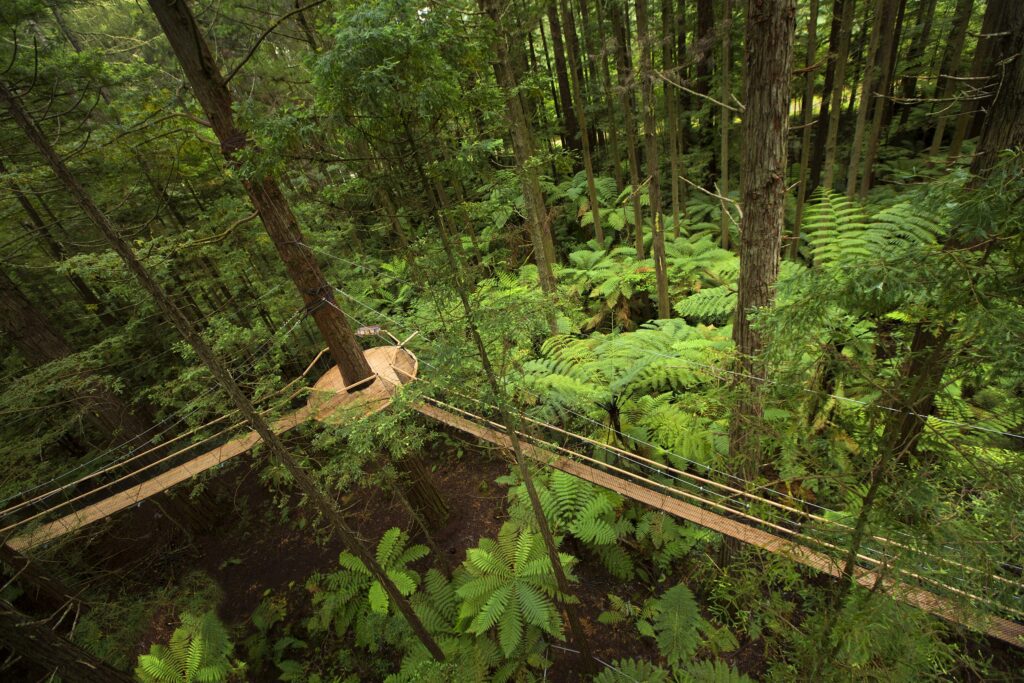
The 11 Best Things to Do in Verona, Italy in One Day

Is Rimini, Italy Worth a Visit?

3 Days in Rome Travel Guide: The Best Things to Do in the Eternal City

A DAY TOUR AROUND ICELAND’S GOLDEN CIRCLE: IS IT WORTH A VISIT?

Last Updated: July 9, 2025

The Golden Circle in southern Iceland is the most popular scenic tourist route in the country. It’s about 250 km (155 miles) long and is open year round.

Visitors can self drive or join a bus tour around the Golden Circle. On the way, you’ll see several attractions that Iceland is known for. This includes epic Strokkur Geyser, a volcanic crater, stunning Gullfoss Waterfall, Icelandic horses, and awe-inspiring vistas!

Many tourists only stay in Iceland for a short time. So the Golden Circle is the perfect daytrip from the capital of Reykjavik. You’ll get a good first impression of a few of Iceland’s highlights and will be back in the city for dinner.

I booked a Day Tour around Iceland’s Golden Circle from Reykjavik with Bus Travel Iceland in June 2024. So I’m thrilled to share this action-packed day experience with you and if it’s worth taking this tour! Here’s a map of the Golden Circle so you can follow along:

Disclosure: I only recommend products that I’ve used in the past, and all opinions expressed in this post are my own. This post contains affiliate links. If you use one of the links throughout the page to buy something, I may earn a small commission at no extra cost to you. Thank you!

Kerið Crater Lake

Address: 24R7+GW9, 805 Klausturholar, Iceland

After about an hour on the bus, we got out at Kerið Crater Lake, the first stop of the day. It is one of multiple crater lakes in the Grímsnes region of Iceland. Its deepest spot is at 7 to 14 meters (23 to 46 ft), depending on the time of year and how much it rained recently.

Most scientists believe that Kerið Crater was formed around 6,500 years ago, when the cone-shaped Kerið Volcano erupted and exhausted its magma reserve. As the years passed, the crater kept filling up with water.

First we walked along Kerið Crater’s upper rim, which was perfect to take shots of the beautiful aquamarine lake! You can also walk down the trail to the water’s edge. The rocky trail can be steep and slippery though, so be sure to not rush and wear sturdy, non-slip footwear!

The best thing about Kerið Crater are the spectacular colour contrasts. The stark black and deep red slopes and green spaces combined with the blue-green lake colour create an out-of-this-world scenery!

Self driving visitors can park next to Kerið Crater Lake and need to pay an entrance fee of 600 ISK at the ticket booth. There’s no admission fee if you’re on a bus tour. It’s not allowed to swim in the lake, as the temperature is insanely cold!

Kerið Crater Lake is open from 8:30 AM to 9:30 PM from June-August and during daylight hours only from September-May. While it’s beautiful under a blanket of snow, it can get very icy! So be sure to put on crampons and watch out for ice patches.

Meet Icelandic Horses and Eat Lunch at Friðheimar Farm

Address: 5HH4+225 Friðheimar, 806 Reykholt, Iceland

The next stop on the tour was Friðheimar Farm. This local family-run business specializes in breeding around 40 Icelandic horses and growing tomatoes and cucumbers in an environmentally-friendly way.

After meeting some Icelandic horses at the horse riding centre, the hostess told us about the history of this unique breed. She also put on a quick horse riding show. The Icelandic horse is famous for its five gaits, variety of colours, strength, endurance, and gentle personality.

Next, walk over to the greenhouses, where thousands of tomatoes grow all year. How is this possible? Well, Iceland is the world leader for taking advantage of renewable energy, which includes heating buildings with geothermal water. Friðheimar Farm is no exception to this.

Besides, the company is proud to use clean water and organic pest controls to grow their tomatoes. This is why they are so healthy and flavourful! There are also 1,200 bumblebees flying around and pollinating the tomato plants.

So trying one of their mouthwatering tomato-themed meals at their restaurant (inside the greenhouse) is a must! I ordered their creamy tomato soup with homemade bread, it was so good!

There’s a wine bar and bistro, too, or buy an awesome souvenir (e.g. tomato jam) at The Little Tomato Shop by the exit!

Strokkur Geyser Geothermal Area

Address: 8M7X+3PJ, Hafnartún, 806 Selfoss, Iceland

Another unique attraction you have to see in Iceland is a geyser eruption!

So it’s perfect that Strokkur, Iceland’s most visited active geyser, is a part of the Golden Circle route! The first thing I noticed even before the geyser was in sight was the “rotten eggs smell”. This is hydrogen sulphide, a chemical that’s created by Iceland’s geothermal activity.

Every five to ten minutes, Strokkur is putting on an awesome (but very short) show by blasting hot water in the air! The water usually goes up to 15 to 20 meters (49 to 65 ft), but sometimes it reaches up to 40 meters (131 ft) as well.

Strokkur Geyser during an eruption. Photo credit: patano on Wikimedia Commons.

The inactive Geysir and other smaller geysers (e.g. Litli Geysir), as well as fumaroles, hot springs, and boiling mud pits are scattered around the Geysir Geothermal Area and the Haukadalur Valley as well. Active geysers like Strokkur are quite rare around the world.

You can only find them in certain parts of highly geothermal areas where the magma is close enough to the surface of the earth, so the rocks are hot enough to boil water. Since Iceland is between the North American and Eurasian tectonic plates, this is possible here.

Visiting the Geysir Geothermal Area and Strokkur is free of charge and it’s open 24/7. Across from the geyser site is also a restaurant, café, campground, hotel, and gift shop. Finally, feel free to walk up the pathway after Strokkur for a breathtaking panoramic view of the area!

Gullfoss Waterfall

Address: Bláskógabyggð, 801 Selfoss, Iceland

Are you dying to see some of Iceland’s epic waterfalls on your trip? Then Gullfoss, which flows into Hvítá River canyon, is a good start! While this scenic two-tiered waterfall is not the highest in Iceland, it’s very wide (175 meters/574 ft) and the most popular waterfall in the country.

Besides, what sets Gullfoss apart is that you’re looking at it from above instead of from the bottom (like the other waterfalls I visited on my Iceland trip)! The various viewpoints on the trail around the falls allow you to admire it from different perspectives, too.

Gullfoss in the summer and winter. Pic #2 is by Erik on Unsplash.

By the way, Gullfoss means Golden Waterfall in Icelandic. Why? Well, if you’re lucky, the sun may hit the water on a sunny day, which will make the falls look golden! On days like these, you may even spot a rainbow on top of Gullfoss.

Visiting Gullfoss is free and it’s open all year. While the falls look epic in the winter, it can get snowy and icy on the trail, and some viewpoints are not open. So it might be better go in the spring or summer, and don’t forget to bring a waterproof jacket and shoes, as you’ll probably get wet!

Grab Homemade Ice Cream at Efstidalur II

Address: Bláskógabyggð, 801 Laugarvatn, Iceland

Need a pick-me-up after being amazed by all the hotspots around the Golden Circle? Then take a break and grab a scoop of yummy ice cream at Efstidalur II! This local dairy farm has been run by the same family since the 1750’s.

You can eat at their cozy Coffeehouse or take your ice cream to go. They have different flavours every day, but some standard ones (like vanilla, chocolate and strawberry) are always available. I chose chocolate ice cream and the edible spoon that came with it was tasty, too! 😀

You can also wave at some cute dairy cows through the Coffeehouse window!

If you’re in this area for longer, consider staying at Efstidalur II’s rustic, but peaceful Farm Hotel, trying homemade meals at their restaurant, or booking a guided Icelandic Horse riding tour (June-August only)!

Efstidalur II is open daily from 10 am to 8 pm (10 am to 9 pm in the summer months).

Þingvellir National Park

Address: 806 Selfoss, Iceland

Last but not least, we stopped at Þingvellir National Park (also spelled Thingvellir). This natural landmark is a must to visit for several reasons. First of all, it’s the only UNESCO World Heritage Site on Iceland’s mainland.

Secondly, Þingvellir is where Iceland’s first parliament was founded back in 930 AD. Norse clans had settled across Iceland since 874 AD, but conflicts were pretty common. So a meeting was launched at Þingvellir (it was easy to reach for every clan representative) to solve these issues.

Besides, this is where Iceland’s Independence Celebration happened in 1944.

Is walking between two continents on your bucket list? Then Þingvellir National Park is THE place to be! Iceland is split by the Mid-Atlantic Ridge, so some parts of the country sit on the North American tectonic plate, while others sit on the Eurasian tectonic plate.

The Mid-Atlantic Ridge was created by volcanic eruptions about 24 million years ago. Iceland is the only place on earth where it is above sea level and the edges of the plates are most obvious at Þingvellir National Park.

The tectonic plates have been drifting apart for about 2.5 cm (1 inch) each year for millennia. This is very obvious inside the national park, e.g. with lava fields, dormant volcanoes, and ravines. Apparently, earthquakes happen here every day, but the majority are too weak to be felt.

You can also book a diving or snorkeling tour between the tectonic plates at Silfra ravine at Þingvellir National Park. The water is crystal clear thanks to Langjökull Glacier filling it with meltwater. It’s one of the Top 5 Diving Sites in the World!

Þingvellir National Park on dry land and a diving tour around Silfra ravine. Pic #2 is Photo Credit of Guillaume Baviere on Wikimedia Commons.

Finally, Game of Thrones fans will get a kick out of visiting Þingvellir National Park, as part of the series was filmed here! The small, but pretty Þingvallakirkja (Þingvellir Church), built in 1859, is worth checking out as well!

There’s no cost to visit Þingvellir National Park and it’s open 365 days a year.

Self-Driving vs. Taking a Bus Tour around the Golden Circle

So now you may ask yourself, should I drive or join a bus tour around the Golden Circle?

Well, if you’re flexible and like to take your time, driving is the better option. I heard that renting a car in Iceland is quite easy and affordable, and the roads are usually in good shape. Signs on the road are very helpful, too. On average, it takes 7-9 hours to see the attractions along the Golden Circle in a day.

You’d be able to visit some off the beaten track attractions along the Golden Circle as well. You can go clockwise or counterclockwise on the Golden Circle and it’s quicker, as you won’t have to wait for other travelers! But of course, there will be additional costs for fuel.

The road along the Golden Circle. Photo Credit: Almir de Freitas on Wikimedia Commons.

On a bus tour, you’re free to relax, read, or enjoy the beautiful scenery, and let someone else do the driving. Buses in Iceland have free Wi-Fi, are safe, air-conditioned, and the local guide shared great insights about Iceland with us. You may also make new friends on the bus!

Besides, there are many pick up and drop off locations to choose from in downtown Reykjavik. But the tour felt a bit rushed sometimes, as we only had limited time to walk around and take photos at every stop before having to meet the guide back at the parking lot. 

Finally, most buses carry 50+ passengers, which can be exhausting for some people. I was very lucky to be upgraded to a smaller bus the day before the trip, that only carried 10-15 people. In total, the bus trip around the Golden Circle took around 8.5 hours.

Wrap Up: Is a Day Tour around Iceland’s Golden Circle Worth it?

Yes, I think driving or joining a bus daytrip around the Golden Circle is worth it! While some people may think that this route is a tourist trap, I disagree. The stops around the Golden Circle are great examples of Iceland’s many natural landmarks, especially if you’re visiting for only a short time.

Whether you’re into waterfalls, geysers, volcano craters, or want to learn about Iceland’s history and geology, the Golden Circle will have you covered! The epic views and supporting local family businesses on the way are just another bonus of this trip.

My favourite attractions around the Golden Circle were Kerið Crater Lake, Strokkur Geyser Geothermal Area, and Þingvellir National Park. I loved learning about what makes them special, and the scenery around them, especially the various colours, was just breathtaking!

Are you interested in learning more about Iceland? Then check out these posts:
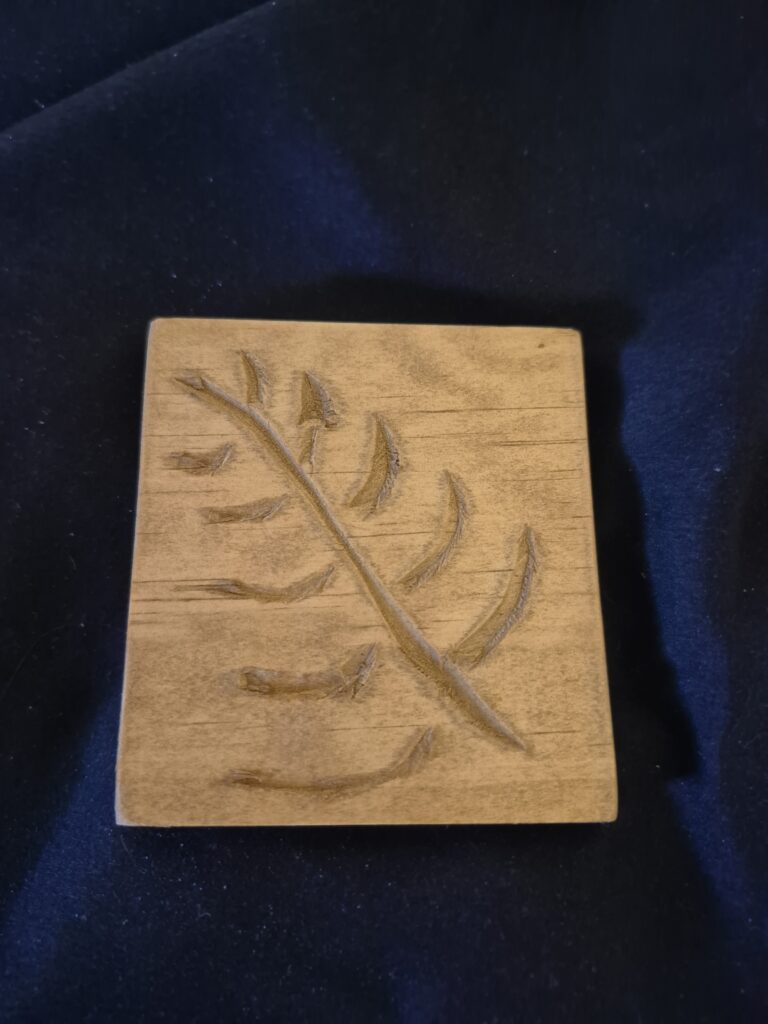
Is a Day Trip around Iceland’s Snaefellsnes Peninsula Worth it?

The Ultimate South Coast of Iceland Itinerary

Proudly powered by WordPress | Theme: Baskerville 2 by Anders Noren.
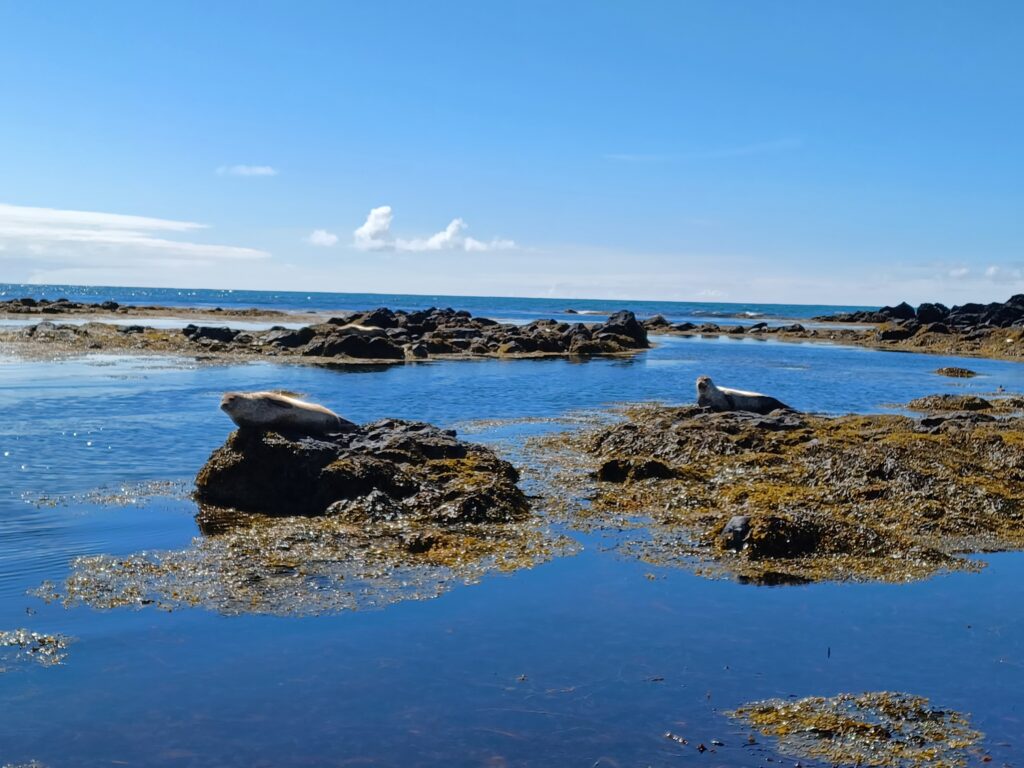
Up ↑